Tarot and String Theory: Ten Dimensions, Vibration and the Tree of Life
Where the Thoth Tarot and modern physics meet, and where the analogy honestly stops
by Redazione · 6 October 2026 · 8 min read
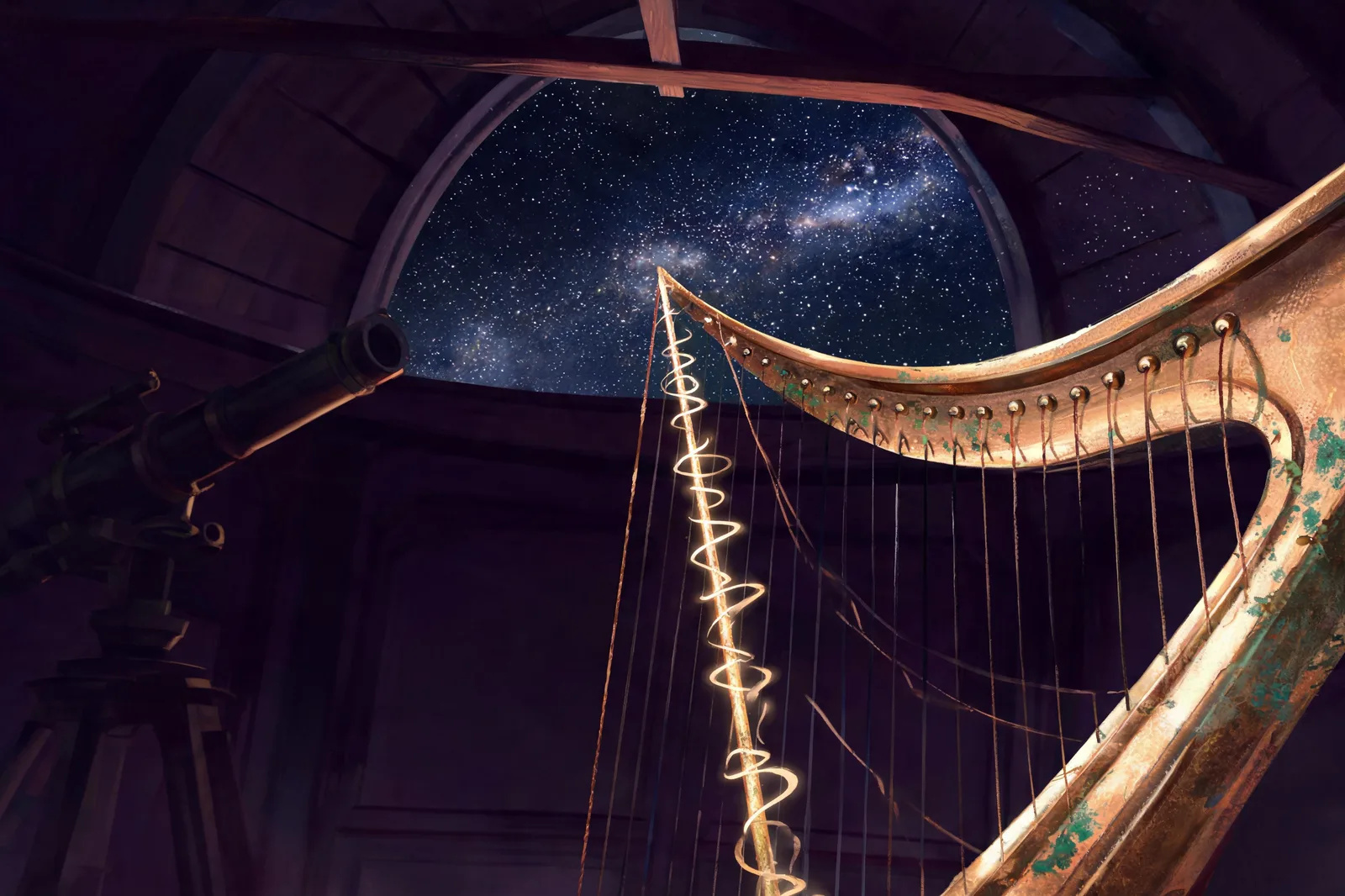
Tarot and string theory seem to belong to different worlds: one is a deck of symbolic cards, the other is a branch of theoretical physics written in equations. Yet both try to describe one hidden order behind the visible world. Both speak of ten levels of reality, of vibration as the root of form, and of opposites that turn out to be one. This article sets out the strongest parallels between tarot and string theory, explains each one clearly, and says plainly where the analogy stops.
A word of honesty first. Nothing here claims that the tarot proves physics, or that physics proves the tarot. String theory is itself unconfirmed by experiment. What we compare are two languages for wholeness, and the comparison helps a reader see the cards with fresh eyes.
What string theory says, in plain words
String theory proposes that the smallest building blocks of nature are not points but tiny one-dimensional strings. A string can vibrate in many ways, and each way of vibrating appears to us as a different particle: an electron, a quark, a photon. Matter and force become different notes played on the same kind of string.
The theory works only if space has more dimensions than the three we see. Superstring theory needs ten dimensions of spacetime: nine of space and one of time. In 1995 the physicist Edward Witten showed that five rival string theories were faces of one deeper framework, later called M-theory, which needs eleven. The six or seven extra dimensions would be curled up so small that we never notice them, folded into shapes that mathematicians call Calabi–Yau spaces. The string theory article on Wikipedia gives a careful overview.
Keep three ideas in mind: vibration makes form, reality has hidden dimensions, and many theories are one theory seen from different sides. Each has a clear echo in the tarot.
Ten dimensions and the ten sefirot of the Tree of Life
The tarot used by the Golden Dawn and by Crowley's Thoth deck is mapped on the Kabbalistic Tree of Life, which has ten sefirot. Each suit of the minor arcana runs through the same ten stations, from the Aces in Kether, the crown, to the Tens in Malkuth, the kingdom. Our Tarot Tree of Life: A Qabalah Primer primer explains the map.
The number ten alone would be a weak coincidence. The surprise lies in how the oldest Kabbalistic text describes it. The Sefer Yetzirah, the "Book of Formation", calls the ten sefirot ten "depths": the depth of beginning and the depth of end, of good and of evil, above and below, east and west, north and south. Six of those depths are the directions of space. Two are time. Two are a moral axis. The rabbi and physicist Aryeh Kaplan, in his commentary published in 1990, read them as a continuum of five dimensions, each with two directions.
So an early Hebrew text already describes the world as a ten-fold structure of dimensions, some visible and some not. String theorists reached ten dimensions by a completely different road, through the mathematics of consistency. The Tree also has a hidden station, Da'ath, "knowledge", which is not counted among the ten. Some readers like to set it beside the eleventh dimension of M-theory. That last step is pure analogy, but it shows how naturally the two pictures sit side by side.
Vibration and the letters of creation
In string theory, the identity of a particle is its vibration. In the Kabbalah behind the tarot, creation happens through sound. The Sefer Yetzirah says the world was formed by engraving and combining twenty-two letters, and a Hebrew letter is above all a spoken sound.
The Golden Dawn gave each of those twenty-two letters to one trump. The Fool is Aleph, a silent letter, pure breath before any sound. The Hanged Man is Mem, the hum of closed lips, the sound of water. The Aeon is Shin, a hiss like fire. Read this way, the Major Arcana are twenty-two notes, and every reading is a chord.
The image of a cosmic chord is also how physicists like to explain their theory to the public. Popular writers such as Michio Kaku describe particles as the notes of a vibrating string and the universe as their music. The old Pythagorean "music of the spheres" stands behind both traditions. The tarot puts it in pictures, and string theory puts it in equations.
Hidden dimensions and the folded layers of a card
The extra dimensions of string theory are real, if the theory is right, but compactified: rolled up too small to see. You cannot point at them; you infer them from what they do to the world you can see.
A Thoth card works the same way. On its surface you see one picture. Folded inside it are several layers that never appear as such: a Hebrew letter, a path between two sefirot, an element, a planet or a sign, one of the four Kabbalistic worlds. Fortune looks like a turning wheel. Inside it are the letter Kaph, the planet Jupiter and the path that joins Chesed, mercy, to Netzach, victory. A good reader "unfolds" those hidden dimensions to explain why the card means what it means.
This is perhaps the most useful parallel for practice. When a card seems flat or obvious, ask which of its folded dimensions the question touches.
Strings, points and the Star: Nuit and Hadit
The deepest change string theory makes is to replace the point with something extended. In Crowley's Book of the Law, the universe also has two poles: Nuit, the infinite circle of space whose "every star" is a point of light, and Hadit, the infinitely small point at the centre of each being. In the Thoth deck Nuit arches over The Aeon, and her waters pour from the hands of the woman on The Star.
Crowley summed up the meeting of these two poles in his formula 0 = 2. Nothing divides into a pair of opposites which, added together, return to nothing. In physics the vacuum is not empty either: pairs of particles and antiparticles appear and vanish in it. The parallel is poetic, not technical. It still captures the same intuition: the many arises from the one by division, and returns to it by union.
Unification: four forces, four suits and the Universe
Physics knows four fundamental forces: gravity, electromagnetism, and the strong and weak nuclear forces. The great promise of string theory is to unite them, gravity included, as aspects of one vibrating reality.
The tarot has its own four: the suits of Wands, Cups, Swords and Disks, the elements Fire, Water, Air and Earth. In the Thoth deck each Ace is the "Root of the Powers" of its element, and the four Aces together point back to a single source, Spirit. Two trumps stage the unification. Art shows the alchemical marriage that The Lovers began, fire and water blended in one cauldron. The Universe, the last trump, shows the dancer inside a single cosmic order where all four elements meet.
M-theory adds one more echo. It joined five string theories that looked incompatible, showing that each was a limit of one framework. Readers meet the same idea when they compare decks: the Thoth, the Rider-Waite and the Marseille look different, yet they share one structure of twenty-two trumps, four suits and ten numbers.
Using tarot and string theory as a lens for readings
You do not need physics to read cards, but the comparison offers three useful habits.
- Ask what a card vibrates with. A trump is a note: look for the other cards in the spread that share its element, planet or sign. They resonate, like harmonics on a string.
- Unfold the hidden dimensions. Before giving a meaning, name the letter, the path and the world of the card, and let them nuance the picture.
- Look for the unity behind the opposites. When a spread shows conflict, such as Fire against Water or Swords against Cups, ask which trump in it, like Art or the Universe, holds both.
If you want to try it, draw a reading on TAROTS chat and ask the reader to show where each card sits on the Tree of Life. You will see the hidden dimensions of your own question open one by one.
Tarot and string theory will never be the same thing. One is a tool for reflection, the other a hypothesis about matter. Side by side, they remind us that people have long described the world as music, as layers and as one.
Questions
Does string theory prove the tarot?
No. String theory is an unconfirmed physical hypothesis and the tarot is a symbolic tool for reflection. The parallels are analogies between two ways of describing a hidden order, not evidence for either.
Why are ten dimensions compared with the Tree of Life?
Superstring theory needs ten dimensions of spacetime, and the Tree of Life has ten sefirot. The Sefer Yetzirah even describes the sefirot as ten depths: six of space, two of time and two of good and evil.
How is vibration connected with the tarot?
In string theory each particle is a way a string vibrates. In the Kabbalah behind the Thoth deck the world is created through 22 spoken letters, and each letter belongs to one trump, so the Major Arcana can be read as notes.
Which Thoth cards best show the idea of unification?
Art, the alchemical marriage of fire and water, and the Universe, where the four elements meet in one dance, are the two trumps that best express unity behind opposites.
This article talks about
You might also like
 Kabbalah
 Kabbalah
© 2026 TAROTS chat (tarots.chat). All rights reserved. No part of this article may be reproduced, distributed or adapted without the owner's written permission.
The Journal
From the Journal
Chosen for this page
 Kabbalah
Yetzirah Tarot: The World of Formation, Air and the Suit of Swords
6 min read
More in Kabbalah Kabbalah
 Kabbalah
 Kabbalah
 Love
Love Love
Love Love
Love