The 231 Gates of the Sefer Yetzirah
by Redazione · 9 October 2026 · 4 min read
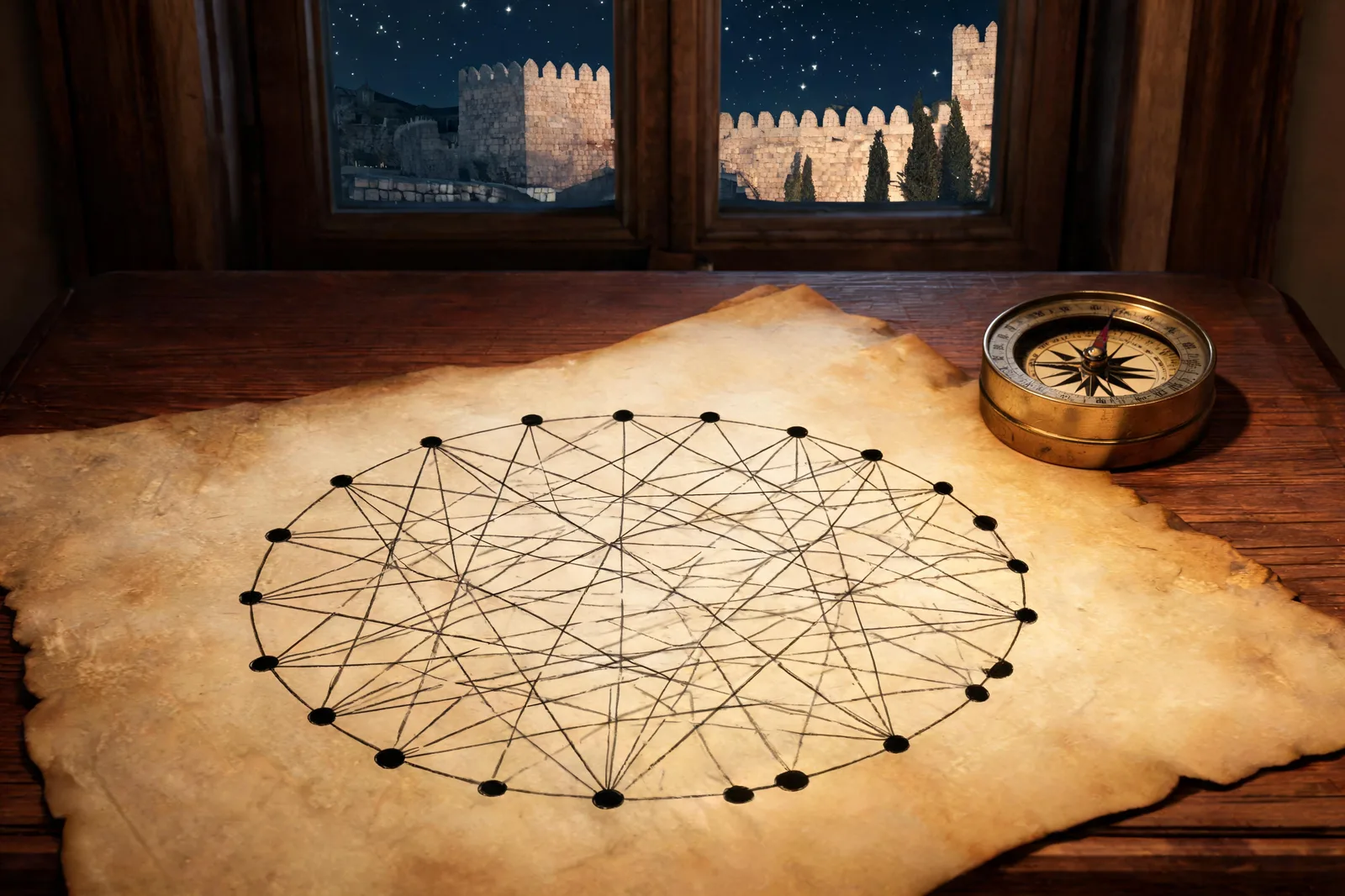
The 231 gates of the Sefer Yetzirah describe every possible pair drawn from the twenty-two Hebrew letters, and they sit directly behind the way the Thoth deck pairs its trumps with the paths between the sephiroth. In The Thirty-Two Paths of Wisdom: Ten Spheres and Twenty-Two Letters the ten spheres and the twenty-two letter-paths were set out as one structure; the 231 gates are what happens when that same alphabet combines with itself, letter against letter, until every possible link has been drawn.
What the text actually says
The Sefer Yetzirah states that God "combined, weighed and exchanged" the twenty-two letters, forming from them "all that is formed and all that is destined to be formed." The number 231 is simple combinatorics. Twenty-two letters taken two at a time, without repeating a pair, gives 231 unique combinations. Some manuscripts describe these as "gates," others as a wheel the letters pass through. The text treats the whole figure as the mechanism of creation itself, letters combining the way atoms combine into matter.
From gates to a diagram
Later Kabbalists drew the 231 gates as a geometric figure: twenty-two points around a circle, with lines connecting every pair. The result is dense, every point joined to every other, and it is often reproduced as a decorative emblem rather than studied pair by pair. For a tarot reader, the useful habit is narrower. Notice that any two trumps can, in principle, be read as a pair of letters in combination, the way two cards drawn together in a spread already imply a dialogue. The Lovers and the Hierophant share a gate whether or not anyone draws it on the diagram.
Gates and spreads
This is where the 231 gates become more than a historical curiosity. A two-card draw, in this light, is not simply card one plus card two. It is a gate: a specific combination with its own character, not reducible to either card read alone. The practice of comparing adjacent trumps across the paths series on this blog already uses this logic informally, path by path. The 231 gates make it explicit. There is, in principle, a reading for every pair of letters, and the deck's structure was built with that density in mind, whether or not any single reader ever maps all 231.
A caution against overreach
It is worth being honest about where scholarship and practice part ways here. Gershom Scholem and later historians of Kabbalah treat the 231 gates as a piece of the Sefer Yetzirah's own cosmology, concerned with how language structures the universe, not with divination. The tarot's use of the figure is a modern graft, made by Golden Dawn-era occultists reading the text through a lens Kabbalists themselves did not intend. Readers can use the structure without ignoring its history: interpretation layered onto a much older text, useful for a Thoth reading precisely because it was built to be, not because the Sefer Yetzirah ever mentioned cards.
A practical way to use it
A reader who wants to feel the 231 gates at work can try a small exercise. Draw two trumps and ask not "what does each mean" but what this particular combination makes possible that neither card makes alone. The Tower and the Star, drawn together, are a gate of collapse followed by quiet hope. The Hermit and the Wheel of Fortune are a gate of withdrawal meeting sudden change. None of this needs the number 231 spoken aloud in a reading. It only needs the reader's trust that the deck's structure already anticipates the pairing, long before the two cards happened to land side by side.
FAQ
Are the 231 gates a spread technique? Not originally. They describe letter combinations in the Sefer Yetzirah's cosmology. Tarot readers have since used the idea informally, to think about how paired cards combine.
Does the number 231 appear in any spread used today? Not as a fixed spread. It functions more as a principle behind two-card and three-card readings than as a named layout.
Is 231 the only number tied to the twenty-two letters? No. The same alphabet also gives the twenty-two paths of the Tree of Life and other combinatorial figures in later Kabbalistic texts, each used for a different purpose.
Should a beginner study the 231 gates before reading the cards? No. It is a layer for a reader who already knows the trumps and the paths well. Starting here first would be structure without the cards to hang it on.
Questions
Are the 231 gates a spread technique?
Not originally. They describe letter combinations in the Sefer Yetzirah's cosmology. Tarot readers have since used the idea informally, to think about how paired cards combine.
Does the number 231 appear in any spread used today?
Not as a fixed spread. It functions more as a principle behind two-card and three-card readings than as a named layout.
Is 231 the only number tied to the twenty-two letters?
No. The same alphabet also gives the twenty-two paths of the Tree of Life and other combinatorial figures in later Kabbalistic texts.
Should a beginner study the 231 gates before reading the cards?
No. It is a layer for a reader who already knows the trumps and the paths well, not a starting point.
You might also like
 Kabbalah
 Kabbalah
 Kabbalah
© 2026 TAROTS chat (tarots.chat). All rights reserved. No part of this article may be reproduced, distributed or adapted without the owner's written permission.
The Journal
From the Journal
Chosen for this page
 Symbolism
 Disks
 Career
The Emperor Tarot Card in Career Readings: Authority, Structure and Leadership
2 min read
More in Career Major Arcana
 Kabbalah
 Kabbalah
 Symbolism
 Symbolism
 Kabbalah