The Thirty-Two Paths of Wisdom: Ten Spheres and Twenty-Two Letters
by Redazione · 9 October 2026 · 5 min read
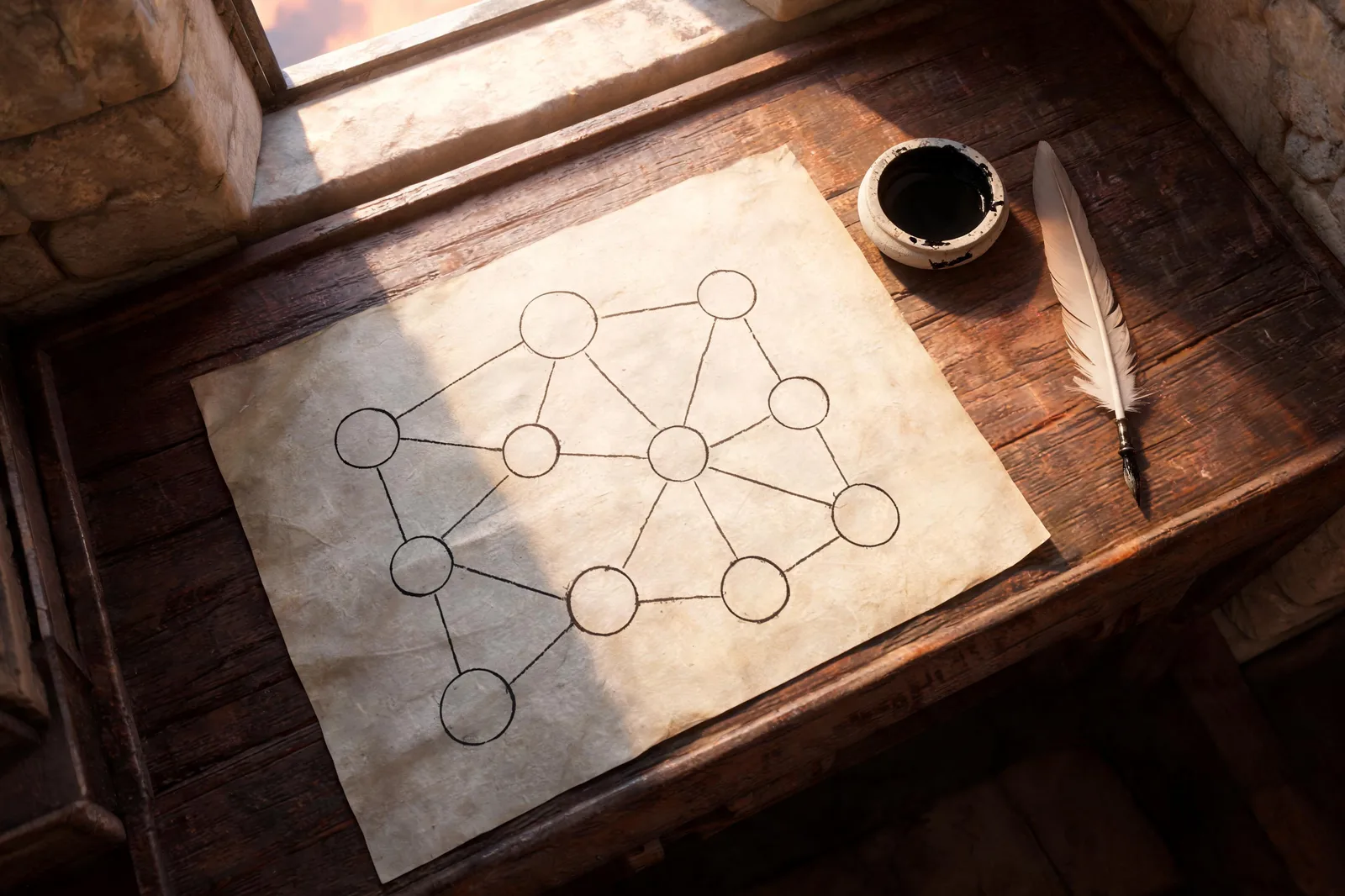
The thirty-two paths of wisdom are the oldest map the Kabbalah offers, and the Thoth deck is built directly on top of it. The phrase comes from the opening line of the Sefer Yetzirah, the "Book of Formation": God created the world "by thirty-two mystical paths of wisdom." Ten of those paths are the sephiroth, the numbered spheres from Kether to Malkuth; the other twenty-two are the connecting lines, one for each letter of the Hebrew alphabet. Together they give the tarot its whole structure: ten spheres for the court and pip cards, twenty-two letters for the trumps.
Ten spheres, counted as paths
The Sefer Yetzirah is unusual in calling the sephiroth themselves "paths," alongside the twenty-two letters. This is not loose language. It means the ten numbers are not static boxes on a chart; they are stages of a single unfolding, each one a station a reader can actually move through. Ein Sof: The Limitless Before the First Card describes the limitless ground these ten paths emerge from, Kether being the first contraction of that ground into something nameable. The series on the ten sephiroth, from Kether and the aces to Malkuth, the Kingdom, and the Four Tens, gives each of those stations its own chapter; the thirty-two paths are the scaffolding that holds the whole set together as one figure rather than ten separate ideas.
Twenty-two letters, counted as paths
The other twenty-two paths are the diagonal and vertical lines drawn between the spheres on the familiar Tree of Life diagram. Every line carries one Hebrew letter, and the Golden Dawn matched each letter to one of the twenty-two trumps: Aleph to the Fool, Beth to the Magus, and on through to Tav and the Universe. Readers who have followed that attribution path by path, from The Eleventh Path in Practice: Aleph and the Fool through to the thirty-second path and Tav, already have the full picture in pieces. This article is the place those pieces get named as a single system: thirty-two paths, not twenty-two trumps plus ten spheres treated separately.
Why thirty-two, and not some other number
The Sefer Yetzirah is a short, dense text, likely compiled between the third and sixth centuries, though tradition sometimes credits it to the patriarch Abraham. It does not explain tarot at all; it predates the cards by at least a thousand years. What it offers is a cosmology: letters and numbers as the building blocks used to form the world, arranged along a structure later Kabbalists drew as the Tree of Life. When Renaissance and then nineteenth-century occultists went looking for a key to the trumps, the number twenty-two was already waiting in the Hebrew alphabet, and the number ten was already waiting in the sephiroth. The thirty-two paths of wisdom gave both counts a shared frame at once, which is part of why the correspondence felt, to the occultists who proposed it, less like an invention and more like a discovery. The Golden Dawn formalized the letter-to-trump assignments in the late nineteenth century, and Aleister Crowley and Lady Frieda Harris carried them into the Thoth deck's design.
Reading the paths as a reader, not a scholar
A reader does not need Hebrew grammar to use this structure. What helps is the habit of asking, for any trump, which two spheres a given path connects, and what the path is doing between them. The Lovers, on the path between Binah and Tiphareth, is a path about choice reaching down from understanding into a balanced heart; the Devil, between Tiphareth and Hod, is a path about the beautiful self meeting the mechanics of mind and sometimes getting trapped there. This is where the thirty-two paths of wisdom earn their keep for a working reader: they turn twenty-two separate meanings, memorized as a list, into one connected territory, where a card's position tells you something no keyword list can.
A system still used today
Modern scholars, including historians working in the line opened by Gershom Scholem, treat the thirty-two paths as a historical structure worth studying on its own terms, separate from what esotericists later did with it. Tarot readers inherited an adaptation, not the original text, and it is worth holding both facts at once: the system is borrowed, and the borrowing has nonetheless produced a genuinely useful way of thinking about the cards. At tarots.chat, a Thoth reading already leans on this structure quietly, in the suits assigned to the four worlds and in the paths assigned to the trumps; naming it directly just makes visible what was already shaping the spread.
FAQ
Are the thirty-two paths only about the Major Arcana? No. Ten of the thirty-two are the sephiroth themselves, which the Golden Dawn linked to the aces and the numbered minor cards; the other twenty-two are the letter-paths linked to the trumps.
Did the Sefer Yetzirah mention tarot cards? No. The text is centuries older than playing cards. The correspondence between its thirty-two paths and the seventy-eight cards was built later, mainly by nineteenth-century occultists.
Is there only one way to count the twenty-two letter-paths? The Golden Dawn's numbering, used here and on most modern decks including the Thoth deck, is the most common, but earlier Kabbalists sometimes drew the Tree of Life with different connecting lines.
Where should a reader start with this structure? With the ten sephiroth series and the paths series already on this blog; each one gives a single station or line its own close reading, and this article is the map that shows how they fit together.
Questions
Are the thirty-two paths only about the Major Arcana?
No. Ten of the thirty-two are the sephiroth themselves, linked to the aces and the numbered minor cards; the other twenty-two are the letter-paths linked to the trumps.
Did the Sefer Yetzirah mention tarot cards?
No. The text predates playing cards by centuries. The correspondence with the seventy-eight cards was built later, mainly by nineteenth-century occultists.
Is there only one way to count the twenty-two letter-paths?
The Golden Dawn's numbering, used on most modern decks including the Thoth deck, is the most common, but earlier Kabbalists sometimes drew different connecting lines.
Where should a reader start with this structure?
With the sephiroth and paths series already on this blog; this article is the map that shows how those separate pieces fit together.
You might also like
 Kabbalah
 Kabbalah
 Kabbalah
© 2026 TAROTS chat (tarots.chat). All rights reserved. No part of this article may be reproduced, distributed or adapted without the owner's written permission.
The Journal
From the Journal
Chosen for this page
 Love
 Major Arcana
Lust Tarot Card Meaning in the Thoth Deck: Passion, Focus and Directed Energy
3 min read
More in Major Arcana Tarot Journal
 Love
 Symbolism
 Symbolism
 Symbolism
 Symbolism
 Kabbalah