Ein Sof: The Limitless Before the First Card
by Redazione · 9 October 2026 · 5 min read
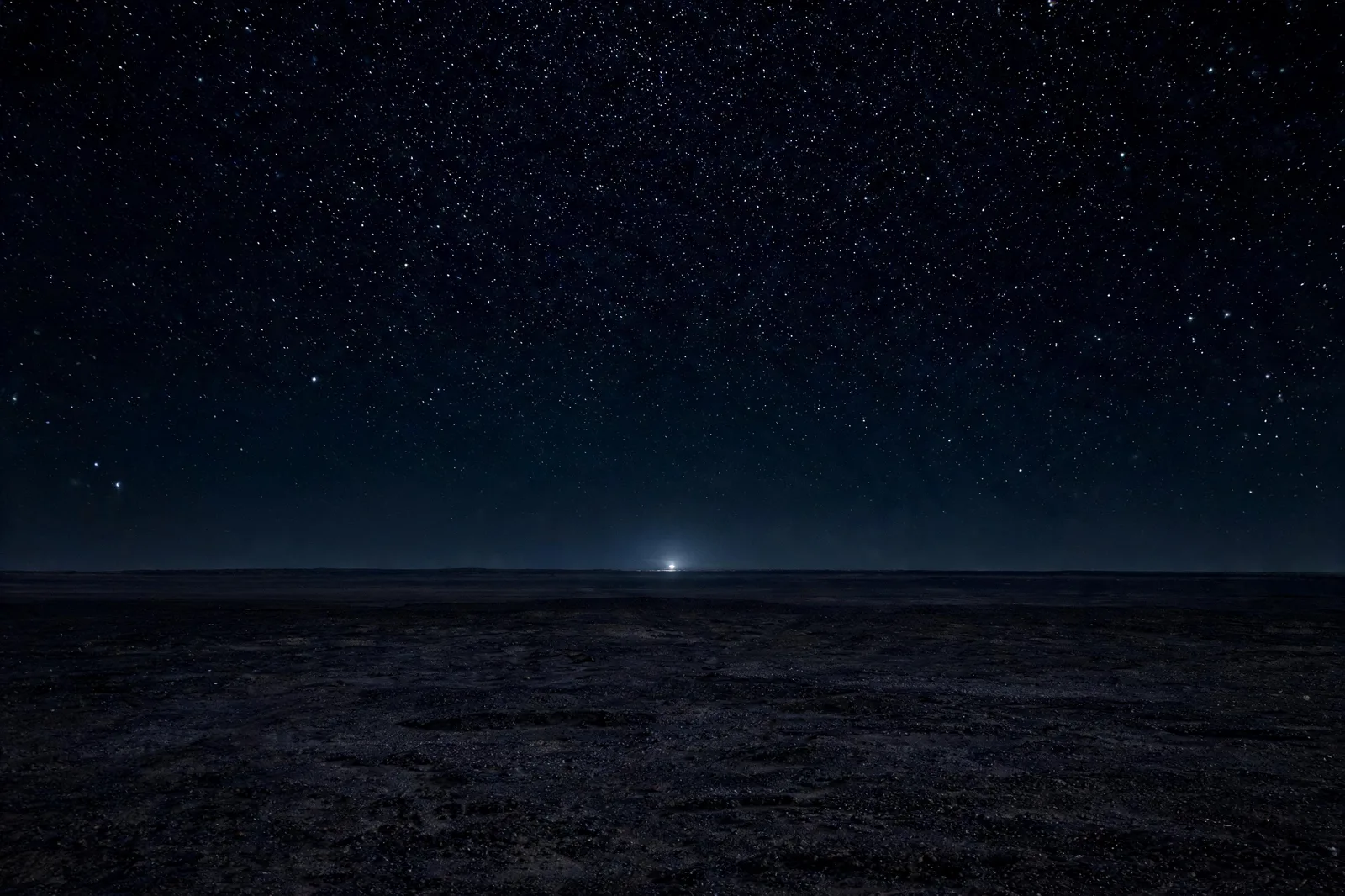
Every system of cards starts somewhere, and the Kabbalah starts before anything starts. Ein Sof, the Limitless, is the name Kabbalists gave to what is prior to Kether, prior to the Tree, prior to a single trump. It is not a sphere on the diagram at all. It is the condition that makes a diagram possible, and it sets the tone for how a reader of the Thoth deck should hold the whole system: as a map drawn downstream of something that cannot itself be mapped.
Ein Sof as "without end"
The phrase means, plainly, "without end" or "without limit." Medieval Kabbalists reached for it because the Hebrew Bible's names for God were already too specific, too bound to attributes, to describe what comes before attributes exist at all. Ein Sof has no qualities a sentence can hold: not good, not wise, not even "one," because number itself belongs to the created order. Scholars of Jewish mysticism, from the early Provençal circle to Gershom Scholem in the twentieth century, treat Ein Sof as a philosophical answer to a theological problem: how an infinite source can produce a finite world without becoming finite itself. Gershom Scholem gave this question its modern academic shape, tracing how Ein Sof hardened from an adjective into a proper name across centuries of Kabbalistic writing.
Before the first card
A tarot deck begins, numerically, at zero: The Fool steps off a cliff with no history behind him. Readers often treat that zero as the beginning of the story. Kabbalah insists on a stranger claim: there is something before the zero, and it is not a card at all, because it has no outline. Ein Sof does not sit in Kether, the first sphere; it surrounds and exceeds the whole Tree, the way a blank page exceeds the first word written on it. When a reader places the Fool outside the numbered sequence of the Major Arcana, the gesture echoes this: the card with the least definition sits structurally closest to a source that has no definition whatsoever.
Tzimtzum: how the Limitless makes room
The Limitless cannot simply emanate outward, because there would be no "outward" for it to fill; it is already everything. Isaac Luria's sixteenth-century school answered this with tzimtzum, a contraction in which Ein Sof withdraws from a point within itself to open a conceptual void. Only inside that withdrawn space does the first structured light appear, the thread that eventually reaches Kether and begins the Tree proper. The companion piece in this series, Tzimtzum and the Fool: A Card for the Withdrawal of Light, follows that withdrawal into the Fool's own blank sky and empty road. Here it is enough to notice the order of operations: limitation comes first, light comes second, and a card comes only after both.
The void that is not empty
It would be a mistake to picture the space opened by tzimtzum as nothing at all, the way an empty room is nothing. Lurianic writers describe a residue, a reshimu, a trace of Ein Sof left behind even in its own withdrawal, the way a scent lingers after someone leaves a room. Every card, on this reading, carries two things at once: a clear, nameable meaning a reader can work with at the table, and a faint residue of the limitless condition it emerged from, which no meaning quite exhausts. This is one reason seasoned readers resist pinning any trump, especially The Universe, to a single fixed sentence. The image closes the sequence of twenty-two, yet it still points past itself, back toward the condition the whole deck began from.
Why a reader should care
None of this changes how a spread is laid or read at the table; it changes what a reader believes the table rests on. A system this old was never meant to be a closed box of seventy-eight fixed meanings. It was built, consciously, on an acknowledged unknown, so that the deck's precision in small details - a Hebrew letter, a planetary attribution, a decan - sits honestly next to a frank admission that the largest claim cannot be made at all. Tradition holds that naming Ein Sof too confidently is itself a kind of error, since a name is already a limit. A reader who keeps that humility tends to read the Fool, and the whole Major Arcana after him, with more patience and less certainty about final answers, which is usually the more useful posture at a reading table.
FAQ
Is Ein Sof a god in the ordinary sense? Not in the sense of a personal figure with a story. It is closer to a philosophical limit-concept: the condition prior to any attribute, including personality, from which later Kabbalistic language derives the personal names used in prayer and myth.
Does Ein Sof appear on the Tree of Life diagram? No. It surrounds the Tree rather than occupying a sphere on it. Kether, the first sephirah, is usually described as the first point where Ein Sof's light becomes structured enough to be drawn at all.
How does this connect to the Fool card specifically? The Fool is numbered zero and stands outside the ascending sequence of the trumps, which makes it the card tradition most often uses to gesture at a state before definition, close in spirit to Ein Sof's own lack of attributes.
Is tzimtzum the same idea as Ein Sof? No. Ein Sof is the limitless source itself; tzimtzum is the act attributed to it, a withdrawal that opens space for creation. One names a condition, the other names an event.
Questions
Is Ein Sof a god in the ordinary sense?
Not a personal figure with a story. It is closer to a philosophical limit-concept: the condition prior to any attribute, from which later Kabbalistic language derives the personal names used in prayer and myth.
Does Ein Sof appear on the Tree of Life diagram?
No. It surrounds the Tree rather than occupying a sphere on it. Kether is usually described as the first point where its light becomes structured enough to be drawn at all.
How does this connect to the Fool card specifically?
The Fool is numbered zero and stands outside the ascending sequence of the trumps, which makes it the card tradition most often uses to gesture at a state before definition.
Is tzimtzum the same idea as Ein Sof?
No. Ein Sof is the limitless source itself; tzimtzum is the act attributed to it, a withdrawal that opens space for creation.
This article talks about
You might also like
 Kabbalah
 Kabbalah
 Kabbalah
© 2026 TAROTS chat (tarots.chat). All rights reserved. No part of this article may be reproduced, distributed or adapted without the owner's written permission.
The Journal
 Kabbalah
 Kabbalah
 Kabbalah
 Tarot Journal
 Kabbalah
 Love
 Symbolism
 Symbolism
 Kabbalah