The Cube of Space on a Card
by Redazione · 8 October 2026 · 9 min read
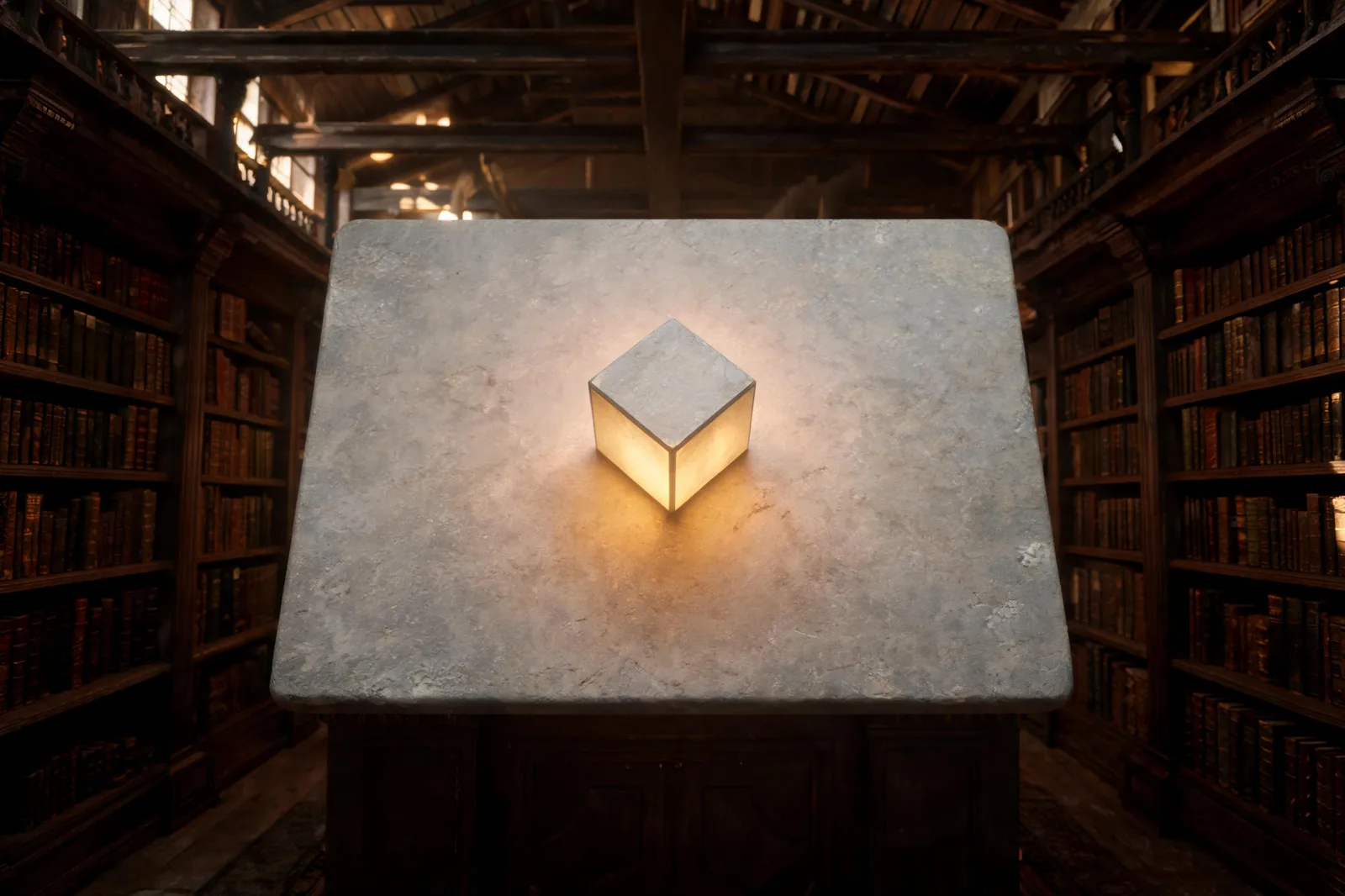
The cube of space tarot reading is the one that most decks never earn, because the cube is a structure, and a single card is a point. The question the Sefer Yetzirah asks is not "how do you map a whole deck onto a cube?" The question is sharper, and it is the one the card actually answers: how does a single card hold the whole cube, the way a single letter holds a whole direction?
The Sefer Yetzirah, the proto-Kabbalistic text that is the oldest source the Golden Dawn and every later tarot system borrows from, is built on three numbers: ten, six, and twelve. Ten sefirot. Six directions, sealed with the six mother letters. Twelve diagonal boundaries, sealed with the twelve plain letters. The cube of space is the figure that those three numbers draw, and the cube of space tarot reading is the act of asking which of those three a single card is standing on.
That is not a metaphor. It is a structure, and the structure is in the text before it is in the deck.
What the Sefer Yetzirah actually says
The relevant verses are in chapters four and five. Chapter four is the sealing of the six directions. The text says that the Holy One sealed the universe in six directions — above, below, east, west, north, south — and that six mother letters, the three vowel letters and their combinations, are the seal. He looked above and sealed the height; he looked below and sealed the deep; he looked forward and sealed the east. The six directions are not points. They are the faces of the cube, and the six mother letters are what close each face.
Chapter five is the sealing of the twelve. The text says there are twelve plain letters, and that their foundation is twelve diagonal boundaries. The boundaries divide the directions and separate the sides: the extremity of the northeast, the extremity of the eastern height, the extremity of the eastern depth, and the rest, until the twelve are complete. In the most authoritative English translation, Aryeh Kaplan reads these twelve diagonal boundaries as the twelve edges of a cube Aryeh Kaplan, Sefer Yetzirah: The Book of Creation (1990).
So the cube is: six faces, twelve edges, and a center. The center is not a seventh direction. It is the point the six faces and twelve edges are built around, the point the text calls the Holy Palace ruling in the center, the place where the seal is held. That center is the part of the cube a single card can actually be.
Why the center, and why one card
The Golden Dawn mapped the twenty-two trumps onto the twenty-two Hebrew letters and the tree of life. That is a deck mapped onto a structure. The cube of space tarot reading does the opposite. It asks what one card is, when the structure is a cube and the card is the center.
The center of the cube is not a face and not an edge. It is the point that the faces and edges are built to hold. In the text, that point is the letter that rules in the center, the point where the seal is not a direction but the thing that makes the directions possible. A card at the center is not one of the six directions. It is the point the six directions are the faces of.
That is a different card than a trumps reading. A trumps reading says the card is one of twenty-two. A center reading says the card is the one that the twenty-two are built around.
The Fool as the center
The card that the deck already gives you for that role is the Fool. The Fool is unnumbered, or zero, or twenty-three depending on the deck, and it is the one card that does not sit in the sequence. It is the card before the sequence and the card after it, and that is exactly the position of the center of the cube: the point that is not one of the six faces but the point the six faces are built around.
Read the Fool as the center of the cube and the card stops being a beginning. It becomes a point. The Fool is not the first card of a journey. The Fool is the point the journey is built around, the center that the six directions and twelve boundaries are the faces and edges of. That is the cube of space tarot reading, and it is the reading the text supports, because the text gives the center a seal of its own, and the Fool is the card that carries a seal it does not share with any of the numbered trumps. That is the same move the tree of life makes with its ten sefirot, the same center the tree is built around Kircher's Tree, the Gra's Tree, Luria's Tree, and it is the move the Lurianic partzufim inherit when they turn the sefirot from positions into configurations Isaac Luria's Sefirot and the Court Cards.
The faces and the edges
The six faces are the six mother letters, the directions. In a reading, the six faces are the six positions the question can take: above, below, and the four compass points. The card does not take one of those positions. The card is the point the six positions are built around, and the reading is the act of asking which face the question is pressing against, and which of the twelve edges is the boundary between the two faces it is pressing against.
That is a richer question than "what does this card mean?" It is the question "where in the cube is this card standing, and which face and which edge does it hold?" The card is not a symbol. The card is a point in a structure, and the structure is the cube.
The twelve edges are the boundaries, the diagonals, the places where two faces meet and the direction changes. In a reading, the edge is the transition, the moment the question moves from one face to another. The card at the center holds all twelve, and the reading is the act of asking which edge the question is crossing, and which face it is arriving at.
Why one card, not the whole deck
The reason the cube of space is a single card and not a whole deck is the reason the text gives it a center at all. A deck has twenty-two positions, and a position is a face or an edge. A center is not a position. A center is the point the positions are built around, and a point is a single card. The cube of space tarot reading is the reading of that single card, the card that is not one of the twenty-two but the one the twenty-two are the faces and edges of.
That is why the Fool is the card. It is the only card in the deck that is not a position. It is the card that is the center, and the center is the cube, and the cube is the space the twenty-two letters are the faces and edges of see the Sefer Yetzirah.
The six letters and the six faces
The six mother letters are the three vowel letters, aleph, mem, and shin, and their combinations. In the text, they are the seal of the six directions, the letters that close each face of the cube. In a reading, they are the six positions the question can take, and the card is the point the six positions are built around.
That is not a reading of the letter. It is a reading of the face. The letter is the seal, the face is the direction, and the card is the center. The three are not the same thing, and the reading is the act of asking which of the three the question is actually about.
The Fool, read this way, is not aleph or mem or shin. The Fool is the point the six seals are the faces of, and the question is not which letter the Fool is but which face the Fool is holding.
The cube of space tarot reading of a card
The cube of space tarot reading is not about what the card is. It is about where the card is standing in the cube. The card is not a symbol of a quality. The card is the point the quality is built around.
When the Fool appears, the reading is not "the beginning of a journey." The reading is "the center of the cube, the point the six directions and twelve boundaries are built around." The question is not where the journey is going. The question is which face the question is pressing against, and which edge it is crossing, and whether the center is holding.
That is the cube of space tarot reading, and it is the reading the Sefer Yetzirah supports. The Golden Dawn inherited the letters and the tree and the deck. The cube is the structure underneath, and the single card at the center is the card the structure is actually about.
Sources
The account of the Cube of Space draws on the Sefer Yetzirah, chapters four and five, in the translation of Aryeh Kaplan Aryeh Kaplan, Sefer Yetzirah: The Book of Creation (1990), and on the standard references for the cube's construction Wikipedia, "Cube of Space" and Wikipedia, "Sefer Yetzirah". The six faces, the twelve edges, and the center are the three parts of the cube, and the single card at the center is the card the cube is built to hold.
Questions
What is the cube of space?
It is the figure the Sefer Yetzirah draws from three numbers: ten sefirot, six directions sealed with the six mother letters, and twelve diagonal boundaries sealed with the twelve plain letters. The six directions are the faces, the twelve boundaries are the edges, and there is a center the whole structure is built around.
Why is it one card and not the whole deck?
Because the center is not a position. A deck has twenty-two positions, and a position is a face or an edge. The center is the point the positions are built around, and a point is a single card. The cube of space tarot reading is the reading of that single card.
Why the Fool?
Because the Fool is the only card that is not a position. It is unnumbered, before the sequence and after it, and that is the position of the center: the point the six directions and twelve boundaries are built around.
How does this change a reading?
It changes the question from 'what does this card mean?' to 'where in the cube is this card standing, and which face and which edge does it hold?' The card is not a symbol of a quality. The card is the point the quality is built around.
You might also like
 Kabbalah
 Kabbalah
 Kabbalah
© 2026 TAROTS chat (tarots.chat). All rights reserved. No part of this article may be reproduced, distributed or adapted without the owner's written permission.
The Journal
 Kabbalah
 Kabbalah
 Kabbalah
 Symbolism
 Symbolism
 Thoth Tarot