Why Waite's Pictorial Key Rewrote Lévi
by Redazione · 8 October 2026 · 8 min read
The question this part asks
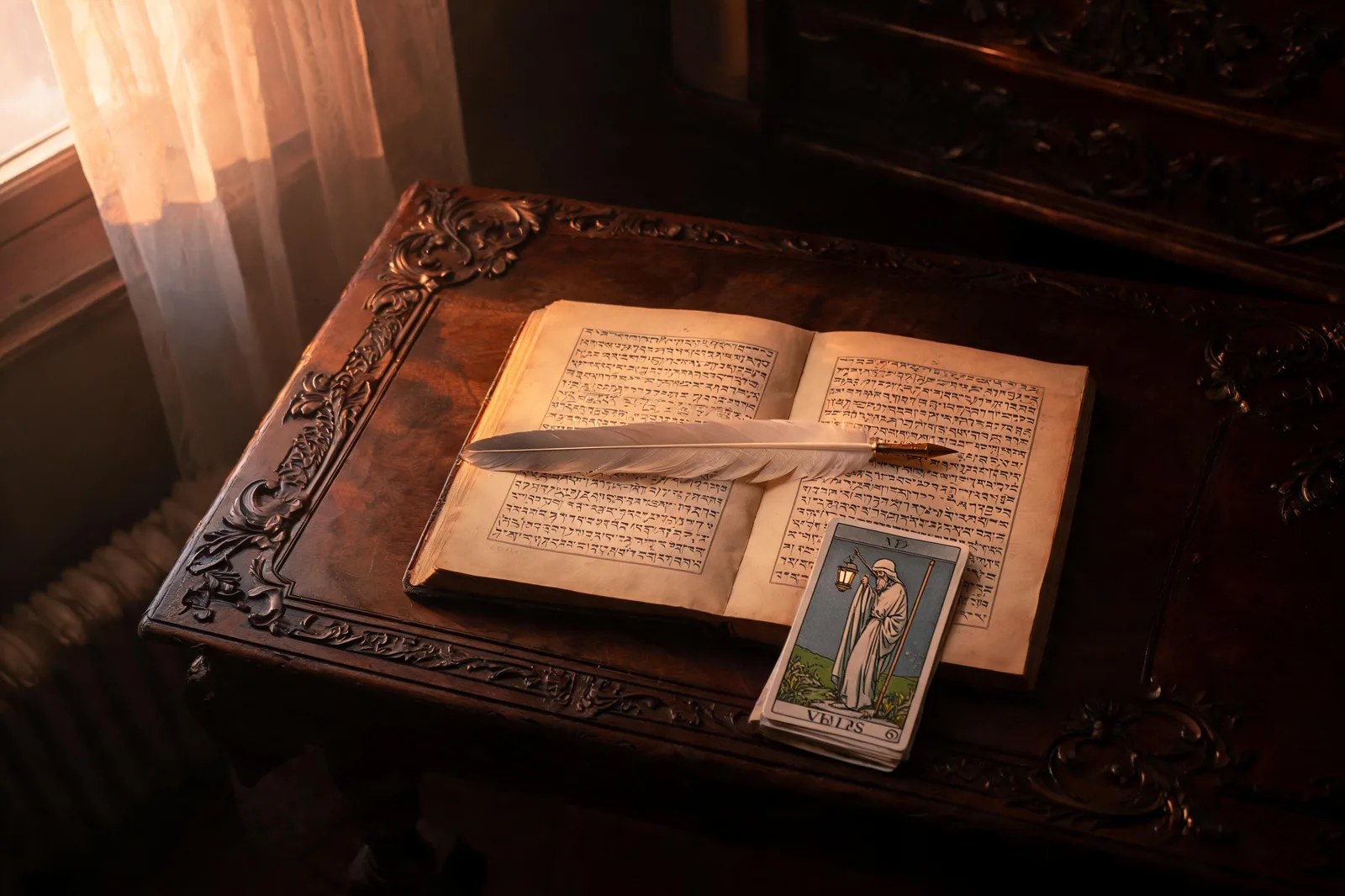
The question for this part is the one that makes the whole chain visible. Lévi gave the trumps their letters in the 1850s. Book T carried those letters into the Order's documents in 1912. Between Lévi and the modern reader, one text did more than any other to make the system legible. It is the Pictorial Key to the Tarot, the book that completed the pictorial key tarot levi line. Waite published it in 1909. The question is not whether Waite was right. The question is what he did to Lévi, and what that doing made possible.
The series' thesis is that the Thoth deck's letter, planetary and decan system is a nineteenth-century and twentieth-century reconstruction. This part tests the link that carried the system from the Order's documents to the public, the text that made the letters visible to a reader who had never opened a Golden Dawn paper. That text is the Pictorial Key, and the Key is a rewrite.
What the Pictorial Key is
The Pictorial Key to the Tarot is a book, published by Routledge and Kegan Paul in 1909. It is the companion to the Rider-Waite tarot deck, and it is the text that explains the deck. Each card has a section, and each section has a description of the card's meaning, a note on the card's symbolism, and a reading of the card in its upright and reversed positions. The book is short, and it is the most widely read text on the tarot in the English language.
That is the fact that matters. The Pictorial Key is not a Golden Dawn document. It is not a secret paper, and it is not a correspondence of the Order. It is a public book, sold in bookshops, and it is the text that carried the tarot's esoteric system out of the Order and into the public record. The Order's documents were secret, and the Key was public. The Key is the door, and the door is the rewrite.
What Lévi had
Lévi had given the trumps their letters, and the letters were the system. The Fool carried no letter. The Magician carried Aleph. The High Priestess carried Beth. The Empress carried Gimel. The sequence ran through the twenty-two cards, and the sequence was the reading. The letters were the structure, and the structure was the meaning.
But Lévi's system was not a system a reader could hold. It was a table, and a table needs a key. The Key is what Waite made, and the Key is the rewrite. Waite took the letters and the planets and the decans and the elements, and he put them into a book that a reader could open and read. The rewrite is the translation, and the translation is the Key.
How the Key rewrote Lévi
The Key rewrote Lévi in three ways. The first is visibility. Lévi's letters were a table, and a table is hard to hold. The Key made the letters visible by putting them on the cards. The Rider-Waite deck has the letters on the trumps, and the letters on the cards are the Key's doing, not Lévi's. Lévi wrote the letters; the Key drew them.
The second is simplification. Lévi's system was a system of correspondences, and a system of correspondences is a table of relationships. The Key turned the table into a story. Each card has a story, and the story is the card's meaning. The story is simpler than the table, and the story is what the reader holds. The simplification is the Key's, and the simplification is the rewrite.
The third is access. Lévi's system was for an initiate, and an initiate has a teacher. The Key's system is for a reader, and a reader has a book. The book is the teacher, and the teacher is the Key. The access is the rewrite, and the rewrite is the door from the Order to the public.
The Pictorial Key and the Rider-Waite deck
The deck and the book are one system, and the system is the Key. The Rider-Waite deck is the Key made visible, and the Key is the Rider-Waite deck made legible. The two are not separate things. The deck shows the cards, and the Key explains the cards, and the two together are the system. The reader holds the deck, and the Key is in the reader's hands, and the reader is the point where the system becomes real.
The deck is what the reader sees, and the Key is what the reader understands. The seeing and the understanding are the system, and the system is the rewrite. The rider waite tarot is the rewrite made into a deck, and the deck is the rewrite made into a book, and the book and the deck are the door from the Order to the public.
Why the rewrite matters
The rewrite matters because it is the point where the system became public. Before the Key, the system was in the Order's documents, and the documents were secret. After the Key, the system was in a book, and the book was public. The book is the door, and the door is the rewrite.
The rewrite is also the point where the system became fixed. Lévi's letters were a choice, and a choice can be revised. The Key's letters are a choice, and the Key's choice is the one that stuck. The modern deck carries the Key's letters, not Lévi's. The Key is the version, and the version is the rewrite.
The rewrite is the point where the system became teachable. Lévi's system was a system for an initiate, and an initiate has a teacher. The Key's system is a system for a reader, and a reader can teach themselves. The book is the teacher, and the teacher is the Key. The teachability is the rewrite, and the rewrite is the door from the Order to the public.
The rewrite is also the point where the system became portable. Lévi's system was a system in a room, and the room was the Order's room. The Key's system is a system in a book, and the book can be carried. The portability is the rewrite, and the rewrite is the door from the Order to the world.
What the Thoth deck inherits
The Thoth deck inherits the Key's rewrite, not Lévi's original. Crowley read the Key, and Crowley's Thoth deck is a response to the Key, not to Lévi. The Thoth deck's letter system is the Key's letter system, modified. The modification is Crowley's, and the modification is the next link in the chain.
The chain runs from Lévi to the Key to Crowley. Lévi wrote the letters. The Key drew them, simplified them, and made them public. Crowley read the Key and rewrote it. The Thoth deck is the result of the rewrite, and the rewrite is the Key. The series' thesis holds: the system is a reconstruction, and the Key is the link that made it a public one.
What the pictorial key tarot levi rewrite gives the reader
A reader of the Rider-Waite deck holds the letters as if they were ancient. They are not. They are Lévi's, rewritten by the Key, and the Key is a 1909 book. The letters are a choice, and the choice is the rewrite, and the rewrite is the door from the Order to the public.
That does not make the letters less real. A reading with letters is a reading, whether the letters are ancient or recent. But it makes them honest. The letters are Lévi's, rewritten by the Key, and the Key is the version. The rider waite tarot carries the letters because the Key put them there, and the putting is the rewrite, and the rewrite is the door.
The reader who knows the history reads the cards differently. The Fool is not just the Fool. The Fool is the card that carries no letter, and the absence is the point. The Magician is not just the Magician. The Magician is Aleph, and Aleph is the first letter, and the first letter is the beginning. The reader holds the card, and the card holds the letter, and the letter holds the history. The history is the rewrite, and the rewrite is the Key.
The series' thesis holds at this link. The system is a reconstruction, and the Key is the link that made it public, fixed, teachable, and portable. The rider waite tarot is the result of the rewrite, and the rewrite is the door from the Order to the world.
For the letter system the Key carries, see the article on Lévi's 1856 attribution. Where the Twenty-Two Letters Come From: Lévi's 1856 Attribution For the text the Key follows, see the article on Book T and its three printings. Book T and Its Three Printings For the court cards the Key explains, see the article on the decan scheme. The Court Cards' Planetary and Decan Scheme
The sources are Arthur Edward Waite, The Pictorial Key to the Tarot (1909), Éliphas Lévi, Dogme et Rituel de la Haute Magie (1856), and the correspondence of the Order's tarot chapter at tarotologist.com.
Questions
What is the Pictorial Key to the Tarot?
The Pictorial Key to the Tarot is the book Arthur Edward Waite published in 1909, the companion to the Rider-Waite deck. It explains each card's meaning, symbolism and upright and reversed positions, and it is the text that carried the tarot's esoteric system out of the Golden Dawn and into the public record.
How did the Key rewrite Lévi?
In three ways: visibility, putting the letters on the cards; simplification, turning the table of correspondences into a story; and access, making the system teachable by a reader instead of an initiate. The Key is the rewrite, and the rewrite is the door from the Order to the public.
Are the Rider-Waite letters ancient?
No. They are Lévi's, from the 1850s, rewritten by the Key in 1909. The letters are a choice, and the choice is the rewrite that made the system public, fixed and portable.
What does the Thoth deck inherit?
The Key's rewrite, not Lévi's original. Crowley read the Key and rewrote it, and the Thoth deck is the result of that chain: Lévi wrote the letters, the Key drew them and made them public, and Crowley modified them.
You might also like
 Thoth Tarot
 Thoth Tarot
 Thoth Tarot
© 2026 TAROTS chat (tarots.chat). All rights reserved. No part of this article may be reproduced, distributed or adapted without the owner's written permission.
The Journal
 Thoth Tarot
 Thoth Tarot
 Thoth Tarot
 Symbolism
 Symbolism
 Spirituality