The Egyptian Tarot of Falconnier and the Church of Light
How a false origin myth became a finished, painted deck for a nineteenth-century occult circle
by Redazione · 9 October 2026 · 5 min read
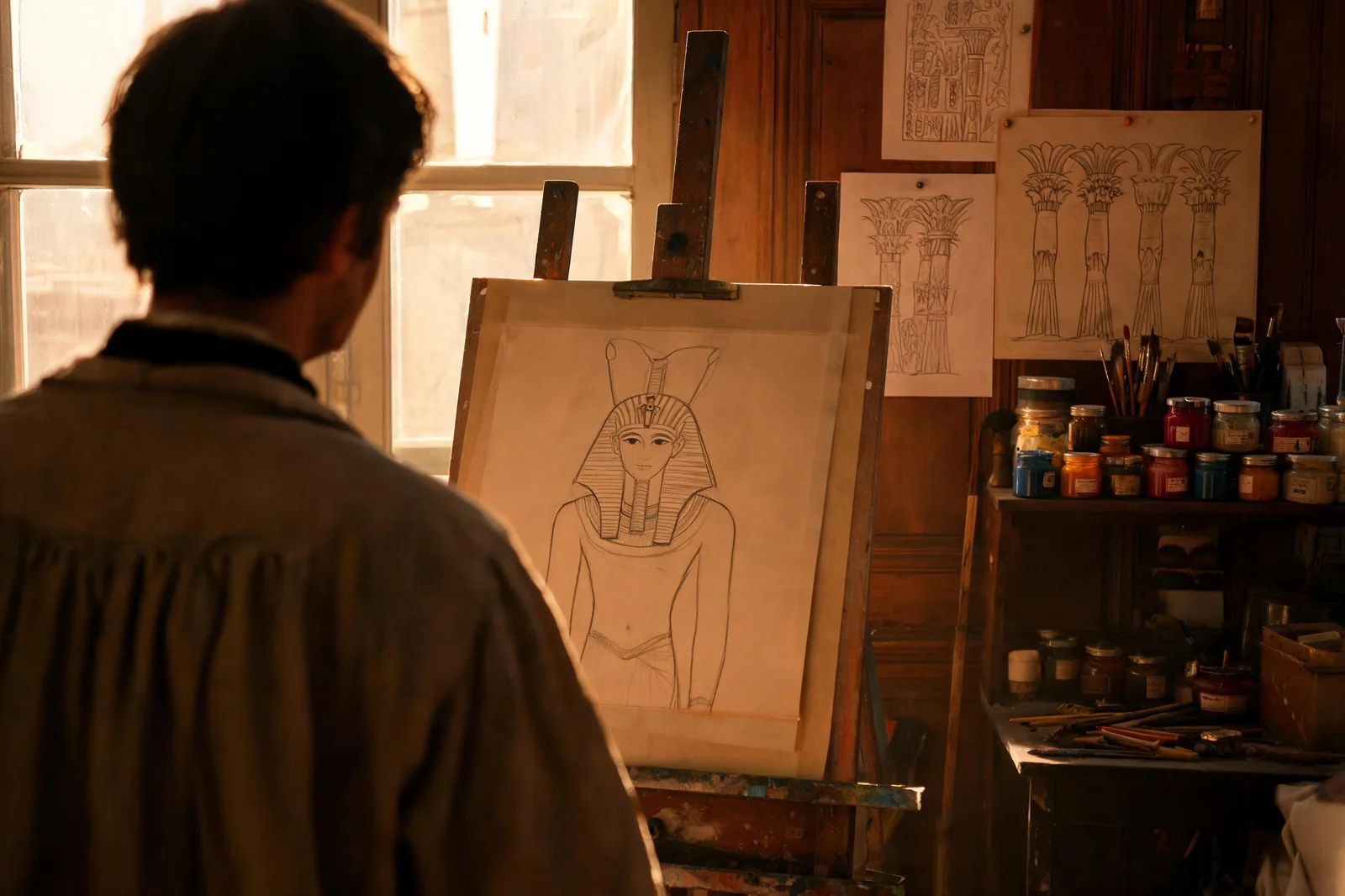
The egyptian tarot falconnier deck is built on a theory nearly everyone now agrees is false: that the tarot was invented in ancient Egypt and smuggled into Europe through secret transmission. R. Falconnier designed his cards around that claim in the 1890s, pairing each trump with Egyptian-style imagery and a corresponding Hebrew letter, and the deck became the visual showpiece of a small French occult church built on the same premise.
That church, L'Église Gnostique founded by Jules Doinel and later reorganized under related Gnostic and Martinist circles often grouped together as "the Church of Light," treated the tarot less as a card game and more as scripture in picture form. Falconnier's egyptian tarot gave that movement something Lévi's theory and Papus's teaching method had only described in words: a finished, paintable Egyptian mythology attached to every single trump.
Court de Gébelin's guess, taken literally
The Egyptian theory did not start with Falconnier. Antoine Court de Gébelin had proposed in 1781 that the tarot was a surviving fragment of the Book of Thoth, an Egyptian sacred text disguised as a card game to escape destruction. Court de Gébelin offered this as an educated guess built on thin evidence; Falconnier, writing over a century later, treated it as settled fact and built an entire deck to illustrate it.
Falconnier worked with the illustrator Maurice Otto Wegener, who painted each trump in a deliberately Egyptianizing style: pharaonic headdresses, lotus columns, hieroglyph-adjacent borders, and poses lifted loosely from tomb paintings and popular Egyptological illustrations of the period. The result looked convincingly ancient to an audience with little direct knowledge of actual Egyptian art, which was exactly the point.
The egyptian tarot falconnier as liturgy, not a game
Unlike the Tarot de Marseille or Wirth's medieval imagiers, Falconnier's deck was designed from the start as liturgical material for a specific group. Members used the cards in ritual settings, treating a session with the trumps as closer to reading scripture than to telling fortunes. The The Empress appeared as an Egyptian mother-goddess figure, and the The Sun as a solar deity drawn with unmistakably pharaonic iconography, reinforcing the group's foundation myth with every card drawn.
Tradition holds that members of these circles saw the deck as proof of their own continuity with ancient priesthoods, a claim that mattered more for group identity than for historical argument. Papus and the Tarot of the Bohemians had already popularized Hebrew-letter correspondences across France; Falconnier's deck simply painted that same correspondence table in Egyptian dress.
Why historians reject the Egyptian claim
The documented history of the tarot is not in doubt among specialists. The earliest surviving decks were hand-painted for fifteenth-century Italian courts, most famously the Visconti-Sforza cards, and the trumps emerged from the conventions of Italian card games, not from Egyptian temple mysteries. No archaeological or textual evidence links the deck to Egypt. Historians such as Michael Dummett traced the game's documented spread through Italy, France and beyond, closing the question definitively for serious scholarship.
Falconnier's deck is therefore valuable today as a historical artifact of nineteenth-century occultism rather than as a key to Egyptian religion. It shows how confidently an invented tradition can be staged, painted and ritualized once a small community decides to believe it.
What the deck left behind
Despite its shaky premise, the egyptian tarot had a long visual afterlife. Its pharaonic styling influenced later commercial "Egyptian tarot" decks throughout the twentieth century, and its confident blending of Hebrew letters with Egyptian costume kept the Court de Gébelin myth alive in popular culture long after scholars had closed the case. Reading Falconnier's deck today is a lesson in how occult communities build identity through shared imagery, whatever the historical cost.
Readers can find a concise overview of the underlying myth at the English Wikipedia article on Antoine Court de Gébelin, who first proposed the Egyptian origin Falconnier later illustrated.
A common misconception worth correcting
Many readers assume any deck with pharaonic imagery must preserve genuine Egyptian tradition. It does not. Falconnier's cards are a nineteenth-century invention layered onto an Italian game, no older than the myth that inspired them. Treating the artwork as decorative occult history, rather than as ancient scripture, is the more accurate way to approach it.
FAQ
Is the Egyptian origin of the tarot historically accurate? No. Historians agree the tarot began as a fifteenth-century Italian card game; there is no evidence connecting it to ancient Egypt.
Who painted Falconnier's egyptian tarot? The illustrator Maurice Otto Wegener painted the cards, working from Falconnier's Egyptianizing program and the earlier Court de Gébelin myth.
What was the Church of Light? It refers loosely to small French Gnostic and occult circles of the late nineteenth century that used Egyptian-styled tarot imagery in ritual, treating the deck as near-scriptural.
Is Falconnier's deck still printed today? Reproductions exist for collectors and historians of occultism, though it is studied now mainly as a period artifact rather than a working divination deck.
Questions
Is the Egyptian origin of the tarot historically accurate?
No. Historians agree the tarot began as a fifteenth-century Italian card game; there is no evidence connecting it to ancient Egypt.
Who painted Falconnier's egyptian tarot?
The illustrator Maurice Otto Wegener painted the cards, working from Falconnier's Egyptianizing program and the earlier Court de Gébelin myth.
What was the Church of Light?
It refers loosely to small French Gnostic and occult circles of the late nineteenth century that used Egyptian-styled tarot imagery in ritual, treating the deck as near-scriptural.
Is Falconnier's deck still printed today?
Reproductions exist for collectors and historians of occultism, though it is studied now mainly as a period artifact rather than a working divination deck.
This article talks about
You might also like
 Symbolism
 Symbolism
 Symbolism
© 2026 TAROTS chat (tarots.chat). All rights reserved. No part of this article may be reproduced, distributed or adapted without the owner's written permission.
The Journal
 Thoth Tarot
 Kabbalah
 Thoth Tarot
 Kabbalah
 Thoth Tarot
 Symbolism
 Symbolism
 Symbolism
 Kabbalah