Pamela Colman Smith: The Artist Behind 78 Images
by Redazione · 9 October 2026 · 5 min read
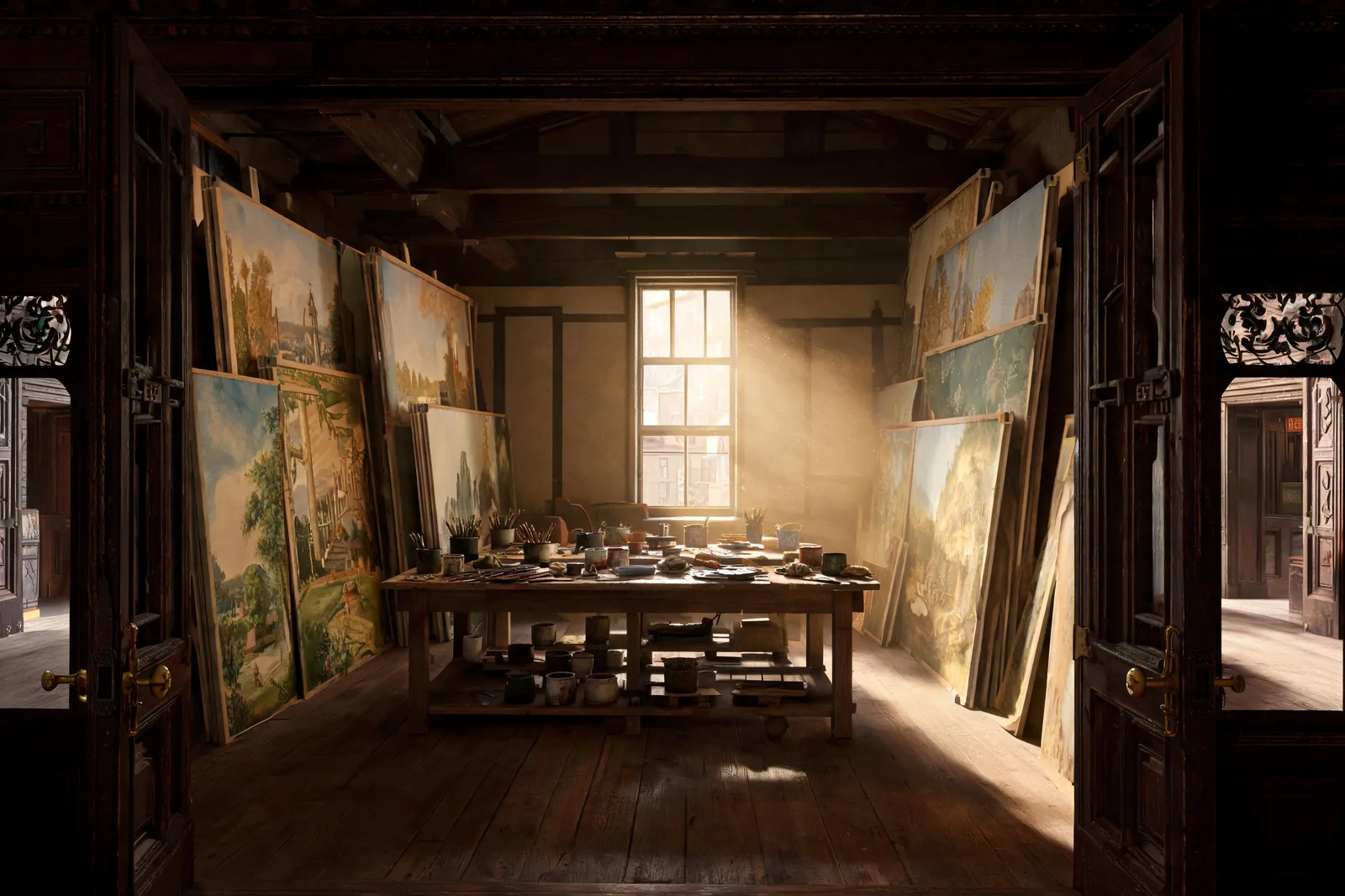
Pamela Colman Smith drew all seventy-eight scenes of the deck that carries her initials beside Waite's. Ask any reader to picture the Ten of Swords or the Three of Cups and they see her lines first, not a theory. This article follows the artist herself: her training, her working speed, and why her name sat in the shadows for most of a century.
Smith was born in London in 1878 to American parents and raised between Jamaica, Brooklyn and Manchester. She trained at the Pratt Institute under Arthur Wesley Dow, whose teaching on flat colour and rhythmic line shaped her whole style. By her twenties she was illustrating books, designing theatre sets for Ellen Terry and Henry Irving's Lyceum company, and publishing her own collections of Jamaican folk tales, told to her as a child by storytellers on the island.
Pamela Colman Smith before the cards
Long before 1909, Smith had a reputation. She illustrated W. B. Yeats's The Wind Among the Reeds, drew for Pamela Colman Smith's Broad Sheets, and moved in a circle that included Bram Stoker and the Golden Dawn's literary members. Her gift was speed combined with economy: a few strong shapes, a limited palette, a story told in one frame. That is exactly what a seventy-eight card commission needed, and almost no illustrator of her generation could have delivered it inside a single year.
She had also performed as a reciter of Jamaican anansi stories on stage in London and New York, a skill that trained her to compress a whole narrative into a handful of gestures. Biographers note her nickname among friends, "Pixie," and her lifelong interest in synaesthesia: she described hearing music as colour and shape, a sensitivity that likely fed the strong, almost musical rhythm of her compositions. That same instinct for a scene's single decisive gesture carried directly into the cards.
Waite's commission and the minor arcana
Arthur Edward Waite hired Smith around 1909 to illustrate a deck for William Rider and Son. Earlier decks, including the Tarot de Marseille lineage, left the forty minor cards as plain pip patterns: ten of swords as ten swords, nothing more. Smith, working from Golden Dawn teaching papers and Waite's direction, gave every pip card a human scene — the readers who use The Tower or the Nine of Swords today owe that choice to her. The result let a beginner read intuitively from the picture, an innovation the trade had not seen before. From the Sola Busca to the Waite Smith Minor Arcana traces how those scenes drew on the Sola Busca deck's own illustrated pips, a fifteenth-century Italian precedent Smith and Waite likely knew through the British Museum's prints.
Payment, credit and a quiet departure
Smith was paid a flat fee, by most accounts around two guineas a card, with no royalty on sales that would eventually run into the millions. The deck was marketed for decades as the "Rider Waite Tarot," her name absent from the cover. She continued other work, converted to Catholicism in 1911, and largely left the public record after the 1910s, living in Cornwall until her death in 1951, in relative poverty and without a will. Only from the late twentieth century did historians and publishers begin calling the deck the Rider-Waite-Smith, restoring her name to the credit line.
Reading her symbols today
Smith's debt to the Golden Dawn is direct: members such as Moina Mathers and the Painted Golden Dawn Deck and the order's founders, covered in Mathers, Westcott and Woodman: Who Built the Golden Dawn Tarot, had already built a system of correspondences — planets, elements, Hebrew letters — that she translated into picture form. When Waite's and Crowley's decks later diverged, as From the Golden Dawn to Waite and Crowley: Two Heirs, Two Decks describes, it was Smith's visual grammar, not Crowley's, that became the template nearly every modern illustrated deck still copies. A cartomancer drawing the Eight of Cups does not need to know her biography to feel the weight in that figure's shoulders; the composition does the work she built into it.
What her archive still tells us
Smith's surviving sketchbooks and letters, held partly at the Smithsonian American Art Museum, show a working method of quick ink studies refined into the final gouache paintings reproduced for print. Tradition holds that she completed the full set in under a year, though no signed contract survives to confirm an exact deadline. What is documented is the scale of the achievement: a single artist, working largely alone, created the visual language that later let psychologists, novelists and casual readers alike treat the tarot as a storytelling tool rather than a numerological puzzle.
Her obscurity was never really about talent. It followed the pattern of many commercial illustrators of her era, hired for a fee and left off the credit, while the publisher's name endured. The difference is that her seventy-eight images outlived every edition page that omitted her, and now open almost every serious history of the cards, including the rest of this series.
A reader of this blog's Thoth-based service meets a different lineage, The Fool drawn by Lady Frieda Harris rather than Smith. The next part of this series follows Harris through the five years she spent painting that second complete deck, a useful contrast: two women, a generation apart, each asked to turn a magician's system into seventy-eight pictures that strangers could read without a teacher in the room.
For more on her life and career, see the Wikipedia article on Pamela Colman Smith.
Questions
Who was Pamela Colman Smith?
She was the artist who illustrated all 78 cards of the deck commissioned by A. E. Waite in 1909, now often called the Rider-Waite-Smith tarot.
Was Pamela Colman Smith paid fairly for the tarot deck?
She received a flat one-time fee, by most accounts around two guineas per card, with no royalty on later sales of the deck.
Why was her name left off the deck for so long?
Publishers marketed the deck under Rider's and Waite's names; her contribution was only widely credited from the late twentieth century onward, once historians restored her name to the Rider-Waite-Smith title.
What other work did Pamela Colman Smith do?
She illustrated books including W. B. Yeats's poetry, designed theatre sets for the Lyceum company, and published her own collections of Jamaican folk tales.
This article talks about
You might also like
 Symbolism
 Symbolism
 Symbolism
© 2026 TAROTS chat (tarots.chat). All rights reserved. No part of this article may be reproduced, distributed or adapted without the owner's written permission.
The Journal
From the Journal
Chosen for this page
 Thoth Tarot
The Fool, the Hanged Man and the Aeon: The Three Mother Letters in the Book of Thoth
8 min read
More in Thoth Tarot Swords
 Love
 Career
 Thoth Tarot
 Kabbalah
 Symbolism
 Symbolism
 Kabbalah