Nicolas Conver and the Tarot de Marseille of 1760
by Redazione · 9 October 2026 · 5 min read
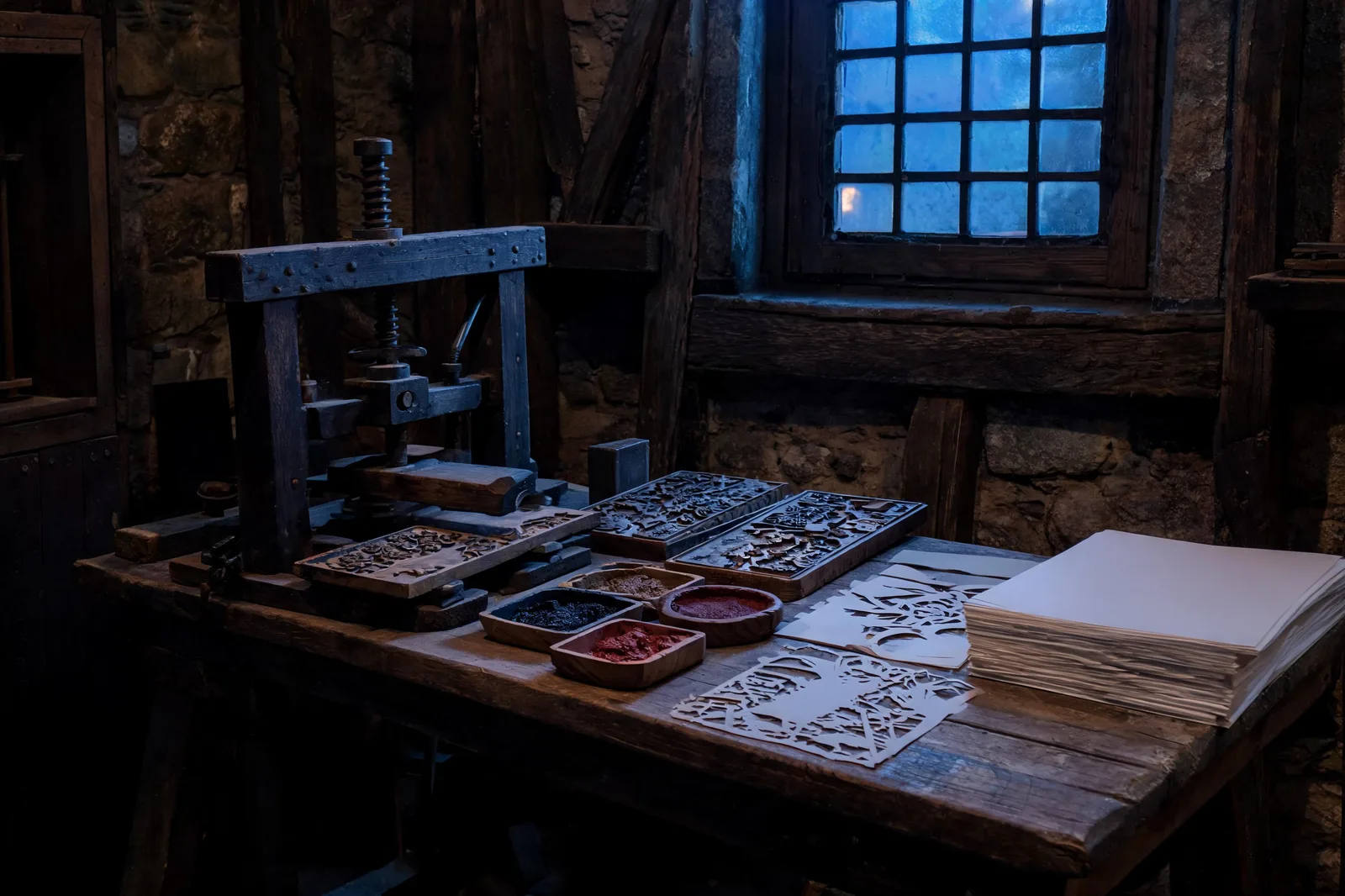
Who was Nicolas Conver, and why does his 1760 deck still define the Tarot de Marseille? He was a cardmaker working in Marseille in the second half of the eighteenth century, and the woodblocks he cut became the reference edition that later printers, and later occultists, treated as the pattern itself. The nicolas conver tarot is not the oldest Marseille-style deck, but it is the one that survived cleanly enough to be copied, and that accident of survival gave one workshop's choices the weight of a standard.
A cardmaker among many
Marseille in the eighteenth century held a dense cluster of playing-card workshops, feeding a trade that ran along the Rhône and out through the Mediterranean ports. Cardmaking was a regulated craft: guild rules fixed the paper stock, the woodblock technique, and often the colours a shop could use, since dyes and tax stamps were watched closely by local authorities. Conver's workshop was one among several producing the pattern now called Marseille, a layout of trumps and pip cards that had circulated under various hands since at least the sixteenth century. What set his deck apart was not invention. Tradition holds that he refined an existing design rather than creating a new one, tightening the line work and standardising details that earlier printers had handled inconsistently from sheet to sheet.
The deck of 1760
The deck bearing Conver's name and the date 1760 (sometimes given as 1761 in later catalogues) survives in a well-preserved set of woodblocks and printed sheets, a rarity for commercial cards of the period, which were cheap, heavily used, and rarely kept once worn out. Its survival is why this particular Marseille deck, rather than a dozen comparable ones from Lyon or Avignon, became the template reprinted in the twentieth century. The cards followed the standard Marseille structure: twenty-two trumps, four suits of wands, cups, swords and coins, with stencilled colour applied over black woodcut outlines, a technique that let a small workshop produce vivid decks without engraving separate blocks for every hue.
From workshop stock to occult standard
Conver's blocks might have stayed a footnote if the French card manufacturer Grimaud had not acquired and reissued them in the twentieth century, under the editorial hand of Paul Marteau. Marteau's 1930 edition, now itself sometimes called the Grimaud Marseille or the Ancien Tarot de Marseille, popularised Conver's exact line work as the pattern, printed and reprinted for decades and treated by many readers as the baseline against which every other Marseille deck is measured. This matters for anyone tracing how the game described in The Card Before the Deck Was Esoteric: Marseille Pattern and the Game's Rules turned into fixed, collectible imagery: Conver did not design for divination, he designed for the card table, and the deck only acquired its esoteric authority generations after it was cut.
Reading the woodblocks today
Look closely at a Conver-pattern Tower, The Tower, or at the Hanged Man, and the stiffness of eighteenth-century woodcut is obvious: thick outlines, flat colour fields, figures drawn with the economy of a craftsman who needed to cut dozens of nearly identical sheets a day, not compose a single refined image. That economy is part of the deck's appeal to later readers. The Marseille line is plain where the Thoth deck, by contrast, is dense with correspondence and colour theory; a reader moving between the two feels the difference between a game pattern inherited from printers like Conver and a twentieth-century system built deliberately as a teaching tool. Scholars of playing-card history, including Michael Dummett, have argued that the trumps' order and imagery in decks of this kind were never fixed doctrine but regional convention, hardened into "tradition" largely by later reprints rather than by any single inventor's intent.
Why the date still matters
Placing Conver's work at 1760 matters because it falls squarely before the turning point described in From Parlor Game to Sacred Text: The 1780s Turning Point, when French writers began reading the trumps as Egyptian survivals rather than card-game emblems. Conver's deck, in other words, is a hinge: the last clean example of the Marseille pattern produced purely as a game object, cut only a couple of decades before it was swept into occult reinterpretation. Anyone studying the Thoth deck's own departure from Marseille conventions does well to start here, with the plain workshop deck that the esotericists inherited and then transformed. For background on the pattern's rules and layout before that transformation, see the Wikipedia overview of the Tarot de Marseille.
A plain deck's long afterlife
Nicolas Conver left no treatise, no claimed system, nothing but cut wood and a date. That absence of commentary is itself informative: it shows how late the idea of the tarot as a symbolic instrument arrived, layered onto cards that a Marseille workshop had cut for an evening's game. Readers who want the Thoth deck's innovations in proper perspective gain from seeing what came immediately before them, plain, regional, and entirely unaware of the role it would later be asked to play.
Questions
Who was Nicolas Conver?
A Marseille cardmaker active in the second half of the eighteenth century whose 1760 woodblocks became the reference edition of the Tarot de Marseille.
Why is the 1760 Conver deck so influential?
Its blocks survived intact and were reissued by Grimaud in 1930 under Paul Marteau, turning one workshop's pattern into the standard used by generations of readers.
Did Conver design the tarot for divination?
No. Tradition holds he refined an existing game pattern for the card table; occult readings of the trumps only developed decades later.
How does the Conver deck differ from the Thoth deck?
The Conver pattern uses plain woodcut outlines and flat stencilled colour for a card game, while the Thoth deck was built deliberately as a dense symbolic and astrological system.
This article talks about
You might also like
 Symbolism
 Symbolism
 Symbolism
© 2026 TAROTS chat (tarots.chat). All rights reserved. No part of this article may be reproduced, distributed or adapted without the owner's written permission.
The Journal
 Love
 Kabbalah
 Symbolism
 Kabbalah
 Kabbalah
 Kabbalah
 Symbolism
 Symbolism
 Kabbalah