Italo Calvino's The Castle of Crossed Destinies
by Redazione · 9 October 2026 · 5 min read
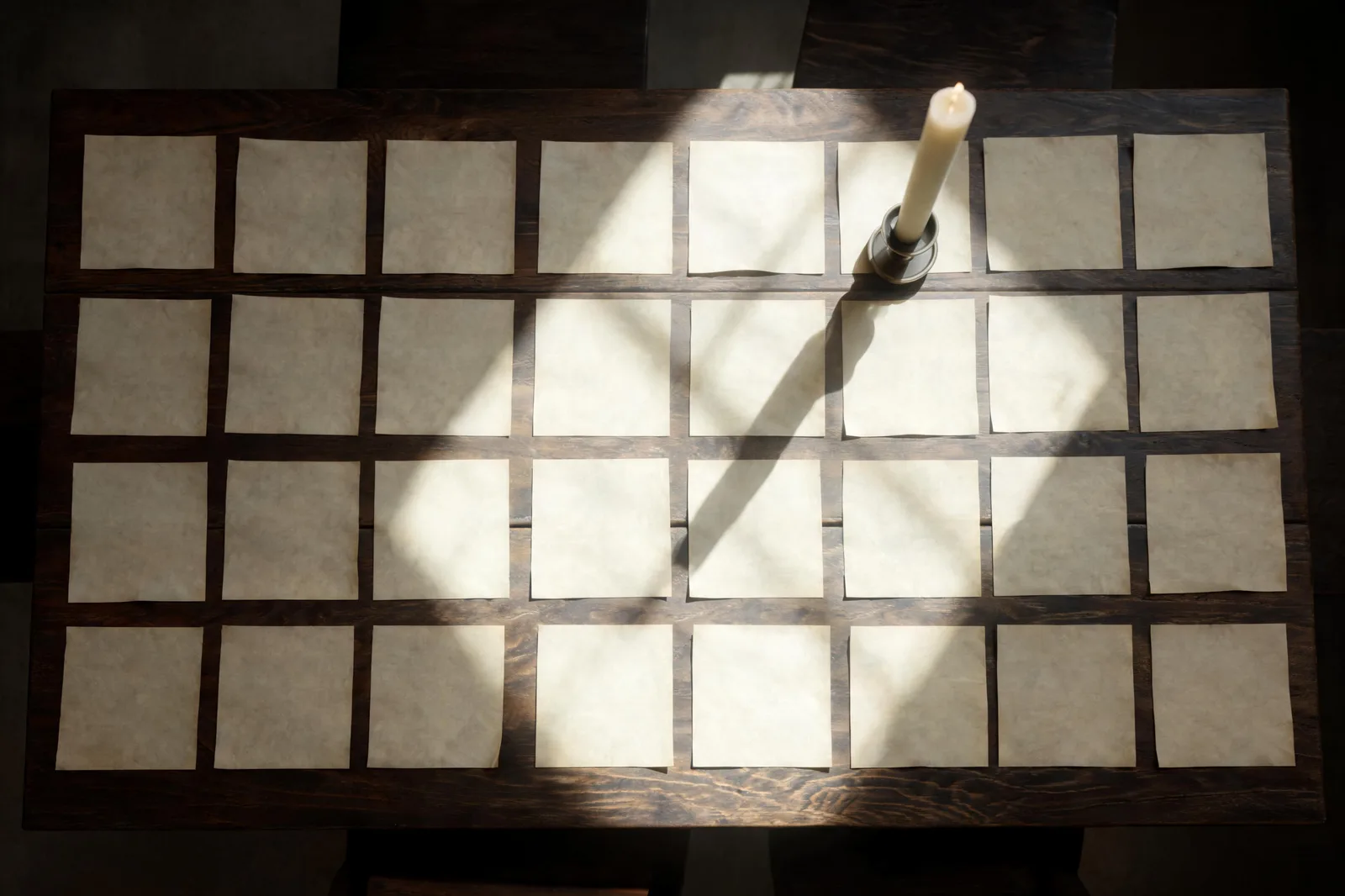
Italo Calvino's The Castle of Crossed Destinies turns the tarot into a storytelling machine rather than a fortune-telling one. First published in 1969 and expanded in 1973, the book imagines travellers who meet in a castle and later a tavern, struck mute by some unexplained enchantment, able to communicate only by laying out tarot cards in a grid and letting other guests read stories from the overlapping sequences.
Calvino built the book around two historical decks rather than inventing his own imagery: the fifteenth-century Visconti-Sforza cards for the castle section, and the Tarot de Marseille for the tavern section that follows it. Each story is literally generated from a shared tableau of cards laid crossword-style on a table. A single card belongs to several travellers' narratives at once. It is read differently depending on the direction and sequence in which another guest approaches it.
The device forces an unusual kind of reading discipline on both narrator and audience. Calvino, playing the silent witness who reconstructs each guest's story from the tableau, repeatedly admits uncertainty about which card belongs to which tale, and offers more than one possible reading where the grid allows it. That admitted ambiguity is part of the book's point: a shared set of images can support several equally plausible stories at once, none of them more authoritative than the others.
A literary experiment, not a divinatory guide
The project reflects Calvino's broader interest, in this period of his career, in combinatorial and structuralist approaches to narrative: fixed elements, the cards, generating variable stories depending on arrangement, much as his other experimental fiction of the era treated plot as a system of possibilities rather than a single fixed sequence. He had encountered serious scholarly attention to the Visconti-Sforza deck's imagery around the same years, and the book grew in part from that encounter with tarot as a historical art object worth close reading, not only as an esoteric tool.
Reading the castle of crossed destinies as narrative units
Where André Breton and the Surrealist Game of Marseille used the tarot's structure to encode a movement's values, Calvino used it to test how far pictorial sequence alone could generate narrative meaning, independent of any fixed symbolic tradition. A card like The Tower appears in his schema as a plot event — catastrophe, revelation, a fall — but Calvino deliberately kept interpretation loose and literary rather than anchored to any single esoteric system, Golden Dawn or otherwise. The method owes more to oracular ambiguity and reader participation than to the fixed correspondences this blog's own readings draw on.
Why two decks, two registers
The shift from the ornate, courtly Visconti-Sforza imagery to the plainer, more schematic Tarot de Marseille cards in the second half of the book changes the stories' register noticeably. The castle's tales, drawn from richly painted Renaissance figures, read as elevated and courtly; the tavern's tales, built from the Marseille deck's blockier woodcut-style imagery, feel coarser and more folkloric. Calvino seems to have used the visual texture of each deck deliberately, letting the cards' own historical style shape the tone of the narratives built from them.
Influence beyond literature
The book remains a touchstone for writers and game designers interested in constraint-based storytelling. It is frequently cited in discussions of the tarot as a narrative device independent of fortune-telling, alongside explicitly esoteric works like Crowley's Book of Thoth. Calvino's deliberate agnosticism toward divinatory meaning — he treats the cards as a formal puzzle, not a spiritual claim — makes the book a useful counterpoint for readers of this series who want to see how far the cards' imagery can travel from the esoteric traditions most of these articles cover.
Later writers borrowed the same constraint directly. Workshops in experimental fiction still set Calvino's tableau method as an exercise: hand a writer a fixed spread of cards and ask for a story that touches every one in order, with no card left unused and no image repeated. The exercise teaches a lesson tarot readers already half-know, that meaning in a spread comes as much from the relationships between cards as from any single card's isolated definition.
A different kind of tarot reading
For a contemporary reader familiar mainly with divinatory spreads, Calvino's exercise is a reminder that a tarot image always carries some narrative charge independent of any occult system attached to it. A courtly figure holding a sword, a tower struck by lightning, a wheel turning: each already suggests a story before any tradition assigns it a fixed meaning. The Castle of Crossed Destinies simply makes that narrative potential the entire point, stripped of prophecy and built instead as literary play.
Modern tarot readers who treat a spread as a story to interpret, rather than a set of isolated fortune-telling verdicts, are doing something closer to Calvino's method than they might realise. A reading that weaves the Tower, the Hermit and the Ten of Cups into one coherent account of a client's situation borrows the same instinct the novel turns into formal literary structure: cards mean more together, in sequence, than any one of them means alone.
For more on Calvino's career and his structuralist period, see the Wikipedia article on Italo Calvino.
Questions
What is The Castle of Crossed Destinies about?
A 1969 novel by Italo Calvino in which mute travellers tell their stories by laying tarot cards in a shared grid, letting other guests read narratives from the overlapping sequences.
Which tarot decks does Calvino use in the book?
The fifteenth-century Visconti-Sforza deck for the castle section and the Tarot de Marseille for the tavern section that follows it.
Is The Castle of Crossed Destinies a guide to tarot divination?
No. Calvino treats the cards as a formal device for generating narrative, not as a divinatory or esoteric system.
Why did Calvino choose two different tarot decks for the book?
The ornate Visconti-Sforza imagery suits the castle's courtly tales, while the plainer Tarot de Marseille gives the tavern's stories a coarser, more folkloric register.
This article talks about
You might also like
 Symbolism
 Symbolism
 Symbolism
© 2026 TAROTS chat (tarots.chat). All rights reserved. No part of this article may be reproduced, distributed or adapted without the owner's written permission.
The Journal
 Love
 Thoth Tarot
 Kabbalah
 Symbolism
 Symbolism
 Kabbalah
 Symbolism
 Symbolism
 Kabbalah