How Playing-Card Taxes Shaped the Tarot
by Redazione · 9 October 2026 · 5 min read
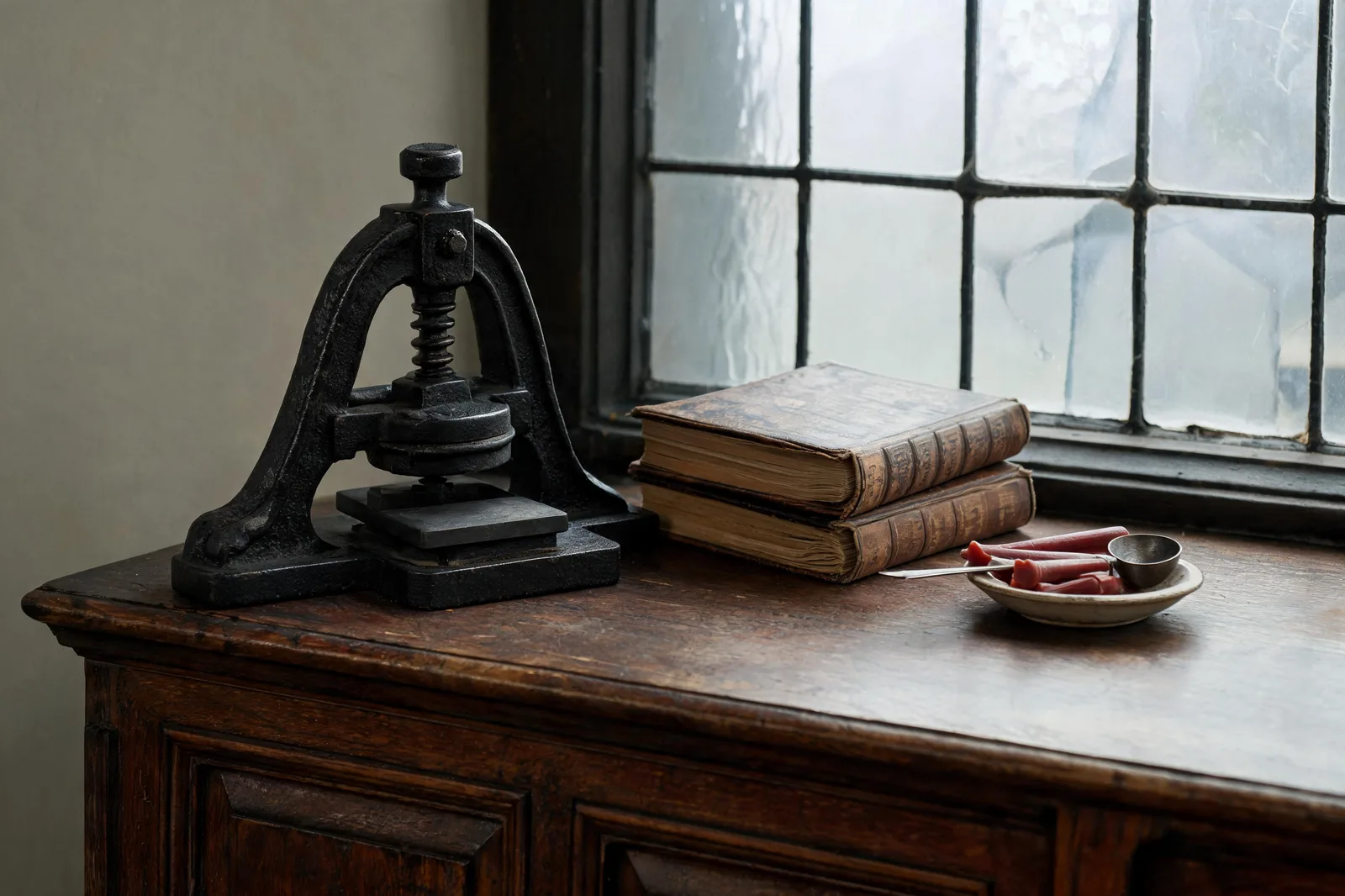
Governments taxed cards long before anyone read meaning into them. The story of playing card tax tarot history runs straight through the guild workshops already covered in this series, from Rouen and Lyon's printers in Tarot Card Printers of Rouen and Lyon to the stamped decks that followed. Once a state realised playing cards were a profitable thing to tax, the physical deck itself started changing shape around the tax stamp, not around any symbolic design choice.
England's famous stamped Ace
The clearest example comes from England, where a series of duties on playing cards, running from the early eighteenth century until 1960, required every legally sold deck to carry an official stamp. Cardmakers initially had to send printed decks to a government office to be hand-stamped before sale, a slow and costly process that encouraged a workaround: printing the stamp directly onto the Ace of Spades, the card that still carries elaborate, decorative printing in English-pattern decks today, long after the tax itself ended. That card's visual prominence, a habit collectors and players still recognise, is a direct fossil of tax administration, not an aesthetic or symbolic choice by any designer.
France's parallel system
France ran its own version of card taxation under the Ancien Régime, requiring printers to use officially approved paper, stamped at designated points, and to pay duties tied to the number of decks produced. These rules sat alongside the guild regulations already shaping workshops in Rouen, Lyon and Marseille, adding a layer of state oversight on top of craft tradition. Tradition holds that French tax administration pushed toward more uniform card dimensions and stock weights across regions, since a non-standard deck was harder for tax officials to inspect and certify quickly. Taxation, in other words, nudged French regional patterns slightly closer to each other over time, even as local workshops kept their own trump imagery and line style.
Why playing card tax tarot history mattered more than iconography
A tax stamp is a practical, bureaucratic object: it has to be placed somewhere consistent, verified quickly, and hard to forge. None of that has anything to do with what a deck's trumps mean, yet it directly shaped where printers placed ink, how many cards a legal pack had to contain, and how cheaply a workshop could produce a deck while still turning a profit after duty was paid. A city like Bologna, whose shortened tarocchino pack was examined through The Tarocchino of Bologna and Its Shortened Deck, had its own local tax arrangements layered onto its distinctive sixty-two card structure, another reminder that a deck's final shape answered to administrators and guild officers as much as to any artistic or divinatory intention.
Smuggling and evasion
Wherever a tax exists, evasion follows. Unstamped decks, sometimes called "private" or "wildcard" packs by collectors, circulated through informal channels in both England and France, and governments periodically tightened penalties and inspection routines in response. Surviving customs and court records document prosecutions against printers caught selling unstamped cards, giving historians an unusually direct paper trail for a trade that otherwise left few written records. These documents, dry as they are, confirm card production volumes and pricing in a way that no surviving deck alone could.
A practical exercise in reading old decks
Anyone handling a reproduction of an old English or French deck can spot this history directly. Look at the Ace of Spades in a modern pack descended from the English pattern: its scrollwork and printer's name are still there, decades after the duty that made the design valuable disappeared. Compare it with a Marseille-pattern Ace of Coins, plain and unremarkable by contrast, because French tax stamps were never anchored to one specific card the way England's were. The asymmetry between these two aces is a small, visible lesson in how differently two national tax systems left their mark on the same basic object.
A tax history, not a symbolic one
None of this fiscal machinery touched the question of what the trumps meant, because in the period when these taxes mattered most, nobody was asking that question yet. The tax stamp and the Ace of Spades decoration predate Court de Gébelin's Egyptian theory by decades in England's case, and ran parallel to France's own esoteric turn without the two systems ever really intersecting. A general overview of this administrative history is available at the Wikipedia entry on the Ace of Spades, which traces the stamp duty's visible legacy on the card still used today.
What the tax stamps still tell us
Reading tarot history through tax law feels unglamorous next to Kabbalah or astrology, but it is some of the firmest ground historians have. A stamp is dated, official, and impossible to romanticise into hidden meaning. Wherever playing card tax tarot history leaves a paper trail, it tells researchers exactly when, where and at what volume cards were legally produced, a dry but reliable anchor for dating the more speculative claims made about the same decks later.
Questions
How did playing card tax shape the tarot?
Duties on cards pushed printers toward standard sizes and stock, and in England led directly to the elaborately printed Ace of Spades as a tax stamp card.
Why is the Ace of Spades special in English decks?
It carried the official tax stamp under English duty law, so printers made it decorative; the habit outlived the tax itself, ending in 1960.
Did France also tax playing cards?
Yes. Ancien Régime France required approved paper and duty stamps, nudging regional patterns toward more uniform dimensions and stock weight.
Did card taxes affect the trumps' symbolism?
No. Tax rules shaped size, stock and stamp placement; no surviving tax record engages with the trumps' meaning at all.
You might also like
 Symbolism
 Symbolism
 Symbolism
© 2026 TAROTS chat (tarots.chat). All rights reserved. No part of this article may be reproduced, distributed or adapted without the owner's written permission.
The Journal
 Major Arcana
 Love
 Kabbalah
 Symbolism
 Kabbalah
 Kabbalah
 Symbolism
 Symbolism
 Kabbalah