Knight, Queen, Prince, Princess: The Golden Dawn's Four Court Ranks
by Redazione · 9 October 2026 · 5 min read
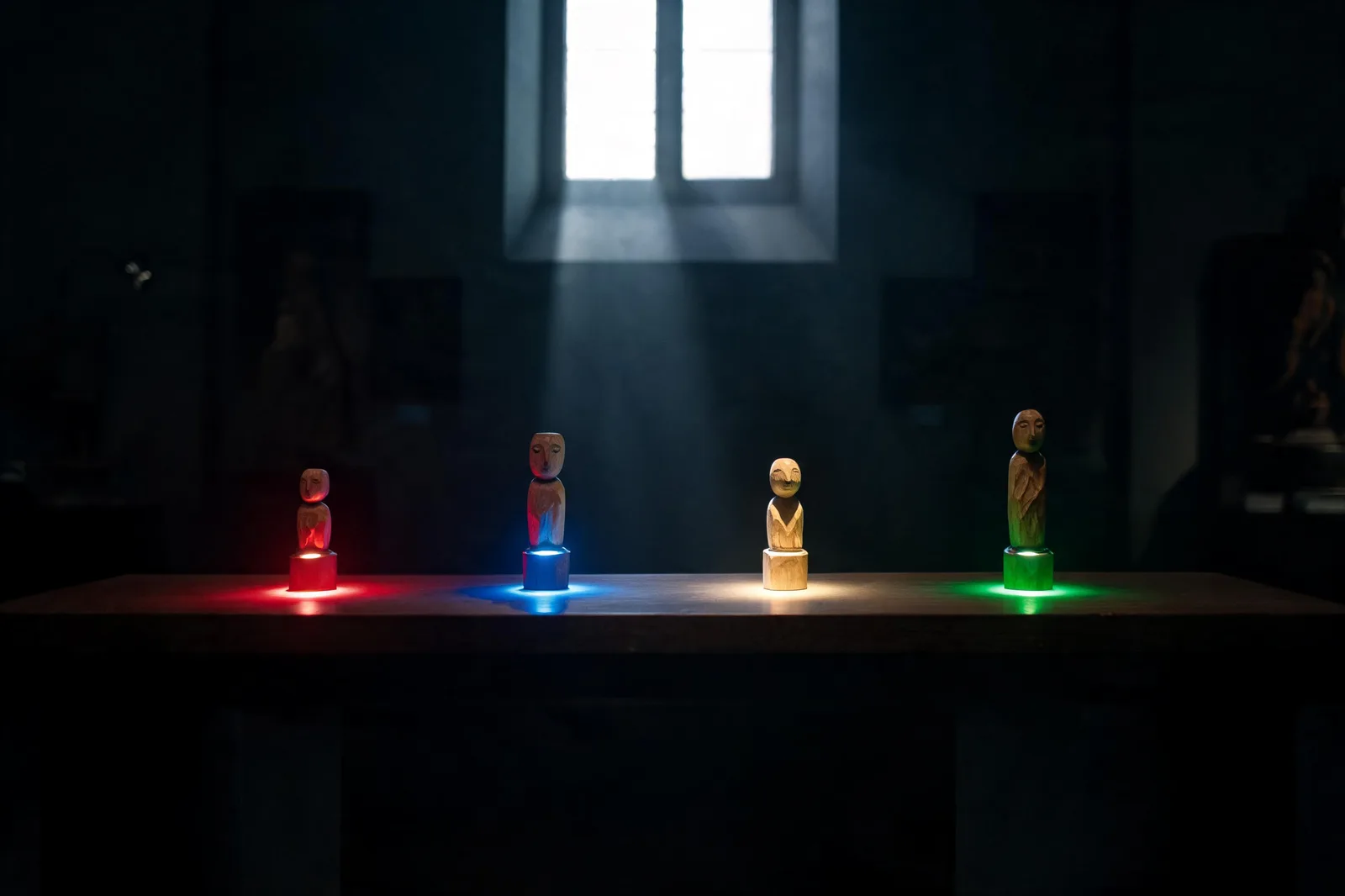
Knight, Queen, Prince, Princess: tarot readers who grew up on the Rider-Waite deck meet this four-rank court and wonder where the familiar King and Page went. The Golden Dawn replaced the old four-rank court on purpose, building a hierarchy that maps directly onto the four elements rather than onto a royal family's ranks. Having already fixed a court card as the The Significator in Golden Dawn Readings of a reading, a student still needs to know what these four ranks actually represent, and why the Order thought the change mattered enough to make.
Why the Old Court Did Not Fit
The traditional King, Queen, Knight and Page court, inherited from ordinary playing cards, ranks its figures by social status: a king outranks a knight, a queen outranks a page. The Golden Dawn considered this scheme philosophically empty for a system meant to teach elemental theory. Social rank says nothing about Fire, Water, Air or Earth. So the Order renamed and reordered the court to express a different idea entirely: each rank is itself an element, and each card is that element combined with its suit's element.
The Four Ranks as Four Elements
In the Golden Dawn scheme, the Knight is attributed to Fire, swift and initiating; the Queen to Water, receptive and stabilising; the Prince to Air, intellectual and mediating; and the Princess to Earth, grounded and manifesting. Crossed with the four suits, Wands for Fire, Cups for Water, Swords for Air and Disks for Earth, this produces sixteen double-element combinations. A Knight of Wands is Fire of Fire, pure and sometimes reckless momentum, while a Princess of Disks is Earth of Earth, the most grounded and least mobile card in the whole court. A Queen of Wands becomes Water of Fire, a more complex blend of steady feeling wrapped around Fire's drive, a nuance the older King-Queen-Knight-Page scheme had no vocabulary to express.
Reading the Hierarchy, Not Just the Rank
Because every court card carries two elements rather than one, a Golden Dawn-trained reader looks first at which element dominates. A card like the Prince, Air acting on a suit's own element, tends to represent ideas, plans and communication filtered through that suit's concern. A Prince of Cups suggests an emotional situation approached analytically, perhaps even too coolly. This double-element reading is a separate question from the planetary and decan attributions the small cards carry, which this series covers elsewhere; the court ranks describe a card's elemental character and social posture, not its position in the zodiac.
The Princess as Earth and as a Throne
The Princess holds an unusual double role in Golden Dawn doctrine: she is both Earth of her suit and, in the Order's cosmology, the throne upon which the King, the suit's own pure elemental force, never actually drawn as a card, is said to rest. This makes the Princess cards, uniquely among the court, carriers of a latent, fuller power beneath their grounded, earthy surface. A reader meeting a Princess card in a spread is meant to see patience and groundedness in the foreground, with a greater concentrated force implied beneath it, rather than reading her as simply the junior-most court card the way a Page would be read in older systems.
Why This Still Matters for a Thoth Reader
The Thoth deck inherits this four-rank system whole, so a reader unfamiliar with it will misjudge every single court card in the deck, reading a Prince as if he were a King, or a Princess as if she were merely a Page. Recognising that each court card is a deliberate cross of two elements, rank and suit, rather than a single social role, is the single most useful piece of Golden Dawn theory a modern Thoth reader can learn early. Aleister Crowley's own explanation of the scheme appears throughout The Book of Thoth, and a general account of court card history is summarised on the Wikipedia page for court cards.
Frequently Asked Questions
Why did the Golden Dawn remove Kings and Pages from the court? The Order replaced a social hierarchy with an elemental one, so every rank, Knight, Queen, Prince, Princess, represents an element rather than a social station.
What does it mean for a court card to carry two elements? The rank gives one element and the suit gives another, so Knight of Wands combines Fire's energy with Fire's own suit, while Queen of Disks combines Water's receptivity with Earth's suit.
Is the Princess the weakest court card? No. She is read as grounded and still rather than weak, and in Golden Dawn doctrine she is also the throne beneath which a greater elemental force is said to rest.
Does this court system apply outside the Thoth deck? It originates with the Golden Dawn and is used by Thoth-derived decks; many other modern decks keep the older King-Queen-Knight-Page court instead.
Questions
Why did the Golden Dawn remove Kings and Pages from the court?
The Order replaced a social hierarchy with an elemental one, so every rank, Knight, Queen, Prince, Princess, represents an element rather than a social station.
What does it mean for a court card to carry two elements?
The rank gives one element and the suit gives another, so Knight of Wands combines Fire's energy with Fire's own suit, while Queen of Disks combines Water's receptivity with Earth's suit.
Is the Princess the weakest court card?
No. She is read as grounded and still rather than weak, and in Golden Dawn doctrine she is also the throne beneath which a greater elemental force is said to rest.
Does this court system apply outside the Thoth deck?
It originates with the Golden Dawn and is used by Thoth-derived decks; many other modern decks keep the older King-Queen-Knight-Page court instead.
This article talks about
You might also like
 Disks
 Wands
 Swords
© 2026 TAROTS chat (tarots.chat). All rights reserved. No part of this article may be reproduced, distributed or adapted without the owner's written permission.
The Journal
From the Journal
Chosen for this page
 Cups
 Thoth Tarot
The 72 Names in the Deck: The Shem Angels and the Decans of the Small Cards
9 min read
More in Thoth Tarot Spirituality
The Tower Tarot in Spiritual Awakening: Destruction, Revelation and Liberation
2 min read
More in Spirituality Major Arcana
 Symbolism
 Career
 Symbolism
 Symbolism
 Kabbalah