The Tarot Reaches England: Victorian Occultists and Imported Decks
by Redazione · 9 October 2026 · 5 min read
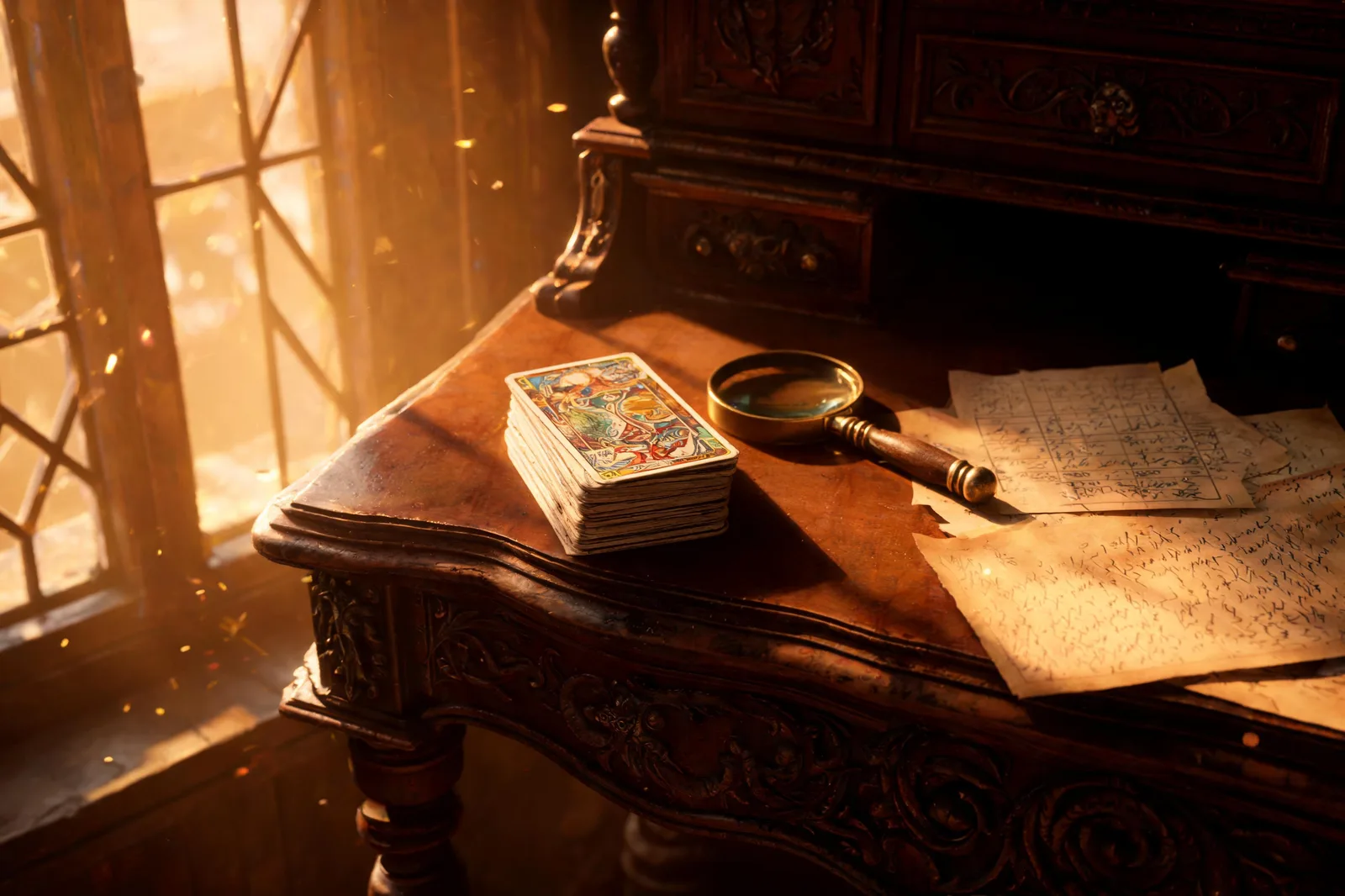
England had no native tarot trade to tax or regulate, unlike the printers discussed through How Playing-Card Taxes Shaped the Tarot, because the country simply did not make tarot decks before the late nineteenth century. Victorian tarot occultists who wanted to study or use the cards had to go looking for them abroad, in a country whose own card-making industry had never bothered with trionfi at all. That gap shaped how the English esoteric revival encountered the tarot, and it is worth tracing before this series reaches the English deck that finally ended the gap.
No deck, no domestic trade
English card manufacturers, taxed and regulated under their own stamp duty system, produced standard fifty-two card packs for whist, piquet and similar games; tarot's extra trumps had no established market across the Channel. When English readers of French esoteric literature, Éliphas Lévi's works especially, wanted a physical deck to study or practise with, they faced a simple problem: nobody in England printed one. The only option was importing a Marseille-pattern or Etteilla-style deck from France, at a time when customs, shipping and limited print runs made this neither cheap nor reliable.
Translation before practice
Interest in the tarot's esoteric reading reached England largely through translation. A. E. Waite, among the most active English-language translators of French occult material, brought Lévi's writing and related continental sources into English years before any homegrown tarot literature existed. This meant English occultists often knew the theory, the correspondences, the Kabbalistic associations, well before most of them had handled an actual tarot deck, let alone a complete, well-printed one. Reading preceded practice for a Victorian audience in a way that was unusual compared with the continental tradition, where decks had circulated freely for generations before anyone wrote extensively about their hidden meaning.
Hand-painted trumps for ritual use
The Hermetic Order of the Golden Dawn, founded in 1888, solved the deck shortage directly: members hand-painted or hand-copied their own sets of trumps for ritual and study, based on continental models but adapted to the order's own attribution system of Hebrew letters, planets and zodiac signs. These working decks were never commercially printed or widely distributed; they existed as practical tools for a small membership engaged in structured, graded study, not as objects intended for a buying public. The practice reflects how differently the Golden Dawn treated the deck compared with the card game context covered through The Tarocchino of Bologna and Its Shortened Deck: these were study aids built for a specific curriculum, not an entertainment product sold through ordinary trade.
Imported decks and private collections
Collectors and occultists able to afford it imported French and Italian decks directly, forming small private collections that occasionally surface in auction records or museum donations today. These imported packs, printed for a continental card-playing public with no awareness of their English afterlife, ended up studied, annotated and sometimes repainted by English owners pursuing an entirely different purpose than the printer had intended. The mismatch between a deck's original commercial purpose and its adopted esoteric use is nowhere clearer than in these imported English collections, where a plain Marseille pattern might carry handwritten Hebrew letters added decades after it left a French workshop.
What victorian tarot occultists actually owned
Surviving inventories and auction catalogues of English occult libraries from this period list tarot material almost entirely as continental imports or manuscript copies, rarely as English-printed decks, since none existed to list. A Golden Dawn member's working set might sit beside a worn Marseille pattern bought from a Parisian dealer and a sheaf of handwritten correspondence tables linking each trump to a Hebrew letter. That combination, foreign print, homemade study material and translated theory, was the normal toolkit for serious tarot study in England for roughly two decades, and it shaped expectations about what an English deck would eventually need to provide.
Waiting for an English deck
This situation persisted for roughly two decades after the Golden Dawn's founding, with serious English tarot study resting on imported cards, hand-painted ritual sets and translated continental theory, but no printed English deck of its own. The gap is why the deck finally produced in London in 1909, discussed next in this series, mattered so much to English readers specifically: it was the first time the country's own publishing trade caught up with decades of accumulated esoteric interest. Background on the wider English occult revival that created this demand is covered in the Wikipedia overview of the Hermetic Order of the Golden Dawn.
A revival that outran its own supply
Victorian tarot occultists built an entire body of theory, ritual practice and Kabbalistic correspondence around a deck that most of them could not easily buy. That mismatch between demand and supply is unusual in the tarot's broader history, where decks were normally printed first and interpreted later. In England, the order ran backward: interpretation arrived through translated French sources years before an adequate domestic deck existed to match it.
Questions
Did Victorian England produce its own tarot decks?
No. English card manufacturers made only standard fifty-two card packs; tarot decks had to be imported from France or Italy.
How did the Golden Dawn use tarot without printed decks?
Members hand-painted or hand-copied their own trump sets for ritual study, adapted to the order's own correspondence system.
Who brought continental tarot theory into English?
A. E. Waite was among the most active translators, bringing Éliphas Lévi's writing to English readers well before an English deck existed.
When did England get its own tarot deck?
Not until 1909, decades after Victorian occultists had already built a developed body of theory around imported and hand-painted cards.
You might also like
 Symbolism
 Symbolism
 Thoth Tarot
© 2026 TAROTS chat (tarots.chat). All rights reserved. No part of this article may be reproduced, distributed or adapted without the owner's written permission.
The Journal
From the Journal
Chosen for this page
 Kabbalah
 Kabbalah
 Thoth Tarot
The 72 Names in the Deck: The Shem Angels and the Decans of the Small Cards
9 min read
More in Thoth Tarot Kabbalah
 Kabbalah
 Thoth Tarot
 Symbolism
 Symbolism
 Kabbalah