Paul Foster Case and the Builders of the Adytum
A Golden Dawn exile builds a mail-order school around hand-painted cards and daily meditation
by Redazione · 9 October 2026 · 4 min read
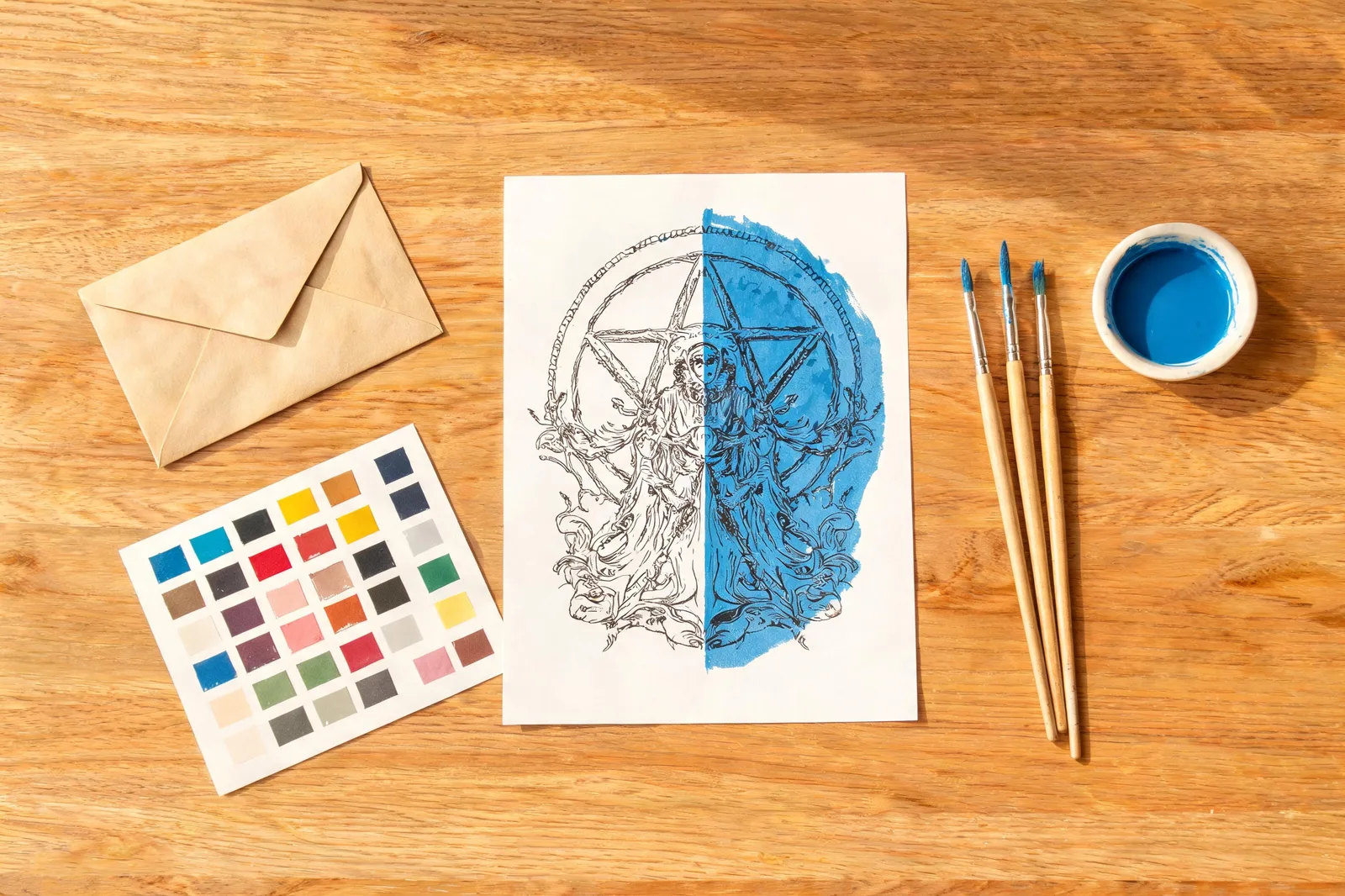
The Builders of the Adytum is the tarot school Paul Foster Case founded in 1922 after he was expelled from the Alpha et Omega, a Golden Dawn successor order, for publishing restricted material. Rather than quietly withdraw from occult teaching, Case built his own correspondence school, designed from the ground up to deliver Golden Dawn-style Kabbalah and tarot instruction by mail to students across the United States.
Case's approach differed sharply from the closed-lodge model he had just left. Where the Golden Dawn and its offshoots guarded their teachings behind oaths and graded initiations held in person, the Builders of the Adytum, often shortened to B.O.T.A., sent structured lessons through the postal service, each one built around meditation on a specific trump. Ouspensky's The Symbolism of the Tarot had already argued the cards belonged to inner work rather than prediction; Case built an entire institution on exactly that premise.
Expelled, then founding his own order
Case trained as a stage magician and musician before his occult career began, and that performer's instinct for clear presentation shows throughout his teaching. He rose quickly within the Alpha et Omega, the American branch descended from the original Golden Dawn, eventually clashing with its leadership over how openly its Kabbalistic and tarot material should be shared. After his expulsion, he spent years refining his own curriculum before formally launching the Builders of the Adytum in Los Angeles.
The split was partly a question of access. Case believed the deeper material, usually kept for advanced initiates only, could be taught responsibly to a wider, carefully guided audience. That conviction shaped every lesson the school later produced.
A deck meant to be hand-painted
The Builders of the Adytum is known as much for its tarot deck as for its lessons. Case commissioned artwork close to the Golden Dawn's own symbolic system, but distributed it as black-and-white line drawings that students were instructed to color in themselves, following a precise, assigned color scale. The act of painting the The Moon by hand, choosing exactly the shade the lesson specified, was treated as part of the instruction itself, not a hobby alongside it.
This hands-on method reflected Case's broader conviction that understanding came through disciplined practice, not passive reading. A student who had personally rendered every color on every trump, he argued, retained the symbolism far more deeply than one who had only read a description of it.
Correspondence courses and meditation practice
B.O.T.A. lessons arrived in a fixed sequence, each pairing a trump with Hebrew letter study, guided meditation instructions and questions the student was expected to answer in writing before advancing. This structured, cumulative method echoed the step-by-step teaching style Papus had pioneered decades earlier, though Case added a strong emphasis on daily meditative practice absent from Papus's more purely intellectual curriculum.
Case also tied the trumps closely to Qabalistic pathworking, treating each card as a doorway onto a specific path of the Tree of Life. Students were encouraged to visualize themselves entering the scene of a card, engaging with its figures, rather than simply observing the image from outside.
A living school, still teaching today
Unlike several of the schools this series has covered, the Builders of the Adytum still operates, continuing to send correspondence lessons and maintain study groups descended from Case's original structure. Its survival across a full century testifies to how durable a correspondence model can be when paired with disciplined, repeatable practice rather than charismatic leadership alone.
Case's own writing, especially his book on Qabalistic tarot correspondences, remains in print and continues to shape how English-speaking students approach the hand-colored, Golden Dawn-derived image of the deck. Readers curious about his life can consult the English Wikipedia entry on Paul Foster Case, which covers his expulsion and the school he built afterward.
FAQ
Why was Paul Foster Case expelled from the Alpha et Omega? He was expelled for sharing restricted Golden Dawn material too openly, a dispute over access that led him to found his own teaching order.
Do Builders of the Adytum students really color their own cards? Yes. Students receive line drawings and are instructed to paint them using a specific assigned color scale as part of the lesson itself.
Is the Builders of the Adytum still active? Yes, it continues to operate correspondence courses and study groups descended from Case's original curriculum.
How does B.O.T.A. differ from the Golden Dawn it descended from? It replaced closed, in-person lodge initiation with structured mail-order lessons, aiming to teach similar Kabbalistic and tarot material to a wider audience.
Questions
Why was Paul Foster Case expelled from the Alpha et Omega?
He was expelled for sharing restricted Golden Dawn material too openly, a dispute over access that led him to found his own teaching order.
Do Builders of the Adytum students really color their own cards?
Yes. Students receive line drawings and are instructed to paint them using a specific assigned color scale as part of the lesson itself.
Is the Builders of the Adytum still active?
Yes, it continues to operate correspondence courses and study groups descended from Case's original curriculum.
How does B.O.T.A. differ from the Golden Dawn it descended from?
It replaced closed, in-person lodge initiation with structured mail-order lessons, aiming to teach similar Kabbalistic and tarot material to a wider audience.
This article talks about
You might also like
 Symbolism
 Symbolism
 Symbolism
© 2026 TAROTS chat (tarots.chat). All rights reserved. No part of this article may be reproduced, distributed or adapted without the owner's written permission.
The Journal
From the Journal
Chosen for this page
 Cups
 Kabbalah
 Kabbalah
The Thirty-Two Paths of Wisdom: Ten Spheres and Twenty-Two Letters
5 min read
More in Kabbalah Spirituality
The Tower Tarot in Spiritual Awakening: Destruction, Revelation and Liberation
2 min read
More in Spirituality Symbolism
 Kabbalah
 Symbolism
 Symbolism
 Kabbalah