Thaumiel to Lilith: The Ten Shells Against the Ten Sephiroth
by Redazione · 9 October 2026 · 4 min read
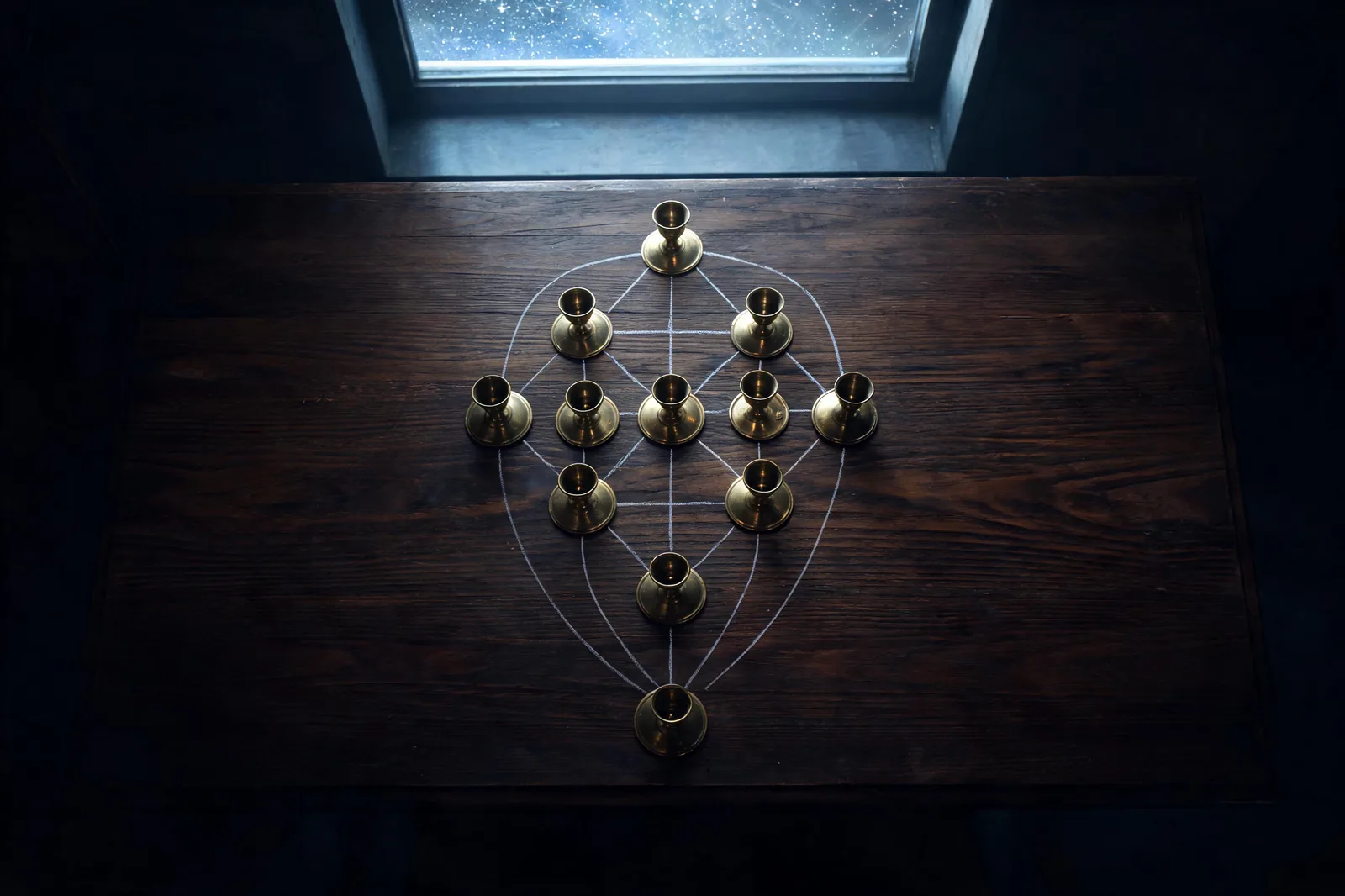
The ten qliphoth, as the Golden Dawn and later Crowley's own correspondence tables recorded them, run Thaumiel to Lilith, one shell set against each sefirah on the Tree of Life. This part of the series lays out the list plainly, the way it appears in the sources, after the careful distinction this series drew in Reversed Cards and the Qliphoth: A Careful Reading between structural study and dramatic shorthand.
A list compiled late, not inherited whole
Tradition holds that the ten names below circulated in various forms among Christian Cabalists and earlier grimoire writers before the Golden Dawn organized them into a single symmetrical table matched against the sefirot. Crowley's own 777 reproduces a version of the list with minor spelling variants from the Golden Dawn's internal papers, a reminder that this is a compiled, standardized table rather than a single ancient source transmitted unchanged. Readers who meet slightly different spellings across different books are seeing that same compilation history, not a contradiction.
Thaumiel, Ghagiel and Satariel: the supernal shells
Thaumiel, "the duads" or "twin contending powers," sits against Kether, suggesting unity split into opposing duplicates rather than simple absence. Ghagiel, against Chokmah, and Satariel, against Binah, round out the supernal triad's shadow: tradition describes them as obstruction and concealment, the Supernal's clarity and structure turned static rather than generative. These three rarely appear in ordinary tarot commentary, since the supernal sefirot themselves sit largely outside everyday reading practice.
Gash'kalah to Tagiriron: the shells of the middle pillar's flanks
Gash'kalah, opposite Chesed, and Golachab, opposite Geburah, describe mercy curdled into indulgence without limit and severity curdled into cruelty without proportion, mirroring the classic tension between those two sefirot in ordinary Golden Dawn teaching. Tagiriron, opposite Tiphareth, names a shell of disputation and self-division, a notable shadow for the sefirah the Golden Dawn associated with harmonized beauty and balance. The Tower sits on a path near Geburah in standard attribution, which is part of why commentators have long paired the Tower's sudden collapse with Golachab's description of severity without restraint.
Harab Serapel and Samael: victory and glory's shadow
Harab Serapel, opposite Netzach, and Samael, opposite Hod, describe excess devotion and corrupted intellect respectively, tradition's way of naming what happens when victory's passion or splendour's cleverness loses its counterweight. Samael's name reaches back furthest among this list into older Jewish demonological literature, long before Lurianic Kabbalah existed, which likely explains why it reads as more fully formed than some of its neighbors on the table.
Gamaliel and Lilith: the shells nearest ordinary experience
Gamaliel, opposite Yesod, and Lilith, opposite Malkuth, sit closest to the everyday and material end of the Tree, and for that reason appear most often in later popular writing. Lilith in particular carries a long separate literary history, from ancient Mesopotamian demon-lists through medieval Jewish folklore to her qliphothic role here, and conflating those earlier, unrelated figures with the Golden Dawn's specific tenth-shell correspondence is a common and avoidable error. The tenth shell's name borrows an older figure; it does not simply continue her story unchanged.
Why the list matters more as structure than catalog
Reading these ten names as a structural chart, a shadow index running alongside the sefirot rather than a roster to memorize for its own sake, keeps the material inside the purpose this series has argued for throughout: understanding how the Tree's builders thought about imbalance, not building a working relationship with ten independent powers. A reader who wants the fullest documented version of this table in English can consult Crowley's own published correspondence tables, still in print and widely available: 777 and Other Qabalistic Writings of Aleister Crowley.
From the full table to a single card
Having the whole table laid out makes it possible to look closely at one card the qliphothic tradition returns to constantly: The Devil, sitting on the path the Golden Dawn attributed near Samael and Gash'kalah's territory. The next part of this series takes that single card and asks what its qliphothic associations actually claim, and what they do not.
Questions
What are the ten qliphoth called?
In Golden Dawn and Crowleyan sources, running from Kether to Malkuth: Thaumiel, Ghagiel, Satariel, Gash'kalah, Golachab, Tagiriron, Harab Serapel, Samael, Gamaliel and Lilith.
Is this list an ancient, unchanged tradition?
No. Tradition holds that the names circulated in varying forms before the Golden Dawn compiled them into one symmetrical table; spelling and detail vary between sources.
Is the qliphothic Lilith the same figure as older Lilith folklore?
She shares a name and some imagery with much older Mesopotamian and Jewish folklore, but the tenth-shell correspondence is a specific, later Golden Dawn attribution, not a direct continuation of those earlier stories.
Why study the ten qliphoth as a table rather than individually?
Because the list works as a structural shadow-index of the sefirot, showing how the Tree's builders thought about imbalance, rather than as ten separate entities to engage with on their own.
This article talks about
You might also like
 Kabbalah
 Kabbalah
 Kabbalah
© 2026 TAROTS chat (tarots.chat). All rights reserved. No part of this article may be reproduced, distributed or adapted without the owner's written permission.
The Journal
 Tarot Journal
 Symbolism
 Thoth Tarot
 Major Arcana
 Cups
 Thoth Tarot
 Symbolism
 Symbolism
 Kabbalah