Florence Farr: Actress, Adept and Golden Dawn Leader
The stage actress who ran the Isis-Urania Temple
by Redazione · 9 October 2026 · 5 min read
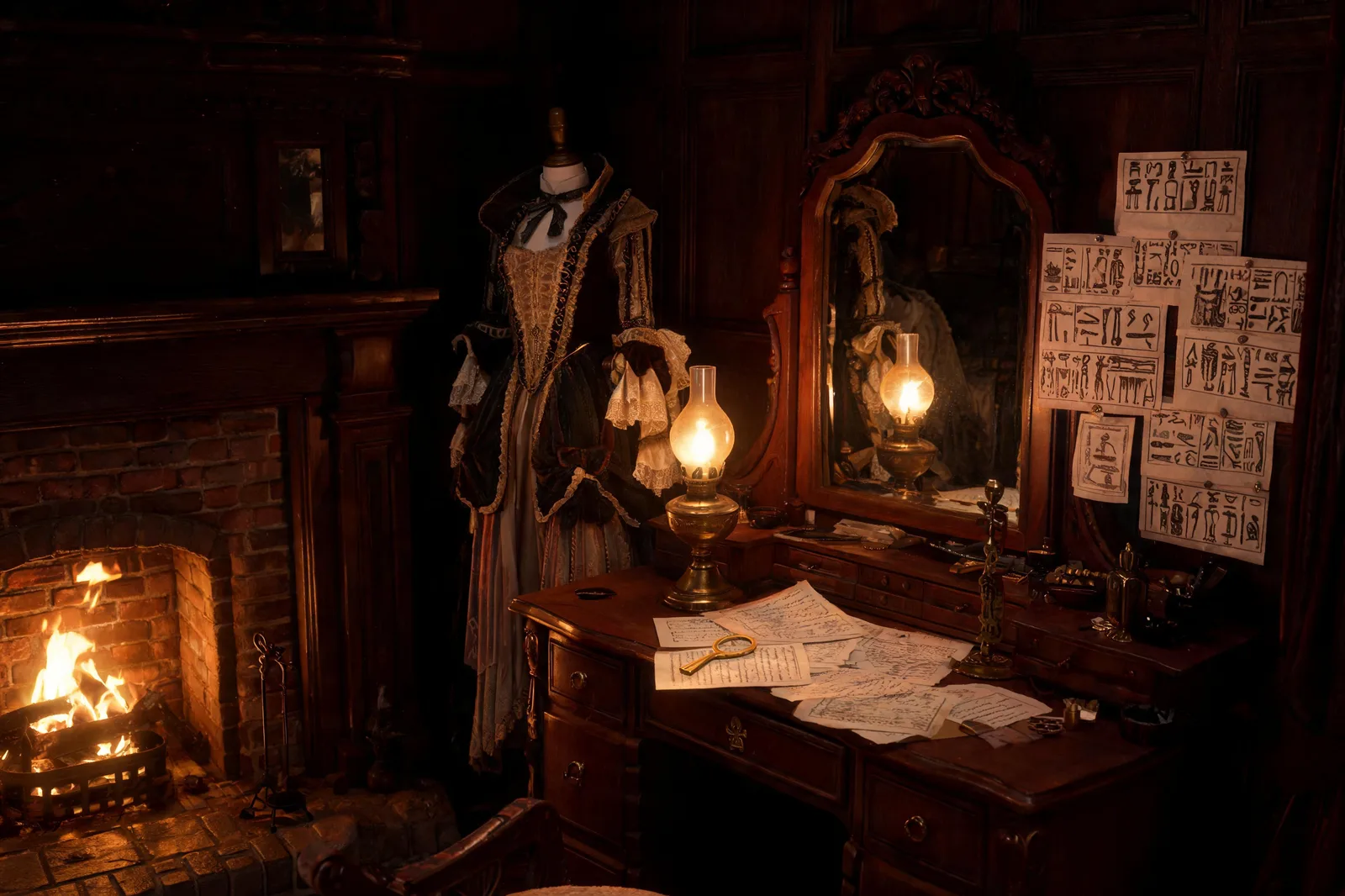
Florence Farr stood at the center of the Hermetic Order of the Golden Dawn for nearly a decade, and few members did more to shape how the order actually ran. An actress by trade, she brought stagecraft, discipline and a sharp intellect to a group that often ran on enthusiasm alone. Her story matters to any reader of the Thoth tradition, because the ritual structure Crowley and Harris later inherited passed through her hands first.
Farr was born in 1860 and trained for the stage in London, where she worked with George Bernard Shaw and became a visible figure in the "New Woman" circles of the 1890s. She joined the Golden Dawn's Isis-Urania Temple in 1890, drawn by the same appetite for self-discipline that drove her acting career. Within a few years she had advanced further and faster than almost anyone outside the order's founders, Mathers, Westcott and Woodman, whose own roles are traced in Mathers, Westcott and Woodman: Who Built the Golden Dawn Tarot.
Chief Adept of Isis-Urania
By 1894 Farr held the office of Praemonstratrix. When Samuel Liddell Mathers relocated to Paris, she effectively ran the London temple in his place. She corresponded with him by letter and carried his instructions back to the membership. This was unusual authority for a woman in occult London, and it was earned rather than given. She had passed through the grades, written her own papers on Egyptian religion, and could lead a ceremony competently, which was not true of every officer in the Order.
Her scholarship leaned toward Egypt rather than the Hebrew Qabalah that dominates the Golden Dawn's written curriculum. She corresponded with Egyptologists, studied mummy inscriptions at the British Museum, and published Egyptian Magic in 1896, arguing that the ancient rites still had living force. Readers of the Thoth deck meet this same Egyptian layer constantly: The Priestess draws on Isis imagery that Farr would have recognised instantly, and her private group experimented with what she called "Egyptian evocation," distinct from the Enochian work Mathers preferred.
The Sphere Group and private research
Frustrated by how little original research the wider membership produced, Farr formed a smaller circle around 1900, sometimes called the Sphere Group, to pursue her own astral and Egyptian experiments outside the main temple structure. Tradition holds that this group tested visualisation techniques later folded into Golden Dawn teaching on the godforms, though the surviving record is thinner than for the order's official rituals. The group's existence shows a pattern worth noting: the Golden Dawn's most durable techniques often began as one adept's private project before becoming common property.
Farr's authority was tested directly during the crisis years around 1900. Mathers's conduct, and disputed claims about the Cipher Manuscripts, had split the order badly by then. Farr sided against Mathers in the dispute that led to the events later known as The Battle of Blythe Road: Golden Dawn Members Fight for a Vault. She did not take Crowley's side either. Once the fighting was over, the London temple fractured into rival successor groups, and she never regained the single, settled leadership she had held through the 1890s. Younger members who had looked to her for guidance, including some who would later carry Golden Dawn teaching into the twentieth century, were left to rebuild the order's structure without her at its head.
Leaving London for Ceylon
Farr's later life moved away from ceremonial magic almost entirely. After her occult circle dissolved into smaller successor groups, she accepted a post as headmistress of Ramanathan College for girls in Jaffna, Ceylon, in 1912, teaching under the Hindu philosopher Ponnambalam Ramanathan. She died there in 1917 of breast cancer, a long way from the Golden Dawn temples of London, and her correspondence from those final years shows a woman more interested in Vedanta than in Egyptian ritual.
That trajectory, from stage actress to Chief Adept to colonial schoolmistress, is easy to flatten into a single theme, and the honest position is to resist that: Farr's own writing suggests she kept revising her commitments rather than settling into one identity.
Why Florence Farr still matters to a Thoth reader
The Golden Dawn curriculum she helped administer is the direct ancestor of the system Crowley used to build the Thoth deck with Lady Frieda Harris. When a reader works the elemental grade structure behind the suit cards, or studies The Magus as a portrait of the will in action, they are using material that passed through Farr's hands at Isis-Urania before it reached Crowley at all. She left no deck of her own and few tarot writings specifically, which is part of why her name surfaces less than Mathers's or Crowley's. The administrative backbone of the order, the one that actually trained people to run rituals competently rather than merely talk about them, owed a great deal to her decade of work. It is a quieter kind of legacy than a published grimoire, but it is no less real for being quiet: ritual competence has to be taught by someone, and for Isis-Urania that someone was usually Farr.
Biographers still disagree about details of her private life and the exact membership of the Sphere Group, so claims beyond the documented record are worth treating as provisional. For a fuller account of her career, the Florence Farr entry on Wikipedia gathers the primary sources. What is not in doubt is the scale of her responsibility: for several years, one of the most influential magical orders in English history ran on the judgment of a working actress who had never set out to lead one.
Questions
What role did Florence Farr hold in the Golden Dawn?
She rose to Praemonstratrix and effectively led the Isis-Urania Temple in London after Mathers moved to Paris, corresponding with him while running ceremonies herself.
Did Florence Farr write about tarot specifically?
Not directly. Her main published work, Egyptian Magic (1896), focused on Egyptian ritual rather than the cards, though her research shaped the order's wider symbolism.
What was the Sphere Group?
A smaller circle Farr formed around 1900 for her own astral and Egyptian experiments outside the main temple structure; the surviving record of its work is incomplete.
How did Florence Farr's life end?
She left occult London in 1912 to become headmistress of a girls' college in Ceylon and died there in 1917.
This article talks about
You might also like
 Thoth Tarot
 Thoth Tarot
 Thoth Tarot
© 2026 TAROTS chat (tarots.chat). All rights reserved. No part of this article may be reproduced, distributed or adapted without the owner's written permission.
The Journal
From the Journal
Chosen for this page
 Disks
 Career
Ace of Swords Tarot Meaning: Clarity, Breakthrough and Mental Power at Work
3 min read
More in Career Kabbalah
 Major Arcana
 Kabbalah
 Kabbalah
 Symbolism
 Symbolism
 Kabbalah