Pico della Mirandola and the Birth of Christian Cabala
by Redazione · 9 October 2026 · 4 min read
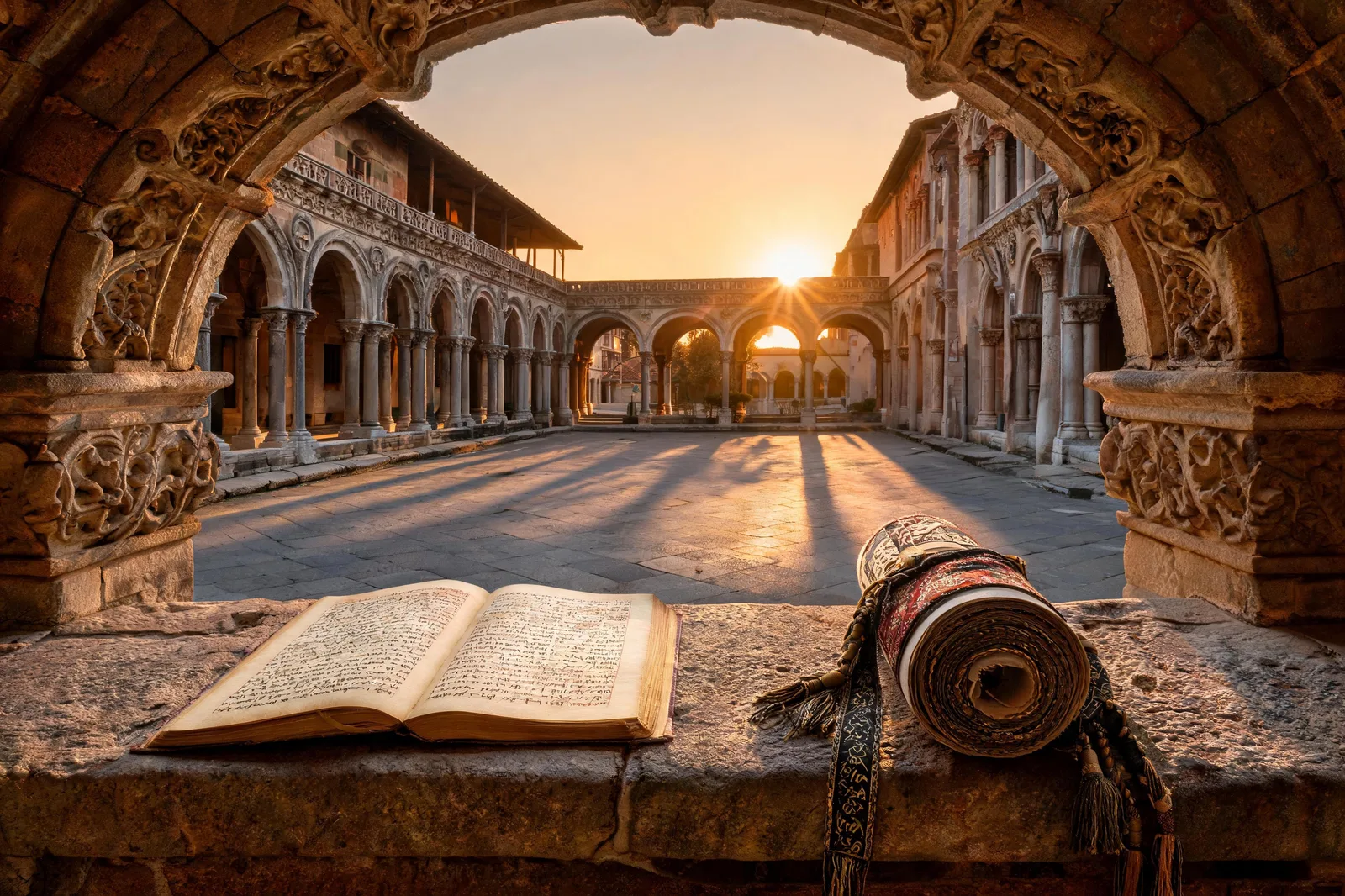
Pico della Mirandola gave Christian Cabala its first confident voice. In 1486, the young Italian nobleman drafted nine hundred theses for public debate in Rome, and among them stood a bold claim: that Kabbalah, properly read, confirmed the truth of Christianity. Kabbalah and Christian Cabala: Two Different Traditions introduced the broader distinction between that Renaissance project and the Jewish tradition it drew from. This article looks at the man who started it, and at what he actually did with the Hebrew sources he found.
A prodigy with too many interests
Giovanni Pico della Mirandola was born in 1463 into a noble family near Modena. By his twenties he had studied in Bologna, Ferrara, Padua, and Paris, reading Latin, Greek, Arabic, and Hebrew. He wanted to reconcile every philosophical and religious system he encountered — Platonism, Aristotelianism, Islamic philosophy, and Kabbalah — into a single harmonious truth. This ambition produced his Oration on the Dignity of Man, still read today as an early statement of Renaissance humanism, and the nine hundred theses, which the Church ultimately condemned in part, forcing Pico to flee Rome for a time.
Learning Kabbalah secondhand
Pico could not read Hebrew well enough on his own to work through Kabbalistic texts unaided. He relied on translations and teaching from Jewish converts to Christianity, most notably Flavius Mithridates, who rendered a large body of Kabbalistic material into Latin for him. This detail matters: Pico's Kabbalah arrived already filtered through a convert's choices about what to translate and how to gloss it, shaped by that convert's own break with Jewish community and practice. What Pico then built from those translations was his own synthesis, not a transmission of the tradition as Jewish scholars understood it.
The claim that Kabbalah proves Christianity
Pico's theses argued that correct Kabbalistic interpretation of the Hebrew Bible revealed Christian doctrines — the Trinity, the divinity of Christ — hidden within it. He treated the sefirot as a kind of coded anticipation of Christian theology, available to anyone who learned to read Hebrew letters the way he proposed. This was a serious claim for Pico, made in good faith by his own lights, but it was also an act of appropriation: it took a living Jewish discipline, stripped it from its practitioners and their own interpretive authority, and redeployed it to argue for a faith most of those practitioners did not hold and, in some periods, faced violent pressure to adopt. Tradition in later scholarship generally treats this as the founding move of Christian Cabala as a distinct current, separate from Kabbalah itself.
What came after Pico
Pico's theses circulated widely despite the papal condemnation, and they set a template other Christian scholars followed for the next two centuries. The Hierophant later became a convenient visual anchor for occultists building on this template, its imagery eventually paired with Hebrew letters by thinkers working far outside any Jewish interpretive community. The next article in this series turns to one of those successors, Johannes Reuchlin, whose De Arte Cabalistica pushed Pico's project further and shaped how Western occultists would later read Hebrew sources. For Pico's own biography and the controversy around his theses, the Pico della Mirandola entry on Wikipedia covers the Roman debate and its aftermath in useful detail.
A caution worth repeating
None of this means Pico acted with hostility. He seems to have believed sincerely that he was honoring Kabbalah by finding Christian truth inside it. But sincerity does not erase the effect: a non-Jewish scholar, working from secondhand translations, repurposed a Jewish tradition's vocabulary for an argument its own community never made and would not have endorsed. Readers encountering the tarot's Hebrew letter correspondences today are, whether they know it or not, standing at the far end of a chain that starts here, with Pico's theses in 1486 — four centuries before the Golden Dawn ever drew a Tree of Life diagram next to The Magus.
Questions
What did Pico della Mirandola claim about Kabbalah?
In his 1486 theses, Pico argued that Kabbalah, correctly interpreted, confirmed core Christian doctrines such as the Trinity, launching what scholars call Christian Cabala.
Did Pico read Hebrew Kabbalistic texts himself?
Only partly. He depended heavily on Latin translations and teaching from Flavius Mithridates, a Jewish convert to Christianity, which shaped what sources reached him and how.
Was Pico's reading of Kabbalah accepted by Jewish scholars?
No. It was a Christian theological reinterpretation built outside Jewish interpretive authority, not a continuation of Kabbalah as practiced within Jewish communities.
How does Pico connect to the tarot?
His template of reading Hebrew letters as hidden Christian or universal truths shaped centuries of later Western occultism, including the Hebrew-letter correspondences occultists later added to the tarot trumps.
This article talks about
You might also like
 Kabbalah
 Symbolism
 Kabbalah
© 2026 TAROTS chat (tarots.chat). All rights reserved. No part of this article may be reproduced, distributed or adapted without the owner's written permission.
The Journal
 Spirituality
 Thoth Tarot
 Love
 Kabbalah
 Kabbalah
 Love
 Symbolism
 Symbolism
 Kabbalah