What a Reader of Thoth Inherits: The Letter on Each Trump
by Redazione · 7 October 2026 · 9 min read
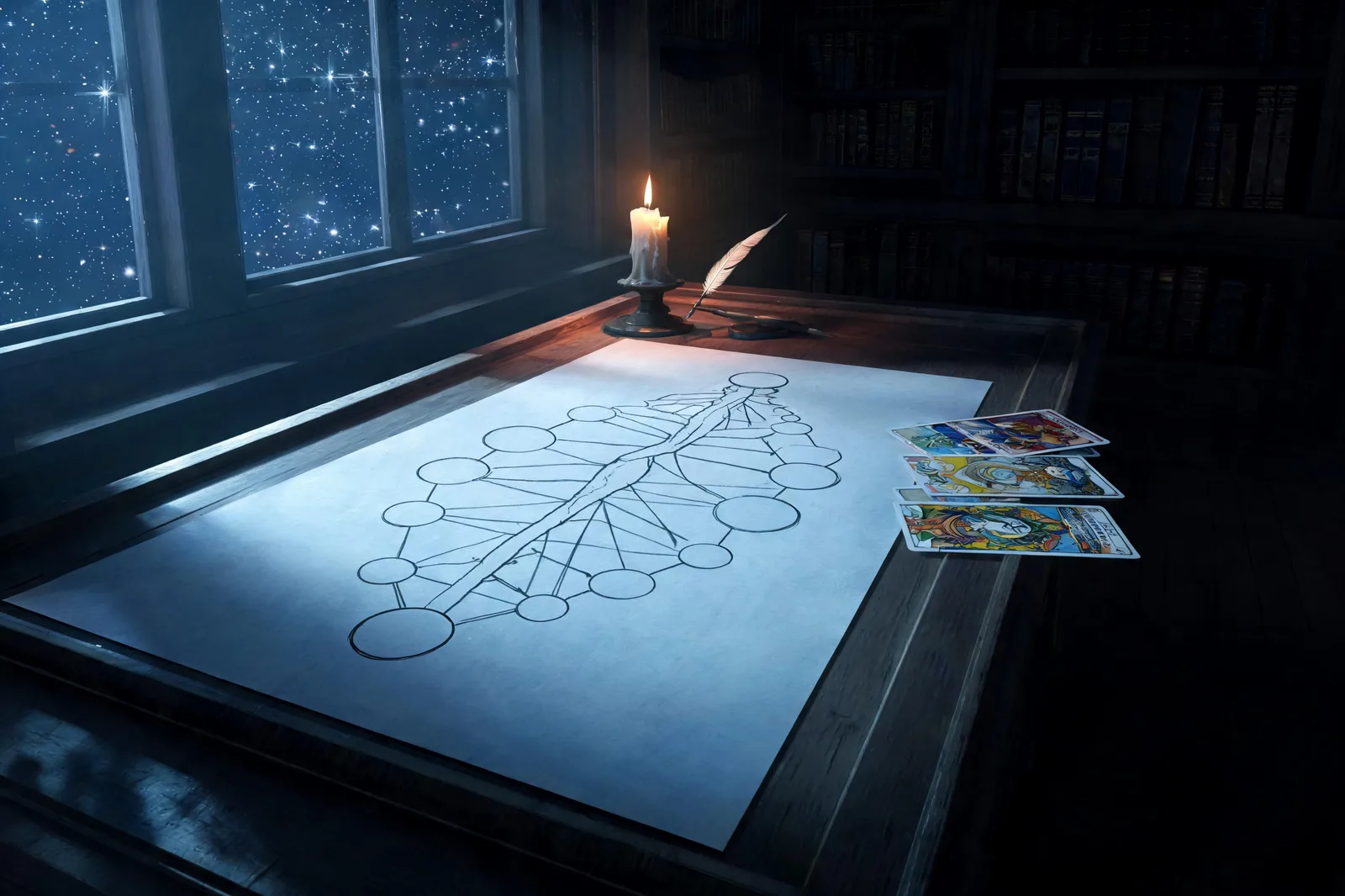
Three parts in this series have done the same job from different angles. Part one showed that the letter tree of the Sefer Yetzirah is two texts, not one. Part two laid the three trees of Kircher, the Gra and Luria side by side and showed that they disagree on the letter on every path. The thoth tarot letter attributions, which this last part settles, are the end point of the argument, the place where the three trees stop being a dispute and become cards in your hand. Part three, in Levi's Letters Versus the Golden Dawn: Why They Disagree, showed that the Golden Dawn did not copy Lévi so much as re-sort him, and that the table under a Rider-Waite-Smith deck is a choice.
What the three trees left behind
The short answer to the series' thesis is this. There is no single correct letter for the Fool, and there never was. There is a family of letters, each one the output of a different reading of the Sefer Yetzirah, and the deck you own is whichever one of those readings its maker inherited. The Golden Dawn inherited a fixed alphabetical order and standardized it into a table. Crowley inherited the same table through the Golden Dawn, and then changed it. So the question is not "which letter is the Fool." The question is "whose Fool is it."
That matters in a reading because the letter is not a label stuck to the card. In the system the trumps are the letters. The twenty-two trumps are the twenty-two paths on the tree of life, and each path carries a letter, an element, a planet or sign, and a number. When a reader says the Fool is Aleph, they are not naming the card. They are naming the path from Kether to Chokmah, the element air, the first letter, and the idea that the Sefer Yetzirah attaches to it. The card is the handle. The letter is the substance. So two decks that both call a card "the Fool" can be carrying two different paths, two different letters, and two different meanings underneath the same picture.
The thoth tarot letter attributions, in one table
The Thoth table is the Golden Dawn table with two deliberate corrections. Crowley kept the alphabetical backbone. Aleph is still the Fool, path eleven, Kether to Chokmah, air. Beth is the Magician, path twelve, Kether to Binah. Gimel is the High Priestess. The sequence runs down the trumps the same way it ran under Regardie. But at two points Crowley broke the order, and those two breaks are the whole signature of the deck.
The first break is the pair at the top. In the Golden Dawn order the letter He goes with the star, and Tzaddi goes with the Emperor. Crowley reversed it. The Thoth deck attaches Tzaddi to the Emperor and He to the star. The reason he gives is simple and honest. He says that Tzaddi "just would not feel right" with the star, and that he put it where it belonged to him, on the Emperor, as the full Thoth correspondence table records (the Thoth Tree of Life correspondence table). This is not a scholarly correction drawn from a manuscript. It is a judgment call, made by a person, on the question of which letter means what.
The second break is the swap of the middle trumps. The Golden Dawn order places Strength as eight and Justice as eleven. Crowley reversed the two. In the Thoth deck the card at eight is the strength figure, and the card at eleven is the justice figure. He did this because he read the two letters and the two pictures and decided they were mismatched in the inherited table, and he put them where they fit. So when you pull "the strength card" from a Thoth deck you are pulling a different letter from the one you would pull from a Rider-Waite deck, and it sits on a different path of the tree.
Crowley is explicit that this is a recovery, not an invention. In the theory section of the Book of Thoth he writes that as soon as one possesses the true attributions of the trumps, "the Tarot leaps into life," and that all the difficulties created by the traditional attributions disappear (Crowley, The Book of Thoth, "Theory of the Tarot," Part I.2). He also writes that Lévi's wrong attribution was deliberate, that Lévi knew the right one and concealed it, with the single exception of Tzaddi, which even he could not place. So the Thoth table is a third position in the family. It is the Golden Dawn order, with the two letters Crowley thought were out of place moved to where their meaning said they belonged.
Where the choice shows up in a reading
A reader who does not know this will read the same picture from two decks and get two different answers, and not know why. That is the whole of the dispute from part three, now inside a single spread. The broader question of how the deck became Kabbalistic at all is laid out in Tarot and Kabbalah: How the 22 Trumps Became the Hebrew Letters. Take the star. In a Rider-Waite reading the star carries the letter He, the fifteenth path, Chokmah to Tiphareth, the air element, the sign of Aquarius in the standard table, the idea of the great mother, the open hand of hope. In a Thoth reading the star carries the same letter, He, but Crowley has read it as the supernal He, the letter of Nuit, the mother of the stars, and the picture is built to that reading. The letter is the same, but the meaning attached to it is Crowley's, and the card is painted to match him, not to Regardie.
Take the Emperor. In the Golden Dawn table the Emperor carries Tzaddi. In the Thoth table the Emperor still carries Tzaddi, and that is exactly the point, because Crowley moved Tzaddi onto the Emperor rather than leaving it on the star. The Emperor in Thoth is therefore the card where Crowley's correction is most visible. If you are reading a Thoth deck and the Emperor comes up, you are reading Tzaddi in Crowley's hands, with his meaning, his planet, his path. If you are reading a Rider-Waite deck and the Emperor comes up, you are reading the same letter in the Golden Dawn's hands, with its meaning. Same letter, different master.
And take the two middle trumps. A reader pulling eight from a Thoth deck gets the strength figure, the lion, the woman holding the sword. A reader pulling eight from a Rider-Waite deck gets the same picture, and in most of them the same meaning. But a reader pulling eleven from a Thoth deck gets the justice figure, the seated judge, and a reader pulling eleven from a Rider-Waite deck gets the strength figure. The numbers are the same. The pictures are swapped. The letter on each one is therefore in a different place on the tree, and the meaning that follows from the letter is in a different place with it. Two decks, the same two pictures, a different letter on each, a different reading of each.
Why none of this is a typo
It is tempting to treat these differences as a matter of one author being right and the others wrong, and to look for the single manuscript that settles it. The series has now shown, across four parts, that there is no such manuscript. The Sefer Yetzirah itself does not assign the letters to the trumps, because the trumps did not exist when it was written. Kircher drew his tree from a Jesuit reading of the Kabbalah in the seventeenth century. The Gra drew his from the Lurianic reading in the eighteenth. The Golden Dawn printed a fixed order in the late nineteenth. Crowley corrected two letters in the early twentieth. Each is a choice. Each is internally consistent. None of them is the original.
So the honest reading of the thoth tarot letter attributions is this. They are Crowley's. They are the Golden Dawn table with the two letters Crowley thought were out of place put back where their meaning said they should be, and they are the most deliberate of all the tables because he said so in the book that came with the deck. If you want the letter a particular trump carries, you have to know which deck you are reading, and then you know which of the four positions in the family you are holding. The Fool is Aleph in all of them. The star is He in all of them, but read differently in each. The Emperor is Tzaddi in all of them, and in Crowley's hands it is where he wanted it. The eight and the eleven are the same two pictures in every deck, and in every deck they carry the same two letters, and in the Thoth deck those two letters are on the opposite pictures from the ones you would expect.
That is the end of the series. The Sefer Yetzirah does not agree with itself, because it is not one text. The tree of life is not one tree, because it is a family of them. The letters on your trumps are not a fact you look up, they are an inheritance you hold, and the deck in your hand is the one whose maker made the choice you are now living with. When you cut a card you are not reading the letter. You are reading the letter as one person chose to read it, and the rest is the story of who that person was.
Questions
Which letter is the Fool in the Thoth deck?
Aleph, the first letter, on the eleventh path from Kether to Chokmah, the element air. The Fool keeps the same letter in every version of the table; it is the one card no one has ever moved.
What did Crowley change from the Golden Dawn table?
Two things. He put the letter Tzaddi on the Emperor instead of the Star, and he swapped the two middle trumps, putting the strength figure at eight and the justice figure at eleven, the reverse of the Golden Dawn order.
Why is the Emperor the card where the correction is most visible?
Because Crowley moved Tzaddi onto the Emperor deliberately, on the grounds that it would not feel right on the Star. The Emperor in Thoth is therefore the card that carries Crowley's own judgment, with his meaning and his path, rather than the inherited Golden Dawn placement.
Are the letters on my cards a fact I can look up?
No. The Sefer Yetzirah does not assign letters to trumps, because the trumps did not exist when it was written. Each deck is one person's reading of the letters, and the deck in your hand is the one whose maker made the choice you are now living with.
Does this matter if I only read the pictures?
Yes, if you read the same picture from two different decks. The star carries the same letter in both, but Crowley read it as the supernal He, the letter of the stars, and painted the card to match him. Same letter, different master, different reading.
- #golden dawn
- #kabbalah
- #series-the-three-trees-why-the-sefer-yetzirah-does-not-agree
- #tarot history
- #tarot symbolism
You might also like
 Kabbalah
 Kabbalah
 Kabbalah
© 2026 TAROTS chat (tarots.chat). All rights reserved. No part of this article may be reproduced, distributed or adapted without the owner's written permission.
The Journal
 Kabbalah
 Thoth Tarot
 Symbolism
 Thoth Tarot
 Thoth Tarot
 Thoth Tarot