Kircher's Tree, the Gra's Tree, Luria's Tree
by Redazione · 7 October 2026 · 10 min read
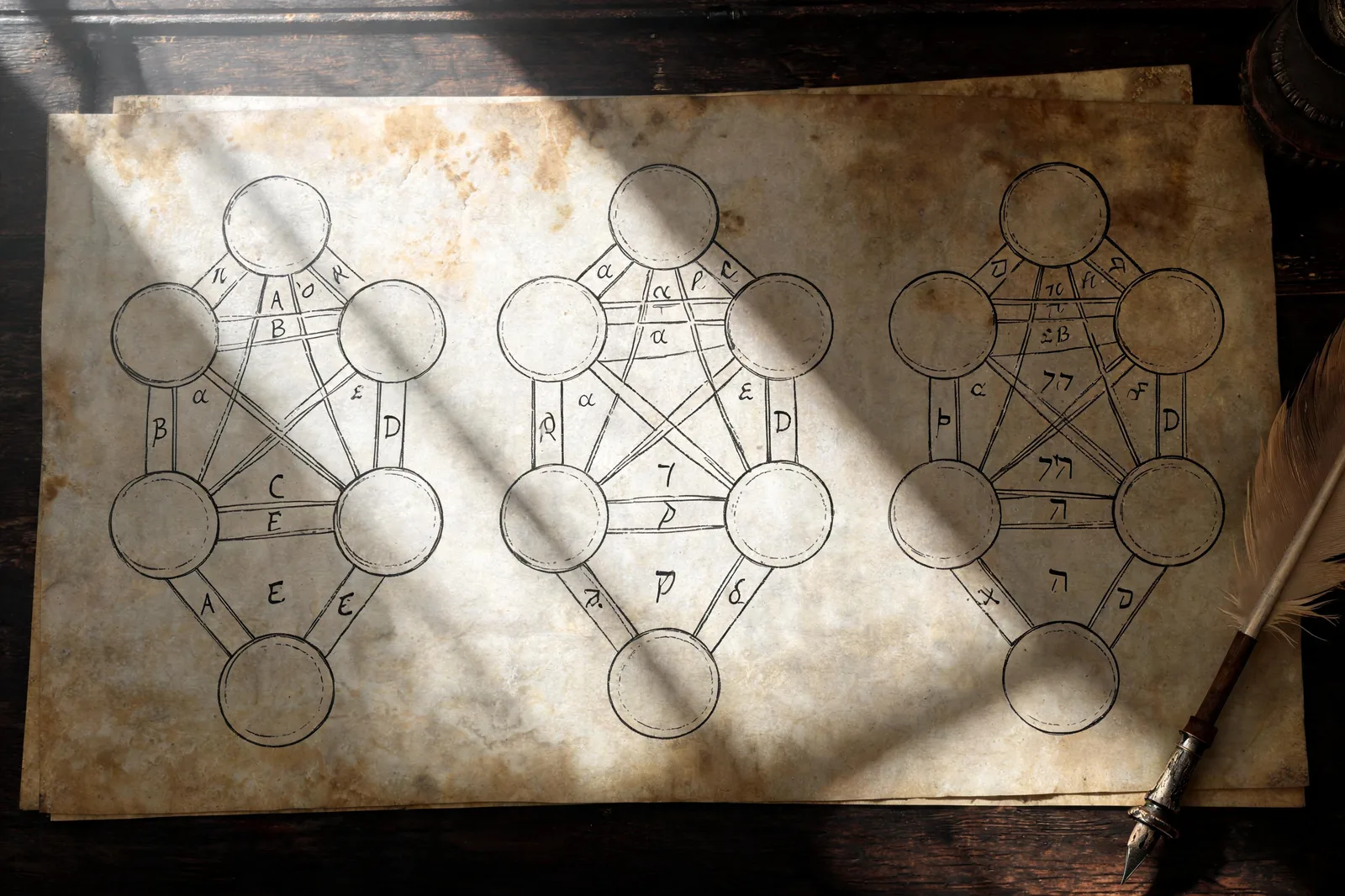
Three trees, one question
Part one of this series established that the 22 letters arrive on the deck through the Sefer Yetzirah, and that the book itself has no single accepted text. It also ended on a claim that deserves testing. The tree of life versions kabbalah actually produced are not one diagram but a family of diagrams, and the deck you hold is one of them. The three trees that matter most are the Kircher tree, the Gra tree and the Lurianic tree. They agree on the number of nodes and the number of paths. They do not agree on what sits on the paths, in what order, or which letter belongs to which connection. The Golden Dawn picked one. This article shows how the three differ, and why the disputes you have read in every tarot forum are really disputes about which of the three you inherited.
The tree had a history before it had a shape
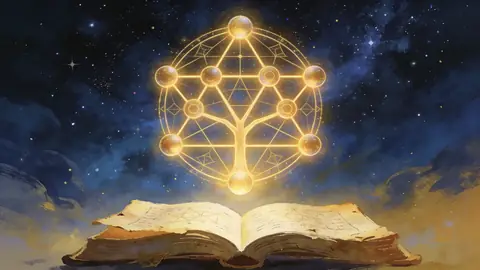
The tree of life as a diagram is not as old as the letters. The Sefer Yetzirah, which is probably the oldest of the texts we are discussing, describes the ten sefirot and the twenty-two letters as the thirty-two paths of wisdom, but it does not give you a picture to hang on the wall. The earliest Hebrew kabbalistic manuscripts that survive from the late 13th century do contain diagrams, including one labelled Tree of Wisdom. The now-iconic shape, the ten circles in three columns joined by twenty-two lines, only emerges during the fourteenth century. The full history, from the 13th-century manuscripts to the 1516 Porta Lucis cover, is laid out in the Wikipedia article on the tree of life in Kabbalah.
The first printed appearance of that iconic shape is on the cover of the Latin translation of the Gates of Light, the Porta Lucis, in 1516. Scholars trace the art of that cover to Johann Reuchlin, the German humanist who had been working on the Kabbalah in the early 1500s. From Reuchlin the diagram passes into the 16th-century German and Latin Kabbalah, and from there it reaches the Jesuit Athanasius Kircher. That is the Kircher tree, and it is the tree that most of the early Western esoteric tradition actually saw, because Kircher was the most widely read Kabbalist of the 17th century.
The tree of life versions kabbalah drew, and the 32 paths they disagree on
The three trees named in this series are not three different books. They are three different redactions of the same underlying system, each carrying a different set of letter assignments. The Lurianic tree is the tree of Isaac Luria and his Safed school. It is the tree the Zohar describes, and it is the one the Golden Dawn inherited. The Gra tree is the Vilna Gaon's redaction of the Lurianic text, the ARI-Gra version that part one described. The Kircher tree is the diagram Kircher drew and printed, the one that reached the West through his books and his museum.
The difference between them is not decorative. It is structural. Rawn Clark, in his essay on the 32 Paths of Wisdom, lays out the two trees side by side and counts the points of agreement. The Hebrew tree, the one that followed the strict rules of the Sefer Yetzirah, and the Western Hermetic tree, the one the Golden Dawn used, agree on only three of the thirty-two paths at the level of paths to letters. Paths one, fourteen and thirty-two. That is the whole set of overlaps. Everything else is different.
The 32 paths, read two ways
The concept of the thirty-two paths does not come from the Sefer Yetzirah at all. It comes from Genesis chapter one, where the name Elohim appears thirty-two times. The document usually titled The 32 Paths of Wisdom, the one that accompanies most English editions of the Sefer Yetzirah, was written in the late 13th century by a member of the Castilian group of Kabbalists known as the Circle of Contemplation. It assigns the ten sefirot to the ten occurrences of Elohim said, the three mother letters to the three occurrences of Elohim made, the seven doubles to the seven occurrences of Elohim saw, and the twelve elementals to the twelve remaining occurrences of the name.
That is the Hebrew tree. The Western tree, the one the Golden Dawn used, keeps the same ten sefirot and the same twenty-two letters but rearranges which letter sits on which path. Path two, for example, is Heh on the Hebrew tree and Chokmah on the Western tree. Path eight is Aleph on the Hebrew tree and Hod on the Western tree. The full side-by-side table, with all thirty-two paths mapped, is in Rawn Clark's essay on the 32 Paths of Wisdom. The two trees share the same vocabulary. They do not share the same map. When a modern reader opens a tarot correspondence table and reads Aleph as the path from Kether to Chokmah, they are reading the Western tree. A reader of the 13th-century Hebrew tree would read that path as Heh, and Aleph somewhere else entirely.
Why the Gra and Luria trees are not the same thing
The Gra tree and the Lurianic tree are often used interchangeably, and that is where the tarot literature goes wrong. Isaac Luria, the 16th-century Safed master, taught a system that his students recorded and that his school redacted. Moses Cordovero, his predecessor, had already established a working text of the Sefer Yetzirah from ten separate manuscripts. Luria then redacted that text to harmonize it with the Zohar. The result is the Lurianic tree, the one the Zohar describes and the one the Golden Dawn inherited.
The Gra tree is a later redaction of that same text. The Vilna Gaon, the 18th-century rabbi known as the Gra, redacted the Lurianic version again. The Gra tree is therefore the Lurianic tree as read through the lens of a later, more rigorous editor. It is not the raw Lurianic system. It is the Lurianic system after two passes of redaction. When the Golden Dawn picked up the ARI-Gra version, they were picking up the Lurianic tree that had already been shaped twice. The deck inherits that double redaction.
What this means for the letter on the card
When you read the Fool as the letter Aleph, or the Magician as Bet, or the High Priestess as Gimel, you are reading the Western tree as it was drawn in the 19th century. The Golden Dawn, as part one of this series noted, built their correspondences on the ARI-Gra version. The Fool is Aleph because on the Western tree Aleph sits on the path from Kether to Chokmah, the first letter on the first path. On the 13th-century Hebrew tree, the first path after Kether is Heh, not Aleph. The Fool as Aleph is a 19th-century reading of a 17th-century redaction of a 16th-century text that describes a 1st-century book that has no definitive edition.
That is not a flaw. It is the whole history of the deck compressed into a single line. The disputes about tarot letters that run through every forum and every book are not disputes about the tarot. They are disputes about which of the three trees you are reading. The Golden Dawn picked the Gra tree. The Kircher tree, the one most Western esotericists actually saw in the 17th and 18th centuries, was a different map. The Lurianic tree, the one the Zohar describes, is the map underneath both. The deck you hold is one of the three, and the letter on the card is one of the three answers.
The tree the deck actually uses
The Golden Dawn's tree is the one that reached the Rider-Waite deck, and from there the Thoth deck, and from there every modern tarot. It is the Western Hermetic tree, the one Rawn Clark contrasts with the 13th-century Hebrew tree. The full correspondence system, with every letter on every path, is mapped out in Golden Dawn Tarot Correspondences Explained. What is less well known is that the tree it sits on is not the oldest tree. It is the newest one, the one that emerged in the 19th century from a 17th-century redaction of a 16th-century text. The deck inherits the latest of the three trees, and the letter on the card is the answer that tree gives.
The previous part of this series, Mother, Double, Simple: The 22 Letters Before They Became Cards, showed how the letters arrive on the tree in the first place. This part shows that the tree itself is not one thing. The next part will show what happens when the tree meets the deck, and why the Fool is the only card that does not get a letter at all.
Questions
What is the difference between the Kircher tree, the Gra tree and the Lurianic tree?
The Lurianic tree is the tree of Isaac Luria and his Safed school, the one the Zohar describes. The Gra tree is the Vilna Gaon's redaction of that Lurianic text. The Kircher tree is the diagram Athanasius Kircher drew and printed in the 17th century. The three trees agree on the ten sefirot and the twenty-two paths but differ in which letter sits on which path and in what order.
Which tree does the Golden Dawn use?
The Golden Dawn uses the Western Hermetic tree, the one that emerged from the 19th-century reading of the ARI-Gra version. It is the tree that reached the Rider-Waite deck and from there every modern tarot. It is the newest of the three trees.
How many of the 32 paths agree between the Hebrew tree and the Western tree?
Only three. Paths one, fourteen and thirty-two. That is the full set of overlaps at the level of paths to letters, according to Rawn Clark's side-by-side comparison in his essay on the 32 Paths of Wisdom.
Where does the concept of the 32 paths come from?
From Genesis chapter one, where the name Elohim appears thirty-two times. The document usually titled The 32 Paths of Wisdom was written in the late 13th century by a member of the Castilian Circle of Contemplation. It assigns the ten sefirot to the ten occurrences of Elohim said, the three mothers to the three occurrences of Elohim made, the seven doubles to the seven occurrences of Elohim saw, and the twelve elementals to the remaining occurrences.
When did the tree of life first appear in print?
On the cover of the Latin translation of the Gates of Light, the Porta Lucis, in 1516. Scholars trace the art of that cover to Johann Reuchlin, the German humanist who had been working on the Kabbalah in the early 1500s.
Questions
What is the difference between the Kircher tree, the Gra tree and the Lurianic tree?
The Lurianic tree is the tree of Isaac Luria and his Safed school, the one the Zohar describes. The Gra tree is the Vilna Gaon's redaction of that Lurianic text. The Kircher tree is the diagram Athanasius Kircher drew and printed in the 17th century. The three trees agree on the ten sefirot and the twenty-two paths but differ in which letter sits on which path and in what order.
Which tree does the Golden Dawn use?
The Golden Dawn uses the Western Hermetic tree, the one that emerged from the 19th-century reading of the ARI-Gra version. It is the tree that reached the Rider-Waite deck and from there every modern tarot. It is the newest of the three trees.
How many of the 32 paths agree between the Hebrew tree and the Western tree?
Only three. Paths one, fourteen and thirty-two. That is the full set of overlaps at the level of paths to letters, according to Rawn Clark's side-by-side comparison in his essay on the 32 Paths of Wisdom.
Where does the concept of the 32 paths come from?
From Genesis chapter one, where the name Elohim appears thirty-two times. The document usually titled The 32 Paths of Wisdom was written in the late 13th century by a member of the Castilian Circle of Contemplation.
When did the tree of life first appear in print?
On the cover of the Latin translation of the Gates of Light, the Porta Lucis, in 1516. Scholars trace the art of that cover to Johann Reuchlin.
- #golden dawn
- #kabbalah
- #qabalah
- #series-the-three-trees-why-the-sefer-yetzirah-does-not-agree
- #tarot symbolism
You might also like
 Kabbalah
 Kabbalah
 Kabbalah
© 2026 TAROTS chat (tarots.chat). All rights reserved. No part of this article may be reproduced, distributed or adapted without the owner's written permission.
The Journal
 Kabbalah
 Kabbalah
 Symbolism
 Symbolism
 Thoth Tarot
 Thoth Tarot