Aurum Solis and the Ogdoadic Tradition
by Redazione · 9 October 2026 · 5 min read
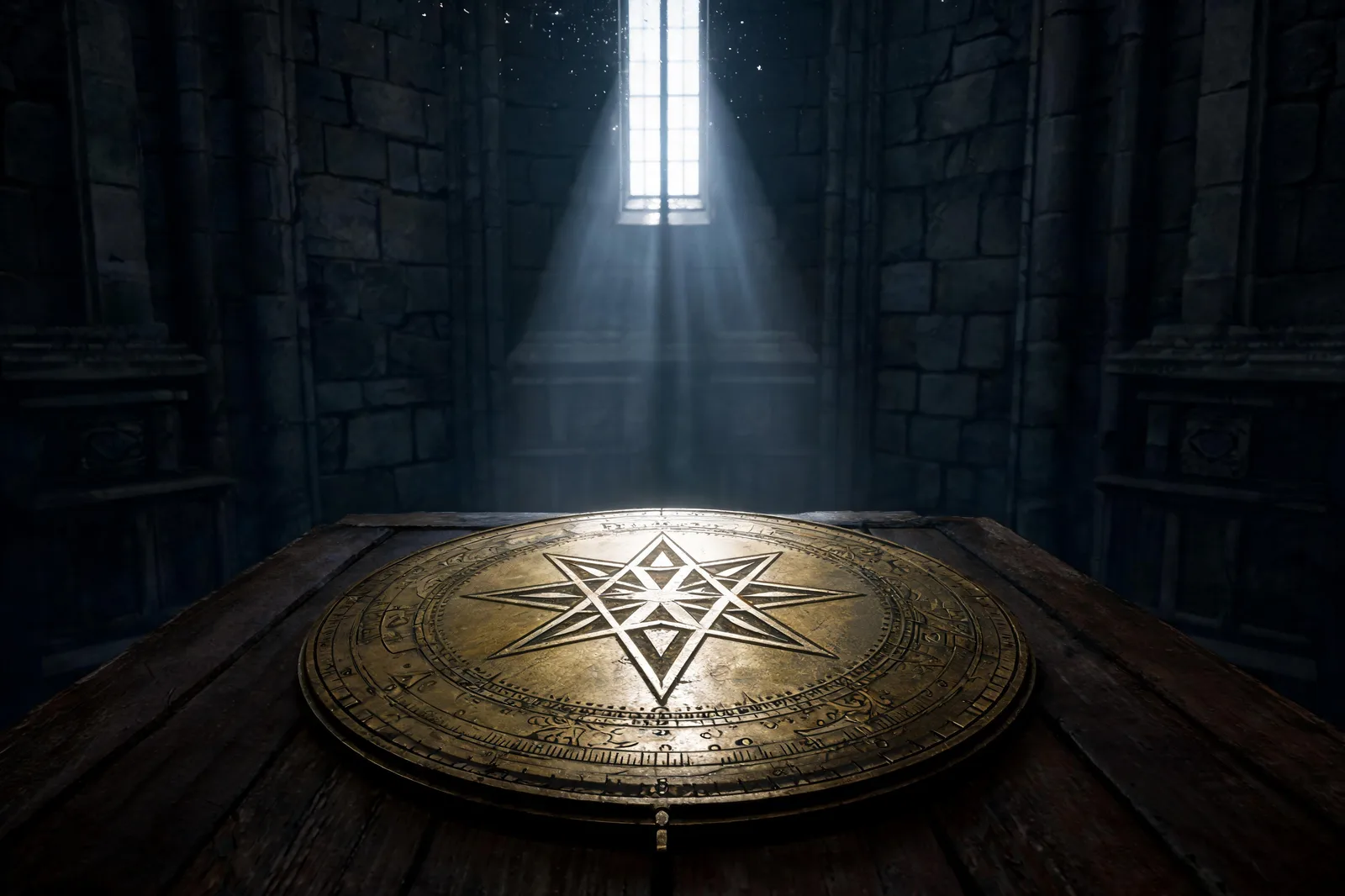
Aurum Solis is a British magical order best known publicly through the books its two twentieth-century leaders wrote for Llewellyn, and it teaches its own Ogdoadic Tradition, an eightfold cosmology distinct from the Golden Dawn's more familiar tenfold Tree of Life, with the tarot folded into that different frame rather than replacing it.
Aurum Solis: A Claimed History, A Documented Revival
The order says it was founded in London in 1897, the same decade that produced the Golden Dawn itself, but unlike the Golden Dawn its early decades left little independent trace for historians to check. What can be documented with confidence begins later: from the 1970s, Vivian Godfrey, writing jointly with Melita Denning, brought the order's teaching into print for the first time at scale, publishing a multi-volume series through Llewellyn that became most readers' only window into Aurum Solis at all. That gap between a claimed nineteenth-century founding and a well-documented 1970s public emergence is common among twentieth-century magical orders, and a careful reader treats the earlier date as the order's own tradition rather than as settled history.
The Ogdoad, Not the Tree of Life
Where the Golden Dawn and its heirs built their tarot correspondences on the ten Sephiroth and twenty-two paths of the Qabalistic Tree, Aurum Solis frames its cosmology around the Ogdoad, an eightfold structure of planetary and elemental forces that the order treats as a native Western current running alongside, rather than descending from, Qabalah. Denning and Godfrey's books present the tarot as one expression of this eightfold pattern among several, alongside planetary ritual and a graded system of initiation the order calls its mysteries. The practical effect for a reader is that Aurum Solis's tarot correspondences, while recognisably related to the wider nineteenth-century revival that also produced Éliphas Lévi's School: The Tarot as a Universal Key's system, group the trumps by eight rather than by the Golden Dawn's more familiar sets of three.
Cards Inside an Eightfold Pattern
The Moon and The Sun sit naturally inside an eightfold planetary scheme, since both were already counted among the classical seven planets that every Western correspondence system, Golden Dawn or Ogdoadic, has to place somewhere. Fortune, the trump of cyclical change, fits the order's eightfold thinking particularly well: Aurum Solis's writing returns often to cycles and turning wheels as a structural metaphor for its own grade system, a student moving through eight stages rather than climbing a single ten-rung ladder. None of this makes the order's tarot teaching wildly different in practice from a Golden Dawn-descended reading; the cards still carry planetary and elemental meanings a Thoth reader would recognise. What differs is the architecture holding those meanings together.
Why the Distinction Is Worth Keeping
Treating every twentieth-century magical order as a simple variant of the Golden Dawn flattens real differences in how these groups organised their own symbolism. Aurum Solis insisted, in its own published material, that the Ogdoadic current was a separate inheritance, not a Golden Dawn offshoot dressed in new language, and whether or not that claim satisfies an academic historian, it shaped how Denning and Godfrey actually wrote about the tarot: less as a Qabalistic alphabet and more as one piece of an eightfold planetary puzzle. A reader comparing orders across this series gains more from noticing that structural choice than from assuming every British magical revival after 1888 simply copied the same blueprint.
A Note on Sources
Aurum Solis's own historical claims are difficult to verify independently, and no scholarly consensus exists on its pre-1970s activity. What is well documented is the printed output from the 1970s onward, under Denning and Godfrey's joint authorship, which remains the order's primary public legacy and the main source for anyone studying its approach to the cards today. Readers researching further should treat the order's own foundation narrative, like similar claims from other esoteric revivals, as tradition rather than verified fact, while taking its published teaching on its own terms as a genuine and internally consistent system.
This pattern repeats across the wider field of twentieth-century magical revivals, and it is worth naming plainly rather than treating as a scandal unique to one order. A founding myth that reaches back a century lends a school gravity it cannot easily claim from a 1970s paperback alone; several orders discussed across this series lean on a similar device, pairing a dramatic early origin with a thin paper trail. None of that invalidates the working system a later generation actually built and used. It simply means a careful reader separates the order's own story about itself from what independent records can confirm, and judges the Ogdoadic teaching on the coherence of the books Denning and Godfrey actually published.
Frequently Asked Questions
When was Aurum Solis founded? The order states 1897, in London, though independent documentation for its early decades is thin; its public teaching dates mainly from the 1970s.
What is the Ogdoadic Tradition? An eightfold cosmology of planetary and elemental forces that Aurum Solis presents as a distinct Western current, organising the tarot differently from the Golden Dawn's tenfold Tree of Life.
Who made the order's teaching widely available? Vivian Godfrey and Melita Denning, writing jointly from the 1970s, published the order's multi-volume teaching through Llewellyn.
Does Aurum Solis use a different tarot deck from the Golden Dawn tradition? No distinct Aurum Solis deck is widely documented; the order worked with existing tarot imagery read through its own eightfold correspondences.
Questions
When was Aurum Solis founded?
The order states 1897, in London, though independent documentation for its early decades is thin; its public teaching dates mainly from the 1970s.
What is the Ogdoadic Tradition?
An eightfold cosmology of planetary and elemental forces that Aurum Solis presents as a distinct Western current, organising the tarot differently from the Golden Dawn's tenfold Tree of Life.
Who made the order's teaching widely available?
Vivian Godfrey and Melita Denning, writing jointly from the 1970s, published the order's multi-volume teaching through Llewellyn.
Does Aurum Solis use a different tarot deck from the Golden Dawn tradition?
No distinct Aurum Solis deck is widely documented; the order worked with existing tarot imagery read through its own eightfold correspondences.
This article talks about
You might also like
 Symbolism
 Symbolism
 Spirituality
© 2026 TAROTS chat (tarots.chat). All rights reserved. No part of this article may be reproduced, distributed or adapted without the owner's written permission.
The Journal
 Kabbalah
 Kabbalah
 Spirituality
 Thoth Tarot
 Disks
 Symbolism
 Symbolism
 Symbolism
 Kabbalah