Fraternitas Saturni and the German Tarot Tradition
by Redazione · 9 October 2026 · 5 min read
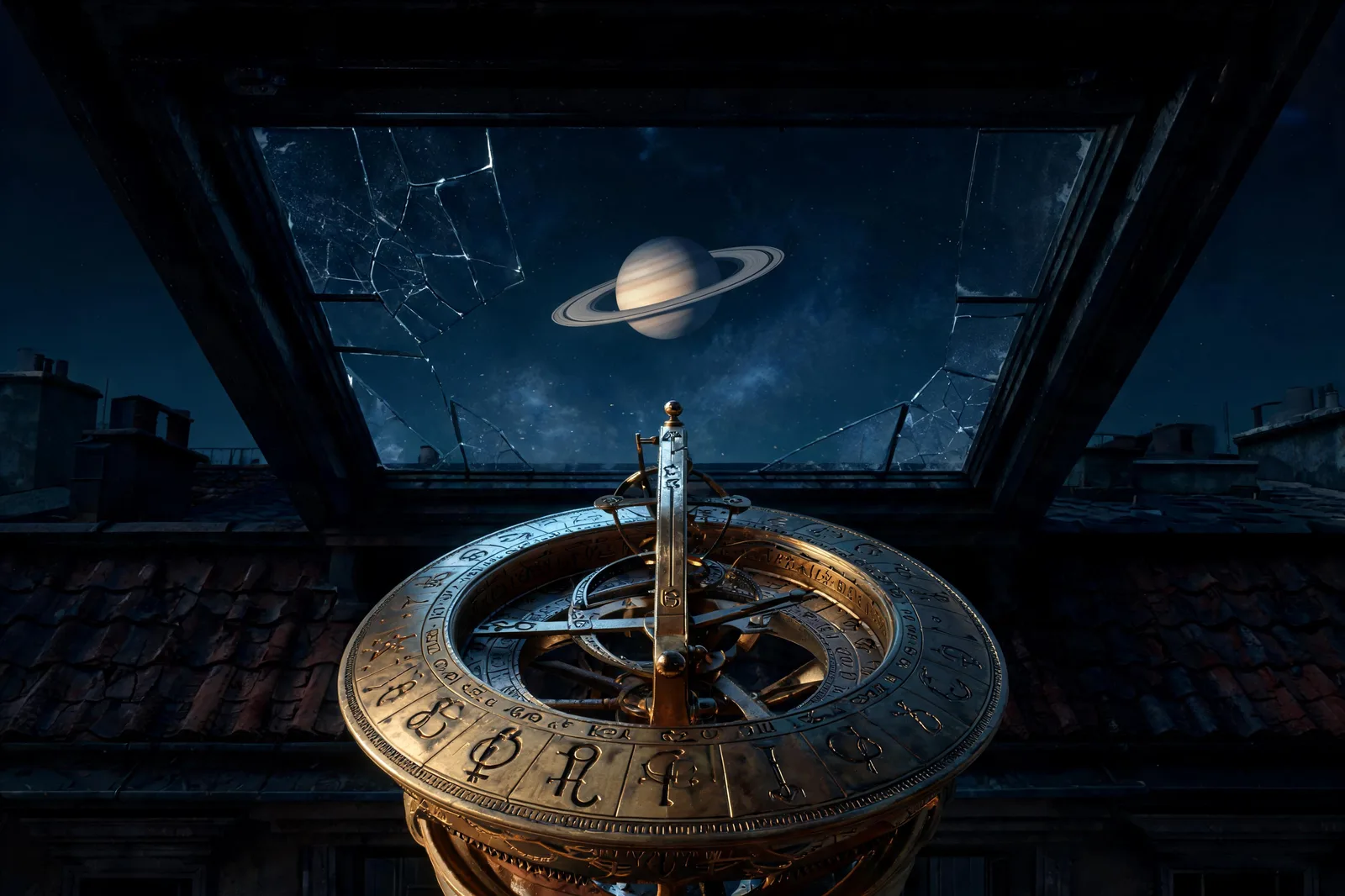
Fraternitas Saturni is Germany's longest-running magical order, founded in Berlin in 1928 by Eugen Grosche under the pen name Gregor A. Gregorius, and it built its whole system around Saturn rather than around a deck of cards: tarot entered its practice as one tool among many inside a much larger astrological structure. Understanding why requires looking at how German occultism organised itself differently from the French and English currents that produced the Golden Dawn and the Thoth deck.
Fraternitas Saturni: A Planetary Order, Not a Card School
Grosche named his order for the planet he considered the gatekeeper of initiation, reading Saturn not as the bringer of limits in the older astrological sense but as a Luciferian figure of hard-won light, the planet that tests a student before it teaches. The order's grade system ran through the seven classical planets and beyond, each step tied to a planetary sphere, a colour and a set of practices that mixed ceremonial ritual with astrology and ascetic discipline. Sexual polarity work also featured in its higher degrees, in the same practical-occult register that marked contemporary American orders. Tarot had no dedicated rung of its own in that ladder; it sat inside the order's wider correspondence system as a tool for meditation on the planets, not as the main curriculum. Readers hoping for a Fraternitas Saturni deck comparable to Thelema as a Tarot School After Crowley's will not find one: this is an order built on the zodiac wheel and the sphere of Saturn first, with cards used in service of that frame rather than the frame itself.
Why Germany Never Built a National Tarot
Germany's relationship with the tarot differs sharply from France's or England's. French occultists from Court de Gébelin to Lévi and Papus treated the trumps as a national intellectual project; English orders translated that project into the Golden Dawn's examination system. German card culture, by contrast, kept the tarock games played across Austria and southern Germany almost entirely separate from esoteric speculation, as a purely recreational trick-taking pastime with no occult overlay at all. When German-speaking occultists did turn to the tarot in the early twentieth century, they usually imported French or English correspondences wholesale rather than inventing their own, because the available planetary and Hebrew-letter attributions already matched the astrological systems German lodges were already using. Fraternitas Saturni followed that pattern: tarot was read through the same planetary lens Grosche had already built for the order's larger magical calendar, with the Saturn degree standing at its summit.
Saturn's Own Card
Within the correspondences the order inherited rather than invented, Saturn maps to The Universe, the final trump in most Golden Dawn-descended systems, the card of completion after a long cycle of initiation. That pairing fits Grosche's own emphasis neatly: Fraternitas Saturni presented its path as the slow, disciplined ascent toward a completed self, mirrored in a card that closes the Major Arcana's whole sequence rather than opening it. The order's writings also returned often to The Devil, read in their Luciferian idiom as a liberating rather than a purely malefic figure, a reversal of the card's older moralising use that parallels how the order reinterpreted Saturn itself.
Suppression and Survival
The Nazi state banned Fraternitas Saturni along with nearly every other esoteric lodge in Germany in 1933, and Grosche was later imprisoned for a time; the order's full activity resumed only after 1945, when Grosche reconstituted it in West Berlin. That history of state suppression sets German occultism apart from its French and English counterparts, which faced social ridicule but rarely outright criminal persecution. Fraternitas Saturni continued after Grosche's death in 1964 under a line of successive Grand Masters, and some version of the order is reported to be active in Germany still, making it one of the few twentieth-century magical lodges with a documented continuous history spanning nearly a century. Its contribution to tarot history is consequently indirect: not a deck, but a working proof that the cards can sit comfortably inside an astrological system built on entirely different foundations from the Qabalistic one that shaped the Golden Dawn and its heirs.
That indirect contribution still matters for anyone comparing esoteric orders across borders. Where English and French lodges published their tarot correspondences for a wide reading public, Fraternitas Saturni kept most of its internal material within the order itself for decades, surfacing in translation and academic study only gradually after the 1970s. A reader who wants to compare German occultism with its French or English cousins therefore has to work from a thinner public record, one built as much from court documents and later scholarly reconstruction as from the order's own journals.
Frequently Asked Questions
Did Fraternitas Saturni create its own tarot deck? No evidence points to a dedicated Fraternitas Saturni deck. The order used existing tarot correspondences within its larger planetary and astrological system.
Who founded the order, and when? Eugen Grosche, writing as Gregor A. Gregorius, founded it in Berlin in 1928.
Why is the order named for Saturn? Grosche placed Saturn at the summit of the order's planetary grade ladder, reinterpreting it as a Luciferian figure of hard-won initiation rather than simple limitation.
Did the order survive the Nazi era? It was banned in 1933 and its founder was later imprisoned; Grosche revived the order in West Berlin after 1945, and it continued under later leadership after his death in 1964.
Questions
Did Fraternitas Saturni create its own tarot deck?
No evidence points to a dedicated Fraternitas Saturni deck. The order used existing tarot correspondences within its larger planetary and astrological system.
Who founded the order, and when?
Eugen Grosche, writing as Gregor A. Gregorius, founded it in Berlin in 1928.
Why is the order named for Saturn?
Grosche placed Saturn at the summit of the order's planetary grade ladder, reinterpreting it as a Luciferian figure of hard-won initiation rather than simple limitation.
Did the order survive the Nazi era?
It was banned in 1933 and its founder was later imprisoned; Grosche revived the order in West Berlin after 1945, and it continued under later leadership after his death in 1964.
This article talks about
You might also like
 Symbolism
 Symbolism
 Symbolism
© 2026 TAROTS chat (tarots.chat). All rights reserved. No part of this article may be reproduced, distributed or adapted without the owner's written permission.
The Journal
 Wands
 Symbolism
 Swords
 Kabbalah
 Symbolism
 Love
 Symbolism
 Symbolism
 Kabbalah