The Four of Swords, Truce: Jupiter in Libra
by Redazione · 9 October 2026 · 5 min read
Crowley titled the Four of Swords Truce, and after The Three of Swords, Sorrow: Saturn in Libra the word reads like relief. But the four of swords truce pairing is not simply rest after pain; it is a deliberate pause built into the suit's own logic, a moment where Air stops cutting long enough to recover its strength. Where the Three ended something, the Four holds the ground that is left and quietly reorganizes it.
The Decan: Jupiter in Libra
The Golden Dawn assigned the Four of Swords to the third and final decan of Libra, roughly 13 to 22 October, ruled by Jupiter. Libra's scale has now passed through the Moon's uneasy balance and Saturn's hard accounting; Jupiter arrives to expand what is left rather than test it further. Jupiter is traditionally the planet of growth, generosity and relief from pressure, and set inside Libra's own concern for fairness, this decan describes a peace that is actually sustainable — not because the conflict has vanished, but because there is finally enough room to rest without forfeiting ground. Tradition holds that a Jupiterian close to a planetary sequence softens whatever came before it, and the Four of Swords is where this suit's early tension gets its first real breathing space.
Chesed and the Shelter of the Number Four
Every four in the Thoth deck answers to Chesed, the fourth Sephirah, called Mercy. Chesed is the first sphere below the Supernal Triad, the point where Binah's severe form finally softens into generosity, structure that protects rather than only limits. Chesed, Mercy, and the Four Fours describes how every four — in Wands, Cups, Disks and Swords alike — represents a stable, built shelter raised from the raw force and firm shape of the Twos and Threes before it. In the suit of Air, Chesed's gift becomes something close to a cease-fire granted by mercy rather than exhaustion: the mind, having cut and been cut, is allowed to stop and repair, under a protection the number itself extends.
The comparison across suits is instructive. The Four of Wands celebrates a homecoming already secured; the Four of Cups turns inward toward a discontent no outer comfort can quite reach; the Four of Disks hardens into a possessive, defended stability. The Four of Swords takes Chesed's mercy and spends it on recovery instead of celebration, withdrawal or ownership — the one four in the deck that is explicitly about healing rather than holding.
Reading the Image: Four Blades at Rest
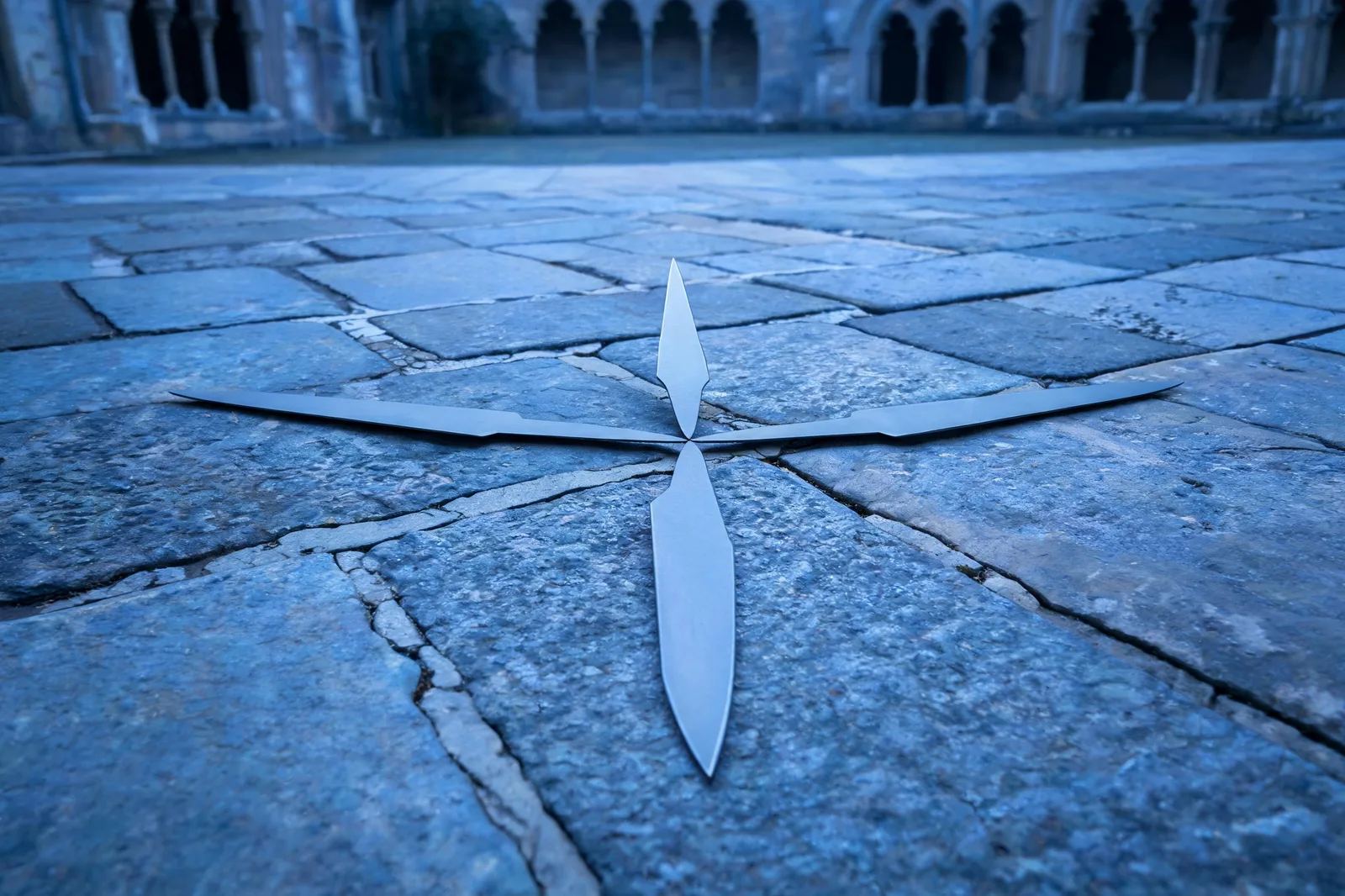
Harris arranged the four swords of this card meeting near their points, forming a stable, almost architectural pattern rather than a clash. The composition reads as balance achieved through structure, not through opposing force the way the Two did. Colour returns here after the Three's starkness — cooler blues and a measured symmetry replace the earlier card's broken grey. Crowley's own commentary frames this truce as watchful rather than passive: a convalescence, a retreat prepared deliberately, with every blade still present and accounted for, simply not in use. Nothing in Harris's design suggests disarmament. The swords have been laid down in an order, which is a very different thing from being abandoned.
The architecture itself is worth lingering on. Where the Three's shattered shape had no coherent outline, the Four's arrangement is legible at a glance — four equal parts meeting at a centre, like a structure someone built on purpose rather than one that simply broke. That legibility is the card's quiet argument: a mind recovering from a real wound still has the capacity to impose order on what is left, and doing so is itself a sign the worst has passed.
Truce as Preparation, Not Surrender
This distinction matters for how the card reads in practice. The Four of Swords rarely means withdrawal from a conflict for good; it means a conflict is being managed by pausing it on purpose. Readers sometimes mistake this for the same stillness shown by the Two, but the two cards describe different mechanisms. The Two's peace is a standoff held by matched force; the Four's truce is a shelter built so that force can be renewed. One is defensive equilibrium, frozen in place; the other is recovery, moving quietly toward whatever comes next. A card that looks restful is not always telling a reader to stop planning — often it is telling them planning is exactly what the rest is for. Jupiter's own character supports that reading: it is the planet of expansion, never of retreat for its own sake, and a Jupiterian truce tends to be the quiet part of a larger campaign rather than its end.
The Four of Swords in a Reading
Set against Swords Suit Symbolism in the Thoth Tarot: Air, Intellect and Conflict, the Four marks the suit's first constructive pause, where Air's divisive nature briefly serves protection instead of conflict. In a layout such as Celtic Cross, it often appears where a reader expects urgency and finds instead a deliberate slowing, worth respecting rather than rushing past. A TAROTS chat session will usually treat this card as permission: to recover fully before the next decision, rather than to call the matter closed. The series continues into Aquarius next, where Venus opens a very different kind of Air — one that will ask what happens when a truce finally breaks.
Questions
What does the Four of Swords mean in the Thoth Tarot?
Crowley titled it Truce: a deliberate, orderly pause for recovery after the Three of Swords, not a surrender or an ending of the conflict.
Why is the Four of Swords linked to Jupiter in Libra?
The Golden Dawn assigned the third decan of Libra, roughly 13 to 22 October, to Jupiter. Jupiter's expansion meeting Libra's balance produces a sustainable rest rather than an exhausted stalemate.
What Sephirah governs the Four of Swords?
Chesed, the fourth Sephirah, called Mercy. It is the first sphere to soften Binah's severity into shelter, giving the suit of Swords its first constructive pause.
Does the Four of Swords mean the same thing as the Two of Swords?
No. The Two is a standoff held by matched force; the Four is a shelter built on purpose so that strength can be renewed before acting again.
This article talks about
You might also like
 Swords
 Swords
 Swords
© 2026 TAROTS chat (tarots.chat). All rights reserved. No part of this article may be reproduced, distributed or adapted without the owner's written permission.
The Journal
 Wands
 Kabbalah
 Kabbalah
 Spirituality
 Kabbalah
 Kabbalah
 Symbolism
 Symbolism
 Kabbalah