The Five of Swords, Defeat: Venus in Aquarius
by Redazione · 9 October 2026 · 5 min read
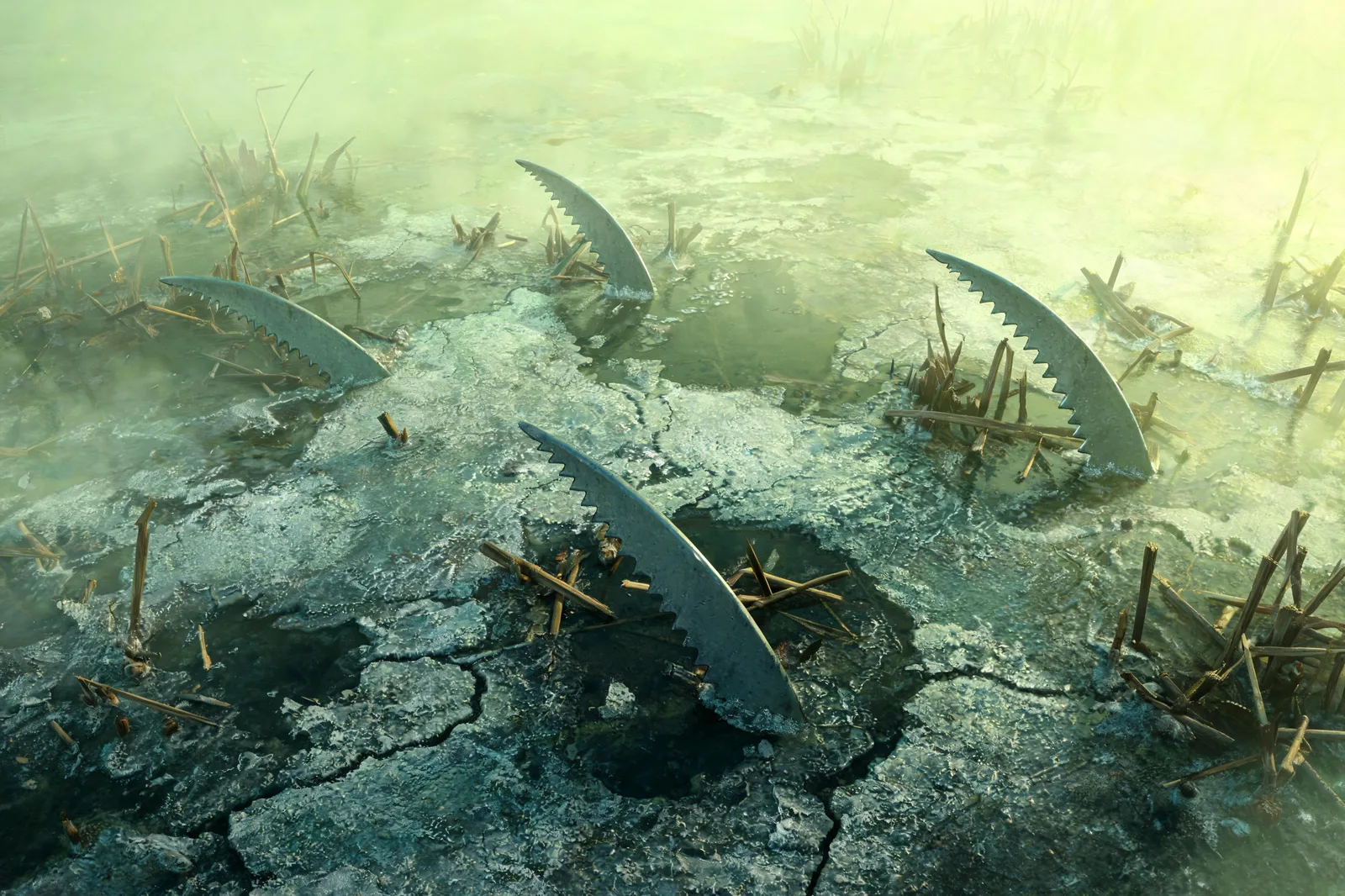
Crowley titled the Five of Swords Defeat, and after The Four of Swords, Truce: Jupiter in Libra the suit begins a new and harder decan. The five of swords defeat design is not simply loss; it is the specific failure of harmony itself — the point where Air's intellect, left unchecked, turns petty, treacherous or self-serving. This is the first card of the suit's second act, and Thoth gives it none of the dignity a clean defeat might deserve.
The Decan: Venus in Aquarius
The Golden Dawn placed the Five of Swords in the first decan of Aquarius, roughly 20 to 29 January, ruled by Venus. Aquarius is a fixed air sign, concerned with groups, ideals and detachment; Venus there is often read as weakened, since her usual warmth and personal loyalty sit awkwardly inside a sign that prizes the abstract over the intimate. Venus governs harmony and relationship, and a Venus struggling in Aquarius' cooler climate describes affection that has been subordinated to principle, strategy or self-interest. Tradition holds that this decan produces a defeat brought on by half-measures: an alliance kept for appearances, loyalty withheld just enough to matter, a cause supported in word but not fully in deed.
Geburah and the Severity Behind the Number Five
Every five in the Thoth deck answers to Geburah, the fifth Sephirah, called Severity. Geburah is the sphere of judgment, force applied without Chesed's mercy to soften it — the Tree's necessary correction to unchecked growth. Geburah, Severity, and the Four Fives traces how every five disrupts the stability the Fours had just built, each suit meeting that disruption differently. In Swords, Geburah's severity becomes a verdict the mind cannot argue its way around: a plan collapses, a position is lost, an argument that looked clever turns out to be hollow once it is tested. The suit of intellect meets a force that does not care how persuasive the argument was.
This is also where the suit's early arc turns. The Two held balance by matched force, the Three broke that balance honestly, the Four rebuilt a shelter on purpose. The Five tests whether that shelter was actually sound, and Geburah's answer is unsentimental: a structure built on a compromise will fail exactly where the compromise was made, not at some random point of bad luck.
Reading the Image: Broken Blades and a Sickly Palette
Harris painted the Five of Swords with its blades fractured, bent and disordered, under a palette that favours a sickly yellow-green rather than the suit's usual cool greys and blues. Nothing in the composition is upright; the swords lean, overlap awkwardly or appear notched, as if damaged in use rather than simply set down. The colour choice matters as much as the broken geometry: Crowley's deck uses that same jaundiced tone elsewhere to signal corruption or diminished vitality, and here it reads as intellect curdled — cleverness turned against itself rather than defeated from outside. No figure stands triumphant over the wreckage, the way some older decks show a gloating victor collecting fallen swords. Thoth withholds even that. The defeat belongs entirely to whoever held the blades, with no outside party left to blame for how they broke.
Defeat Without an Honest Opponent
The Five of Swords differs from a simple loss in combat. Where the Seven of Swords, later in this decan sequence, will show outright theft, the Five more often points to a defeat brought on by one's own compromises: a cause abandoned halfway, a truce from the Four traded away too cheaply, loyalty spent on the wrong side of an argument. Readers who expect a clean adversary in this card are usually looking in the wrong direction. The more useful question is what smaller, self-serving choice weakened a position that could otherwise have held. Venus debilitated in Aquarius describes exactly that kind of harm — not malice from an enemy, but warmth misapplied or withheld when it mattered.
Compare this to Geburah's other fives. The Five of Wands turns severity into open competition; the Five of Cups turns it into grief over what is gone; the Five of Disks turns it into material want. The Five of Swords alone turns Geburah's correction into something closer to shame, because Air's business is judgment, and here the mind is forced to judge its own conduct rather than someone else's.
The Five of Swords in a Reading
Read beside Swords Suit Symbolism in the Thoth Tarot: Air, Intellect and Conflict, the Five of Swords marks where the suit's capacity for conflict turns inward and petty rather than principled. In Celtic Cross, it often lands on a position already compromised before the question was even asked. A TAROTS chat session will treat this card as an honest audit: what was actually lost, and by whose hand, deserves a clearer answer than pride usually allows. That audit is not a verdict on character; it is simply the next useful question before any repair can begin. The series continues with Mercury's decan next, where the same Aquarian air sharpens back into something closer to method, and defeat gives way to a more deliberate, less forgivable kind of intelligence.
Questions
What does the Five of Swords mean in the Thoth Tarot?
Crowley titled it Defeat: a loss caused by compromise, half-loyalty or self-serving choices rather than by an honest opponent.
Why is the Five of Swords linked to Venus in Aquarius?
The Golden Dawn assigned the first decan of Aquarius, roughly 20 to 29 January, to Venus. Venus's warmth sits awkwardly in Aquarius's detached, fixed air, producing harmony sacrificed to principle or self-interest.
What Sephirah governs the Five of Swords?
Geburah, the fifth Sephirah, called Severity. It is the Tree's corrective force, and in the suit of Swords it delivers a verdict the mind cannot argue its way around.
Is the Five of Swords about betrayal by someone else?
Rarely. It more often points to a defeat brought on by one's own half-measures, which is why no triumphant opponent appears in Thoth's design.
This article talks about
You might also like
 Swords
 Swords
 Swords
© 2026 TAROTS chat (tarots.chat). All rights reserved. No part of this article may be reproduced, distributed or adapted without the owner's written permission.
The Journal
 Symbolism
 Symbolism
 Kabbalah
 Spirituality
 Kabbalah
 Symbolism
 Symbolism
 Symbolism
 Kabbalah