The Six of Swords, Science: Mercury in Aquarius
by Redazione · 9 October 2026 · 5 min read
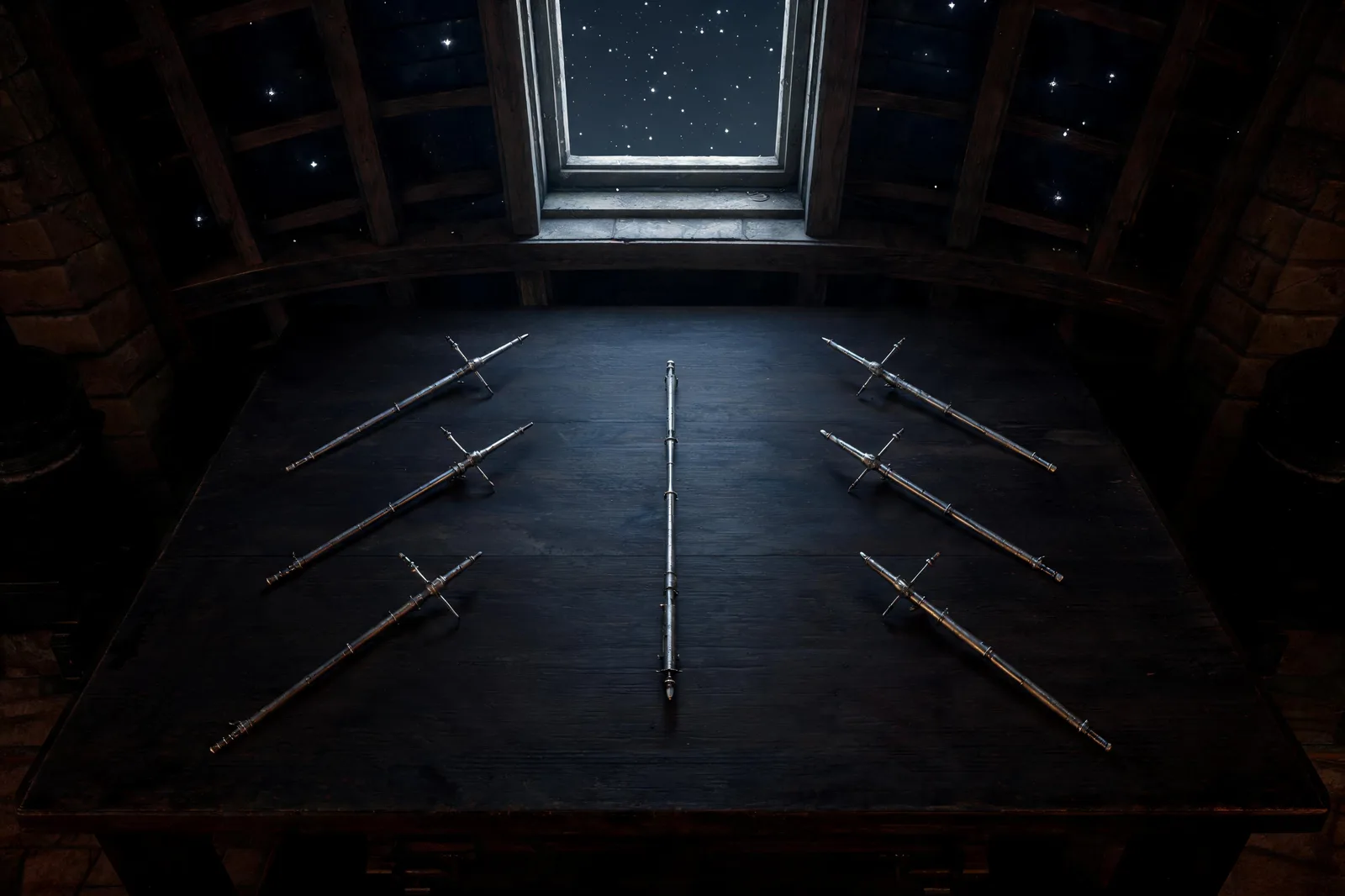
Crowley titled the Six of Swords Science, a name that sets it apart from almost every other card in the Thoth deck. After The Five of Swords, Defeat: Venus in Aquarius, the six of swords science pairing marks a sharp correction: not comfort, not recovery through feeling, but recovery through method. Where the suit's last card dissolved into compromise and curdled cleverness, the Six restores order by exact, repeatable technique.
The Decan: Mercury in Aquarius
The Golden Dawn assigned the Six of Swords to the second decan of Aquarius, roughly 30 January to 8 February, ruled by Mercury. Aquarius is already the sign of system and abstraction; Mercury, the planet of calculation and communication, is arguably as much at home here as anywhere in the zodiac. Mercury governs formula, measurement and precise exchange of information, and inside Aquarius' fixed air this decan produces something closer to a working theory than a passing thought — an idea tested enough times that it can be trusted. Tradition holds that this placement is one of the strongest in the whole suit: intellect operating exactly as it is supposed to, methodical rather than merely clever. Mercury rules both measurement and travel between fixed points, and something of that double meaning survives in the card: a careful method is also a route, a way of getting reliably from one state to another rather than a single clever idea that works once by luck.
Tiphareth and the Harmony Behind the Number Six
Every six in the Thoth deck answers to Tiphareth, the sixth Sephirah, called Beauty. Tiphareth sits at the centre of the Tree, in balance between Chesed's mercy and Geburah's severity, and above Yesod and Malkuth — the point where every other force on the Tree meets and harmonizes. Tiphareth, Beauty, and the Four Sixes describes how the Sixes across the deck each show that same harmony arriving in the suit's own language. In Swords, Tiphareth's gift is exactness: a method that works, derived honestly from what the Five exposed as broken. The suit of intellect, having been humbled, now produces something that actually holds up to scrutiny. That sequence is worth naming plainly: Tiphareth's beauty in this suit is earned beauty, built directly on the Five's honest failure rather than arriving despite it.
Reading the Image: An Exact, Repeating Pattern
Harris composed the Six of Swords around a precise, almost diagrammatic arrangement of blades, laid out with the regularity of a formula rather than the tension of a confrontation. The geometry is deliberately legible: six elements in exact relation to one another, nothing left to improvisation. Where the Five showed damage from careless handling, the Six shows instruments used correctly, each in its proper place. Crowley's own commentary treats this card as close to the suit's ideal — not because conflict has ended, but because the mind has finally learned to work with precision rather than against itself. The colder, clearer tones Harris uses here reinforce the same point: this is a design meant to be read as a diagram first and a scene second.
Science as Method, Not Certainty
It is worth being careful with the word Crowley chose. Science here does not mean a finished discovery or an unshakeable truth; it means the discipline of testing an idea honestly and keeping only what survives the test. A reading that turns up the Six of Swords is rarely pointing to inspiration or sudden insight — those belong to other cards. It points instead to patient, exact work: gathering facts, checking a method against results, refining an approach until it actually functions. The card rewards a reader willing to do the unglamorous part of thinking, the measuring and rechecking that inspiration alone never provides. It is, in that sense, a quietly humble card: it does not claim to have solved anything forever, only to have found a process that keeps working when tested again.
Compare the suit's other Sixes briefly. The Six of Wands marks victory already achieved; the Six of Cups turns toward memory and nostalgia; the Six of Disks balances giving and receiving in material terms. The Six of Swords alone turns Tiphareth's harmony into a working procedure — the suit's intellect finally producing something durable enough to use again, a result the other three sixes reach by feeling, memory or exchange, and this one reaches by proof.
The Six of Swords in a Reading
Set beside Swords Suit Symbolism in the Thoth Tarot: Air, Intellect and Conflict, the Six of Swords shows Air's intellect finally serving a durable purpose rather than conflict for its own sake. In Celtic Cross, it often marks a method worth trusting, a plan that has already been tested rather than merely hoped for. A TAROTS chat session will usually treat this card as encouragement to keep doing the careful work already underway, rather than to search for a shortcut. The series continues into the suit's third Aquarian decan, where the Moon returns to ask whether this careful method can survive contact with real feeling, and whether a formula that works on paper still holds once the question stops being abstract.
Questions
What does the Six of Swords mean in the Thoth Tarot?
Crowley titled it Science: a method tested enough to be trusted, restoring order after the Five of Swords through precision rather than comfort.
Why is the Six of Swords linked to Mercury in Aquarius?
The Golden Dawn assigned the second decan of Aquarius, roughly 30 January to 8 February, to Mercury. Mercury's gift for calculation fits naturally into Aquarius's abstraction, producing a working, repeatable method.
What Sephirah governs the Six of Swords?
Tiphareth, the sixth Sephirah, called Beauty. It sits at the Tree's centre, balancing Chesed and Geburah, and in the suit of Swords it gives the mind a technique that actually holds up to testing.
Does the Six of Swords mean a new idea or a tested one?
A tested one. The card points to patient, exact work, not sudden inspiration, which belongs to other cards in the deck.
This article talks about
You might also like
 Swords
 Swords
 Swords
© 2026 TAROTS chat (tarots.chat). All rights reserved. No part of this article may be reproduced, distributed or adapted without the owner's written permission.
The Journal
 Learn Tarot
 Cups
 Symbolism
 Major Arcana
 Kabbalah
 Spirituality
 Symbolism
 Symbolism
 Kabbalah