The Cipher Manuscripts: What the Golden Dawn's Founding Document Says About the Tarot
by Redazione · 8 October 2026 · 9 min read
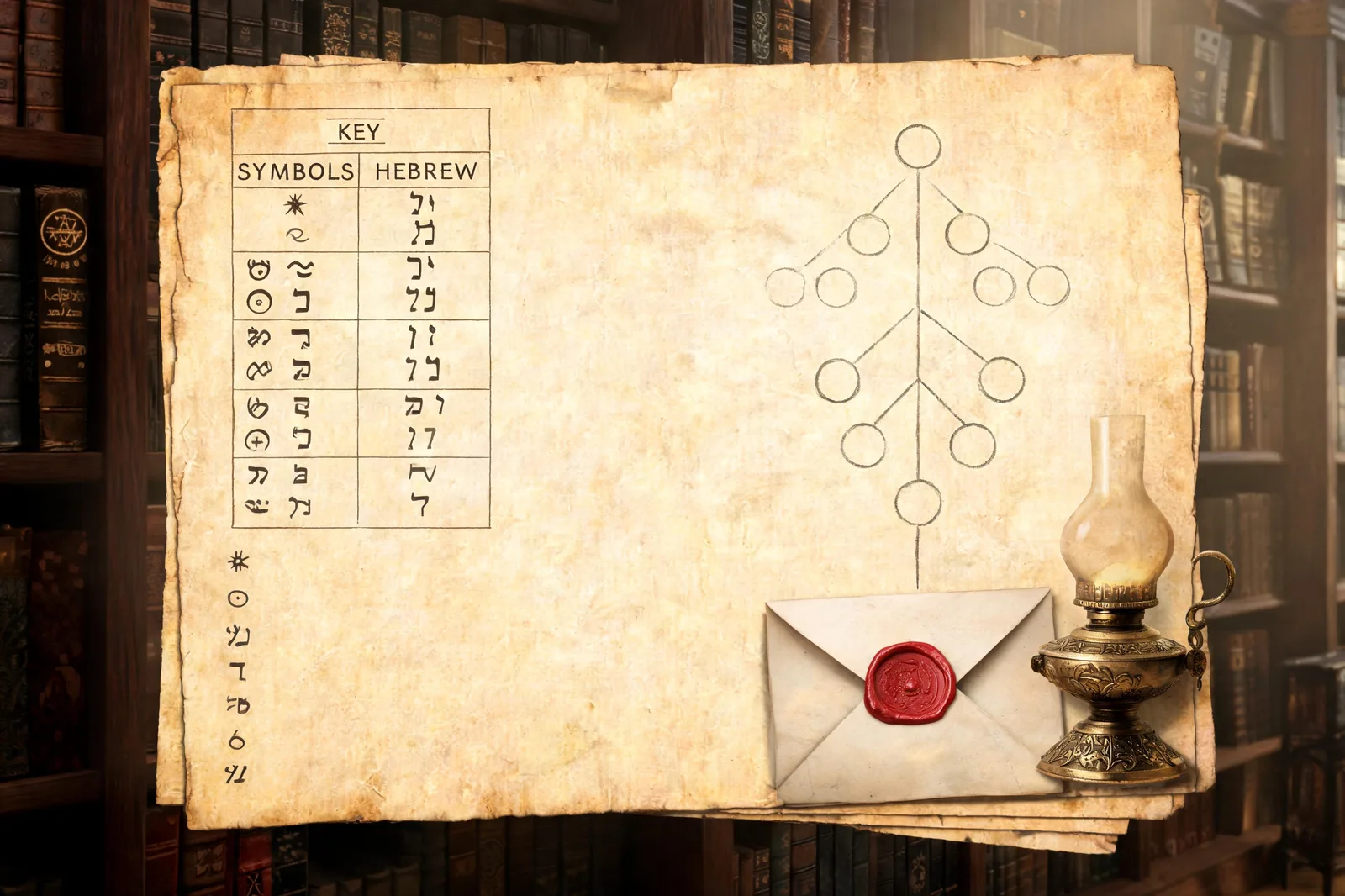
Every student of the Golden Dawn has been told the same story. Three men found a set of encrypted papers. They broke the code. And from the plaintext they built the order's rituals, its grades, and its tarot. The cipher manuscripts tarot question is simpler and stranger than that story suggests. The encrypted pages already carry the deck. They name the twenty-two trumps. They assign them to the tree of life. They use the Hebrew letters as numerals and as signs. And they include crude drawings of cards. So the real question is not whether the ciphers contain a tarot. It is how much of the Golden Dawn's tarot was already in them, and how much was added later by the men who read them.
What the ciphers actually are
The ciphers are a set of folios written in brown ink on cotton paper, transcribed and published in the Golden Dawn Library Project at Hermetic Library. The paper is watermarked 1809. That date matters, because it places the sheets decades before the order was founded in 1888. The text is plain English, written right to left, in a simple letter-for-letter substitution. The substitution is the Trithemius cipher, named for the abbot Johannes Trithemius and his Polygraphia.
The content is a graded curriculum. It lists the grades of the order, Neophyte to Adeptus, and the knowledge and lectures that belong to each. It covers astrology, alchemy, geomancy, Qabalah, Hermetics, and the tarot. It is not a finished book. It is a syllabus with rituals attached.
The provenance is a chain of handoffs, not a discovery. Frederick Hockley and Kenneth Mackenzie, both occult scholars, died in 1885 and 1886. Their papers passed through the Masonic scholar Adolphus Woodford to Dr. William Wynn Westcott, then secretary of the Societas Rosicruciana in Anglia. Westcott is the one who found the key in Trithemius and read the papers back into English. The full English translation, with each folio given in cipher and in plaintext, is published by Ellic Howe and available from the Internet Archive.
The tarot that is already in the ciphers
This is the part that changes how you read the whole order. The ciphers do not merely mention the deck. They prescribe it. Several folios refer to the twenty-two trumps by number and by their place in the tree of life. One folio lists the four worlds of the Qabalah, Assiah among them, and pairs them with the twenty-two trumps. Another names the thirty-two paths and ties the letters to them.
The letters are doing double work. They are the Hebrew alphabet, and they are numerals, with Aleph standing for one and Beth for two, exactly as the order's later correspondence tables use them. So the ciphers already contain the move that is usually dated to Eliphas Lévi, the assignment of a Hebrew letter to each of the twenty-two trumps.
There are also drawings. The ciphers include crude sketches of magical implements, of diagrams, and of tarot cards. They are rough. They are not the elegant plates of Book T or the finished art of the Rider-Waite deck. But the presence of drawn cards in an 1809-dated document is hard to explain if the tarot was supposed to be a late, decorative addition.
How much is really Lévi
The standard account gives the tarot to Lévi. His work on the high magic, published in the late 1850s, is where most readers first meet the idea of the trumps as letters on the tree of life. That is a fair claim. We covered the disagreement between Lévi's letters and the Golden Dawn's in Levi's Letters Versus the Golden Dawn: Why They Disagree, and the way the order's tables settled on a different set of assignments. What is less certain is the direction of the flow. If the ciphers already carry the letter-trump assignments, then the Golden Dawn did not simply inherit Lévi's deck and copy it. They had a document that already did the assignment, and Lévi's book gave them a public vocabulary for it.
This does not settle the authorship question. We do not know who wrote the ciphers, and we do not know whether the author read Lévi or whether the two drew on a common source. What we can say, from the text itself, is that the letter-trump scheme is present in the encrypted pages. That is a fact about the document, not a theory about its origin.
It does change one common claim. The tarot is not the newest thing in the Golden Dawn. It is not the one element the order imported and pasted onto an otherwise non-tarotic curriculum. The deck is in the founding syllabus, before the deck ever had the elegant attributions that the order later gave it.
What the ciphers do not give you
It is worth being precise about the absence. The ciphers do not give you the finished correspondence system that a reader of Thoth or of the Rider-Waite deck now takes for granted. There are no planetary rulers of the court cards in the form that later orders published. There is no full table of the four suits laid out against the decans. The ciphers give you the frame, the trumps, the letters, the tree, and the grades. The detailed attributions were built around that frame, by the order's members, over the years after 1888.
So the honest answer to the original question is a proportion. A lot of the Golden Dawn tarot is already in the ciphers. The letter-trump assignments, the tree of life, the place of the deck in a graded magical curriculum, all of that is there. The detailed correspondences, the planetary courts, the full minor arcana scheme, those came later. The ciphers are the skeleton. The order built the flesh.
The Sprengel question
There is a second layer that most summaries skip. The ciphers name a Rosicrucian adept, a Fraulein Sprengel, in Nuremberg, and they carry an address for her care of a hotel in Stuttgart. Westcott took that address seriously. He wrote to her, and through her he claimed to have received the Adeptus Exemptus grade and the authority to found a temple in England. The warrant for the Temple of Isis-Urania, chartered in 1888, is signed under her motto.
Whether Sprengel was a real person, a figurehead, or a construction of the correspondence itself is one of the standing questions in the order's history. It does not change the tarot question. The ciphers are the ciphers, and the tarot is in them. But it does change how you should hold the whole founding story. The documents were real, the code was real, and the tarot in them was real. The people around them are harder to pin down.
The cipher manuscripts tarot frame behind the finished tables
If you have read the correspondence tables of the Golden Dawn, the ciphers are the layer underneath them. The letter on each trump, the place of the deck on the tree, the grade at which the deck is taught, all of that is present in the encrypted pages in some form. The finished tables are the order's elaboration of that presence. We walked through the finished tables in Book T and Its Three Printings, and the ciphers are what sits behind the first of those printings.
That is why the ciphers are worth opening even if you never intend to do ritual work. They show you that the deck you read was not invented as a single elegant system. It was assembled. Someone put the letters on the trumps, someone put the trumps on the tree, someone built the grades around the two. The ciphers are the earliest written evidence of that assembly, and they are better at showing you the joints than the finished tables are.
What this means for a reader of the deck
If you read the tarot as the Golden Dawn or as the Thoth deck, you are working inside a system that believes its own tarot goes back to an encrypted document. That is a story the order told, and it is a story the ciphers do not fully support or fully refute. The deck is in the ciphers. The detailed system is not.
That distinction matters when you are deciding what to trust in a reading. The letter-trump assignments are older than the order, or at least as old as its founding papers. The finer attributions are the order's own construction. Neither is wrong. They are just from different layers of the same building. When a card's letter and a card's planetary court seem to pull in two directions, this is why.
The cipher manuscripts do not give you a more reliable tarot. They give you a clearer picture of where your tarot came from. And for an expert reader, knowing which layer a detail sits in is worth more than the detail itself.
Questions an expert asks
Did the ciphers come before Lévi? The paper is watermarked 1809, which is before Lévi's book. But the author is unknown, and the direction of influence is not proven. The letter-trump scheme is present in both, and that is what the text shows.
Are the ciphers authentic? They are physical documents in the public record, transcribed and published. The open question is not whether they exist, but who wrote them and how much of the order's later material they already contained.
Do the ciphers change a reading? Not directly. They change how much weight you give to a given attribution. The letter-trump assignments sit in the older layer. The planetary courts and the decan scheme sit in the order's own construction, built on top of that layer.
Questions
Did the cipher manuscripts come before Lévi?
The paper is watermarked 1809, which is before Lévi's book. But the author is unknown, and the direction of influence is not proven. The letter-trump scheme is present in both, and that is what the text shows.
Are the cipher manuscripts authentic?
They are physical documents in the public record, transcribed and published. The open question is not whether they exist, but who wrote them and how much of the order's later material they already contained.
Do the cipher manuscripts change how you read a card?
Not directly. They change how much weight you give to a given attribution. The letter-trump assignments sit in the older layer. The planetary courts and the decan scheme sit in the order's own construction, built on top of that layer.
What does the cipher manuscripts tarot frame add that the finished tables do not?
It shows the joints. The finished tables look like one elegant system. The ciphers show that the letters, the trumps and the grades were assembled from separate pieces, and that the deck is in the founding syllabus, not added to it.
You might also like
 Kabbalah
 Kabbalah
© 2026 TAROTS chat (tarots.chat). All rights reserved. No part of this article may be reproduced, distributed or adapted without the owner's written permission.
The Journal
From the Journal
Chosen for this page
 Thoth Tarot
The 72 Names in the Deck: The Shem Angels and the Decans of the Small Cards
9 min read
More in Thoth Tarot Symbolism
 Symbolism
 Symbolism
 Kabbalah
 Kabbalah
 Thoth Tarot