Kenneth Grant's Nightside of Eden and the Tunnels of Set
by Redazione · 9 October 2026 · 4 min read
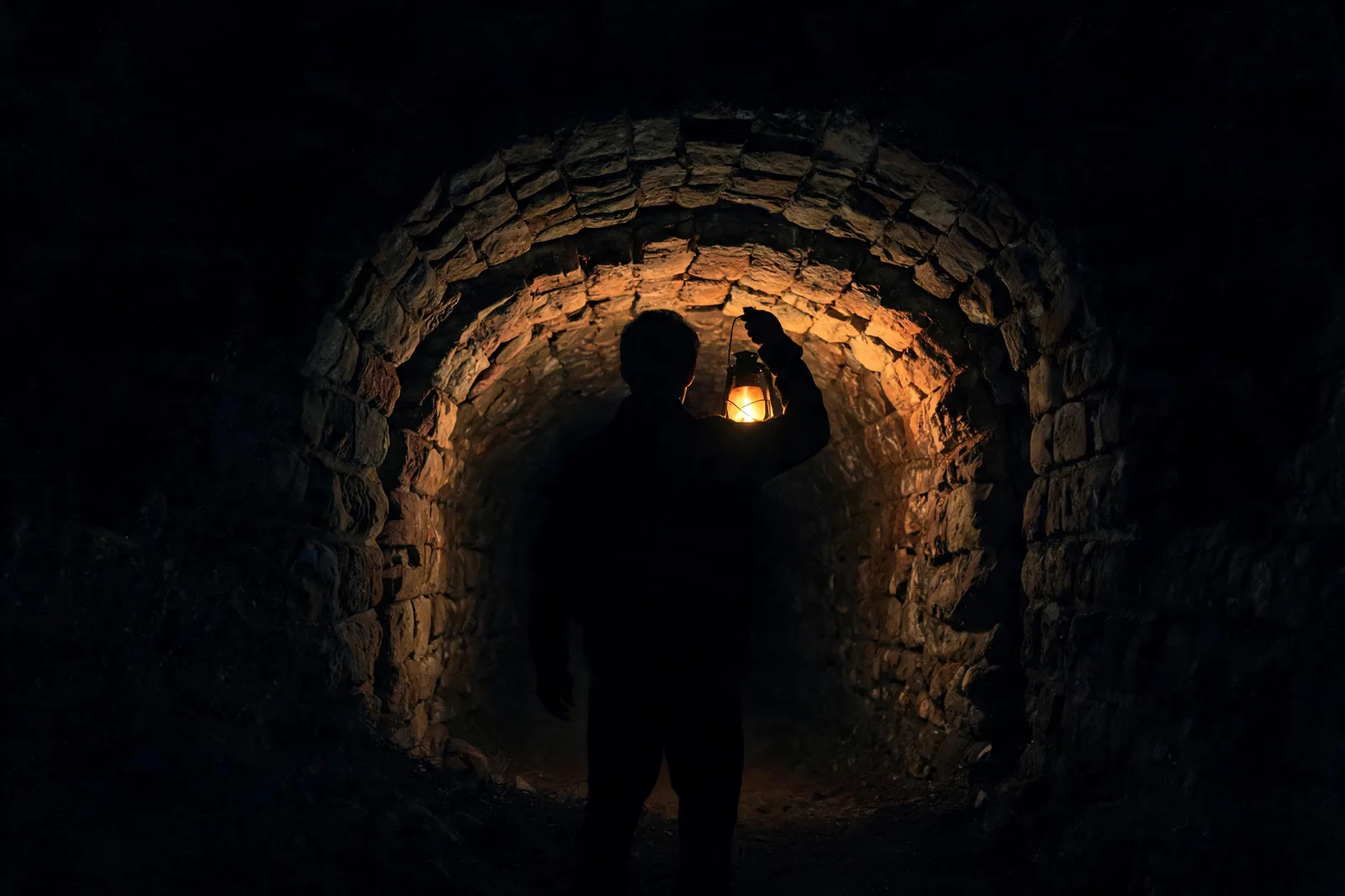
Kenneth Grant's Nightside of Eden, published in 1977, took the Golden Dawn's qliphoth, already covered in The Qliphoth in the Golden Dawn Tradition, and rebuilt them into a sprawling cosmology of twenty-two "tunnels of Set" running beneath the visible Tree of Life. It remains the single most influential modern text on the subject, and the hardest to read as plain history rather than personal myth-making.
Grant's place in the Thelemic lineage
Kenneth Grant served briefly as Aleister Crowley's secretary near the end of Crowley's life, then went on to lead his own Typhonian Order, developing a distinctive and highly idiosyncratic reading of Thelema mixed with Lovecraftian fiction, Tantra and Surrealism. Nightside of Eden sits at the centre of what scholars now call the Typhonian Current, a branch of twentieth-century occultism quite distinct from either the Golden Dawn's grade system or Crowley's own Ordo Templi Orientis teaching.
Twenty-two tunnels, not ten shells
Grant's innovation was structural. Rather than matching shells one-to-one against the ten sefirot, as the Golden Dawn had done, he mapped them onto the twenty-two paths connecting those sefirot, the same paths the Major Arcana traditionally occupy. Each tunnel received a name, often drawn from older grimoires or invented through his own channeling practice, and a connection to a specific trump. This is why the series keeps returning to individual cards: Grant's system was, among other things, an extended commentary on the tarot's own structure, read through a markedly darker lens than Crowley's.
A text that resists simple summary
Nightside of Eden is dense, allusive and deliberately resistant to paraphrase; Grant wrote in a style that assumes familiarity with a dozen other traditions at once, and scholars of esotericism such as Dave Evans have noted how difficult the book is to situate within conventional magical history. That difficulty is itself worth naming plainly: this is a primary artifact of one occultist's syncretic imagination, not a transcription of an older received tradition, whatever its own rhetoric claims.
Reading it as history, not as a manual
This series treats Nightside of Eden the way any serious study of twentieth-century esotericism should: as a document to be read, contextualized and compared against its predecessors, never as an instruction manual. Grant's book contains invocatory material addressed to its tunnels, and that material falls outside the scope of a historical account. What is worth studying is the book's place in a longer argument about where the Tree of Life's shadow side leads, an argument that started with Luria's broken vessels and runs through the Golden Dawn's careful grade system before arriving at Grant's considerably less cautious synthesis.
The Moon, Lilith, and the tunnels beneath
The Moon appears repeatedly in Grant's commentary, since the Thoth deck's own Lust and Moon trumps sit on paths he assigned to some of his most elaborated tunnels. Later writers influenced by Grant pushed this reading further still, treating qliphothic tunnel-work as a distinct magical specialty with its own literature, largely independent of the Golden Dawn's original teaching framework. That later literature is a separate historical phenomenon from anything in Luria's or Mathers's own writing, and conflating the three stages loses exactly the distinctions a careful reader needs.
Why this matters for a tarot reader
A reader of the Thoth deck does not need Grant's full cosmology to use the cards well, but understanding that it exists, and why it developed, clarifies a real split in how twentieth-century occultists read the same Tree. Some treated the qliphoth as a structural caution; Grant treated them as a frontier to be mapped in increasingly elaborate detail. Knowing which lineage a given commentary belongs to helps a reader judge how much historical weight its claims actually carry. Readers wanting a sober overview of Grant's life and influence can consult his biographical entry: Kenneth Grant.
From myth-making to Crowley's own text
Grant's elaborate tunnels were not his own invention from nothing. He built them on a much shorter, much older source: Crowley's Liber 231, a short list of "genii of the paths" that predates Grant's expansion by six decades. The next part of this series goes back to that earlier, sparser text, and asks what Crowley himself actually claimed about it.
Questions
What is Nightside of Eden about?
It is Kenneth Grant's 1977 book mapping twenty-two qliphothic 'tunnels of Set' onto the twenty-two paths of the Tree of Life, each linked to a Major Arcana trump.
Who was Kenneth Grant?
A British occultist who briefly served as Aleister Crowley's secretary, then founded the Typhonian Order and developed his own highly syncretic reading of Thelema.
Is Nightside of Eden historical research or personal doctrine?
Mostly the latter. Scholars treat it as a primary artifact of Grant's own syncretic imagination rather than a transcription of an older received tradition.
Does a tarot reader need Grant's system to use the Thoth deck?
No. Grant's cosmology is one twentieth-century interpretive layer among several; understanding it helps contextualize later qliphothic writing, but it is not required reading for ordinary card study.
This article talks about
You might also like
 Kabbalah
 Kabbalah
 Kabbalah
© 2026 TAROTS chat (tarots.chat). All rights reserved. No part of this article may be reproduced, distributed or adapted without the owner's written permission.
The Journal
 Love
 Symbolism
 Thoth Tarot
 Kabbalah
 Love
 Kabbalah
 Symbolism
 Symbolism
 Kabbalah