The Three of Swords, Sorrow: Saturn in Libra
by Redazione · 9 October 2026 · 5 min read
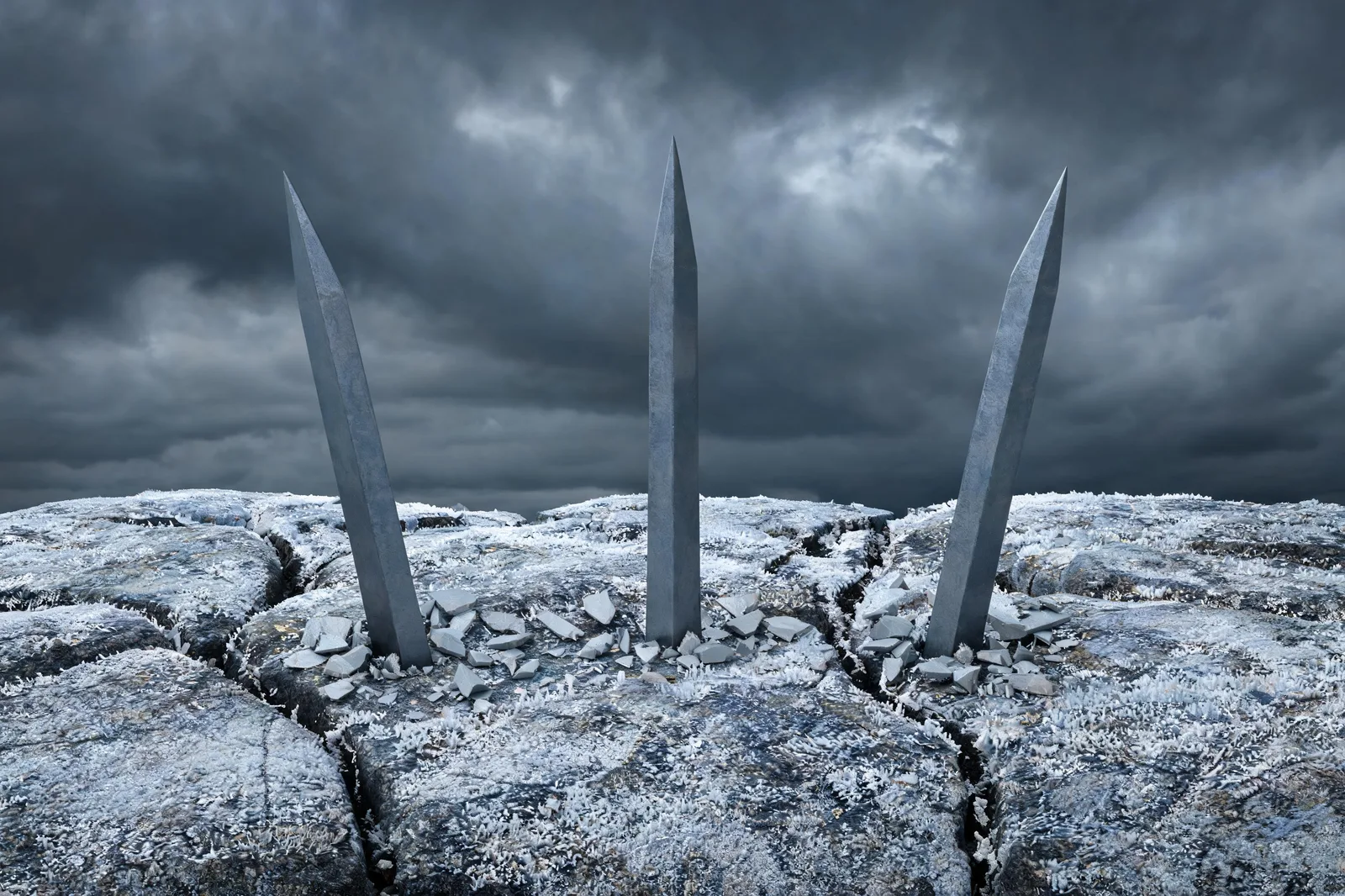
Crowley titled the Three of Swords Sorrow, and the Thoth deck does not soften the word. Where The Two of Swords, Peace: Moon in Libra showed two blades locked in a careful standoff, the three of swords sorrow design breaks that balance outright: a third edge enters, the symmetry fails, and something that was merely tense now actually wounds. This is the suit of Air at its most literal — thought that cuts clean through what it touches, with no promise of healing attached.
The Decan: Saturn in Libra
The Golden Dawn placed the Three of Swords in the second decan of Libra, roughly 3 to 12 October, under Saturn. Libra still asks for balance, but Saturn is the planet of limit, delay and consequence — the one member of the classical seven that never flatters. Where the Moon's decan before it produced an uneasy truce, Saturn's decan forces an accounting: a scale that has been kept artificially level for too long and now has to tip. Tradition holds that a Saturnine decan inside Libra describes grief that arrives through a ledger rather than through drama — a cost finally totalled, a bill nobody can defer again. Saturn in this scheme is rarely cruel for its own sake; it is simply unwilling to pretend that a debt has been paid when it has not.
Binah and the Shape Sorrow Takes
Every three in the Thoth deck answers to Binah, the third Sephirah, called Understanding. Binah is the Great Mother, the force that gives Chokmah's raw push an actual form — and form, in Kabbalistic terms, is also limit. To take shape is to accept an edge, a boundary, a place where a thing stops being infinite and becomes one specific thing instead. Binah, Understanding, and the Four Threes traces how every three in the deck carries this same weight of definition. In the suit of Air, Binah's gift turns painful: the mind, which lives by drawing distinctions, is finally forced to draw one it did not want — a relationship ended, a plan abandoned, a fact accepted. Sorrow, in this reading, is simply what clarity costs when the thing it clarifies is a loss.
Reading the Image: Blades Through a Broken Form
Harris painted the Three of Swords with three blades driven through a grey, splintered shape at the card's centre, set against a cold, colourless sky. Unlike the Two, where the swords merely met, here they pass through something and keep going, leaving it in pieces rather than holding it together. The palette drops the warmer tones found elsewhere in the suit; grey dominates, the colour of a sky that will not clear. Nothing in the composition asks to be read gently. Crowley's own commentary on the card treats it as one of the few in the deck where the only honest response is to let the picture say exactly what it shows, without softening its edges for comfort.
Compare this to the Three of Cups or the Three of Wands, where the same Binah energy appears as abundance taking shape, or virtue settling into a steady course. The suit changes everything. Water gives form a container to hold; Fire gives form a direction to travel in. Air gives form an edge, and an edge, once it exists, can also cut. That is the whole difference between the Threes: the number is constant, Binah's gift of structure is constant, but what each suit does with structure is not. Swords were always going to be the Three that hurts, because Air's structures are boundaries first and containers only by accident.
Sorrow Without a Villain
It helps to separate this card from the Five or Ten of Swords, which arrive later in the suit's decline. The Three of Swords rarely describes betrayal or deliberate harm; Saturn's decan is about structure failing under its own weight, not an enemy's attack. A reading that turns up this card is usually pointing at grief that has an honest cause: an ending that was earned by circumstance, time or an accumulation of small choices, not by malice. That distinction matters practically. Where some cards invite a search for someone to blame, the Three of Swords asks the reader to sit with the fact itself. The wound is real, the card insists, and no reframe removes it — but naming it accurately, rather than dramatizing or denying it, is the only way through.
The Three of Swords in a Reading
Set beside Swords Suit Symbolism in the Thoth Tarot: Air, Intellect and Conflict, the Three of Swords shows what Air becomes once its clean separations stop being merely intellectual and start costing something. In a spread such as Celtic Cross, it often marks the one position nobody wants to look at directly — the cost already incurred, rather than a danger still ahead. A session with TAROTS chat will treat it as information rather than warning: the loss has already happened, or is already decided, and the question left is how to carry it honestly. The card does not promise a timeline for that, and it refuses any neat moral about silver linings; Saturn's decans never trade in those. The next part of this series follows the suit forward into Jupiter's decan, where Libra's scale, for one card at least, is allowed to rest.
Questions
What does the Three of Swords mean in the Thoth Tarot?
Crowley titled it Sorrow: a third blade breaks the balance of the Two, marking a loss or ending that has an honest, earned cause rather than a villain.
Why is the Three of Swords linked to Saturn in Libra?
The Golden Dawn assigned the second decan of Libra, roughly 3 to 12 October, to Saturn. Libra's search for balance meets Saturn's demand for an accounting, producing grief delivered as a settled fact, not a drama.
What Sephirah governs the Three of Swords?
Binah, the third Sephirah, called Understanding. Binah gives Chokmah's raw force a shape, and in the suit of Swords that shape becomes an edge sharp enough to wound.
Is the Three of Swords always about betrayal?
No. It more often describes loss caused by circumstance or accumulated choices than by anyone's malice; that distinction belongs to later cards in the suit.
This article talks about
You might also like
 Swords
 Swords
 Swords
© 2026 TAROTS chat (tarots.chat). All rights reserved. No part of this article may be reproduced, distributed or adapted without the owner's written permission.
The Journal
From the Journal
Chosen for this page
 Symbolism
 Symbolism
The Serpent Symbol in the Thoth Tarot: Wisdom, Power and Kundalini Energy
2 min read
More in Symbolism Thoth Tarot
Where the Twenty-Two Letters Come From: Lévi's 1856 Attribution
8 min read
More in Thoth Tarot Tarot Journal
 Kabbalah
 Spirituality
 Symbolism
 Symbolism
 Kabbalah