The Two of Swords, Peace: Moon in Libra
by Redazione · 9 October 2026 · 5 min read
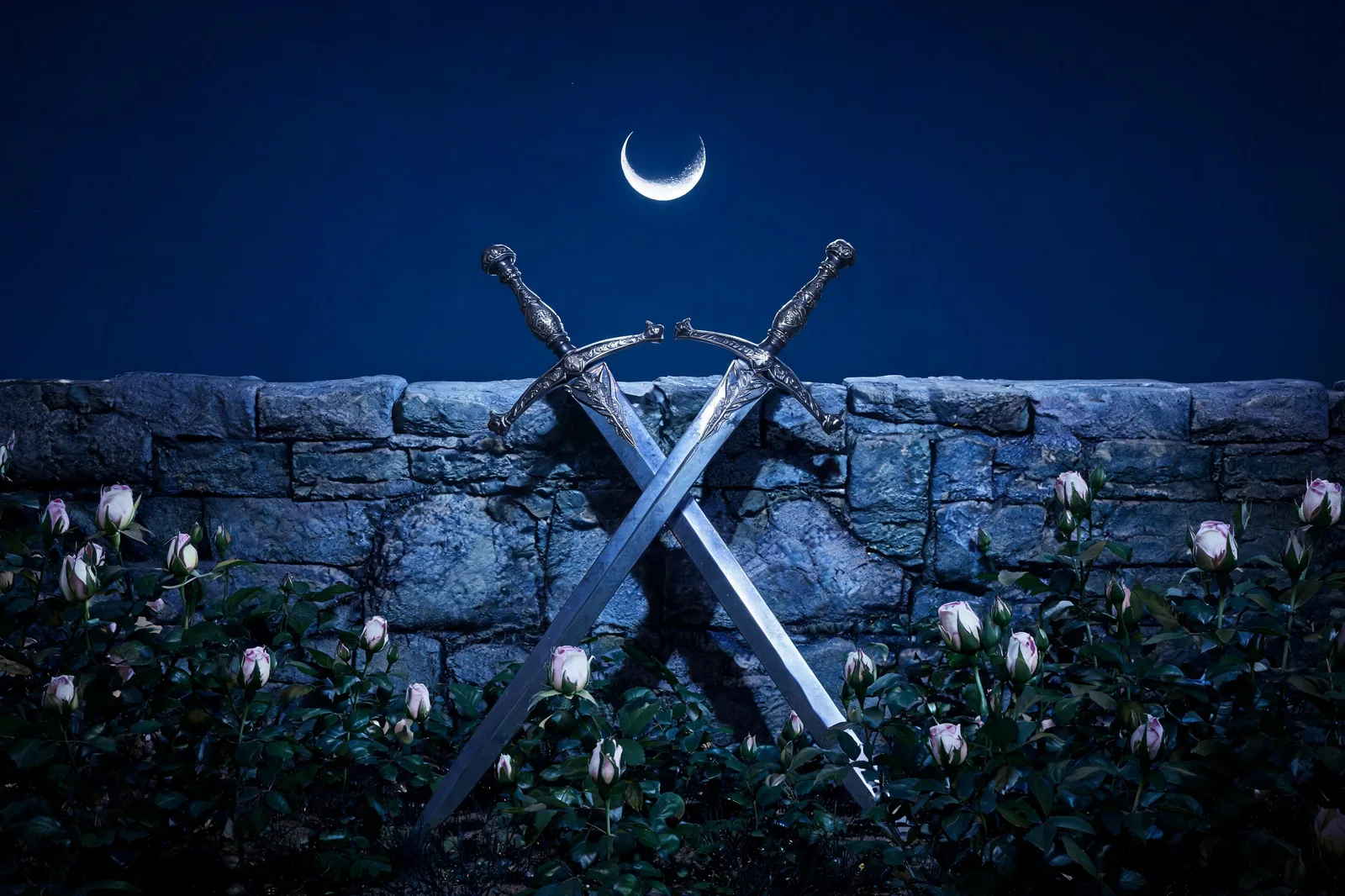
In the Thoth Tarot, the Two of Swords carries the title Peace — a balance held by equal and opposite pressure, not by trust. Crowley named every small card as well as numbering it, and the two of swords peace pairing says plainly what this suit does with conflict: Air exists to divide, and here the division is frozen mid-stroke, each blade canceling the other. It is a real peace, but a costly one, and it only holds while both sides keep their grip.
The Decan: Moon in Libra
The Golden Dawn gave each of the thirty-six small cards to a decan, a ten-degree slice of the zodiac ruled by one planet. The Two of Swords belongs to the first decan of Libra, roughly 23 September to 2 October, ruled by the Moon. Libra itself is Venus's cardinal air sign, the scales, concerned with weighing, pairing and fair exchange. The Moon added to that scale brings something less steady: mood, memory, the tide that will not stop moving. Tradition holds that a Moon-ruled decan inside an air sign of justice describes a peace made from feeling rather than from settled fact — an agreement reached because both parties are tired, not because either has changed their mind. Decans were already old by the time the Golden Dawn adopted them from Hellenistic and Egyptian astrology, and the attribution keeps that older sense of a planet coloring a narrow stretch of a sign rather than ruling the whole of it.
Chokmah and the Weight Behind the Number Two
Every two in the Thoth deck answers to Chokmah, the second Sephirah on the Tree of Life, called Wisdom. Chokmah is pure force without form yet, the first stirring after Kether's point, the Supernal Father pouring undifferentiated energy toward Binah, who will give it shape. Chokmah, Wisdom, and the Four Twos sets out why every two in the deck — wands, cups, disks and swords alike — carries that same raw thrust before it has settled into a pattern. In the suit of Air, though, this unformed energy meets intellect's business: separating one thing from another. The Two of Swords therefore shows Chokmah's force converted into stillness, two blades locked at the point where that first push would otherwise have driven them apart.
Reading the Image: Crossed Blades and a Closed Rose
Lady Frieda Harris painted the card with two curved swords crossing near their tips, framing a rose at the point of contact, under a sky holding a pale crescent. The rose, closed rather than open, reads as potential held in suspension: a resolution that has not been allowed to unfold. The crossing itself is the card's whole argument. Two swords meeting edge to edge do not merge into a stronger weapon; they lock, point against point, and the stalemate is the picture's entire subject. Nothing in the composition suggests warmth exchanged between the blades — only the geometry of a standoff rendered with Harris's usual exactness, each line calculated rather than loose.
Peace as Truce, Not as Resolution
The suit's cutting edge, introduced in Ace of Swords — Root of the Powers of Air, has by the second card turned on itself. Peace here is deliberately kept apart from harmony. A reader who draws the Two of Swords is usually looking at a truce someone is actively maintaining — a decision postponed, a disagreement papered over, a wound bandaged rather than healed. Older decks show the card's figure blindfolded, and even without that image Crowley's design keeps the same idea: looking away is part of how the peace is kept. The card rewards an honest question — is this rest, or is this avoidance? — more than a quick reassurance either way.
This matters because Air, more than the other three suits, is prone to mistaking stillness for resolution. A sword that has stopped moving has not necessarily won or lost; it may simply have met an equal force coming the other way. Crowley's broader argument for the suit treats every victory of the mind as temporary, since thought itself keeps moving once the immediate crisis has passed. Read that way, the Two of Swords is less a verdict than a snapshot: two forces at the exact moment of balance, before either tires and the blades slide apart again.
Where the Two of Swords Sits Among the Air Cards
Read beside Swords Suit Symbolism in the Thoth Tarot: Air, Intellect and Conflict, the Two of Swords marks the suit's first attempt to manage the conflict Air inevitably produces: not by removing it, but by matching it force for force. That makes it a useful card for a reading about a stalled negotiation, a cooling argument, or a mind refusing to pick a side until it must. At Celtic Cross, it often lands as a cross-current — the thing holding two other cards apart. A session with TAROTS chat will usually ask what the truce is costing, since Thoth's Peace was never meant to be mistaken for an ending. The next part of this series follows the suit into its third decan, where the same Air turns from a held balance into open grief.
Questions
What does the Two of Swords mean in the Thoth Tarot?
Crowley titled it Peace: a balance held by two equal, opposing forces rather than by genuine agreement. It often points to a truce or a postponed decision.
Why is the Two of Swords linked to Moon in Libra?
The Golden Dawn assigned the first decan of Libra, roughly 23 September to 2 October, to the Moon. Libra's search for balance meets the Moon's changeability, producing a peace built on feeling rather than settled fact.
What Sephirah governs the Two of Swords?
Chokmah, the second Sephirah, called Wisdom. It is the raw, unformed force of the number two, which in the suit of Swords becomes a standoff between two equal blades.
Is the Two of Swords a good or bad card?
Neither by itself. It describes a stalemate that can be protective or avoidant depending on what the reader is actually postponing.
This article talks about
You might also like
 Swords
 Swords
 Swords
© 2026 TAROTS chat (tarots.chat). All rights reserved. No part of this article may be reproduced, distributed or adapted without the owner's written permission.
The Journal
 Major Arcana
 Love
 Kabbalah
 Wands
 Kabbalah
 Kabbalah
 Symbolism
 Symbolism
 Kabbalah