The A∴A∴ and the Thoth Tarot as a Teaching Tool
by Redazione · 9 October 2026 · 5 min read
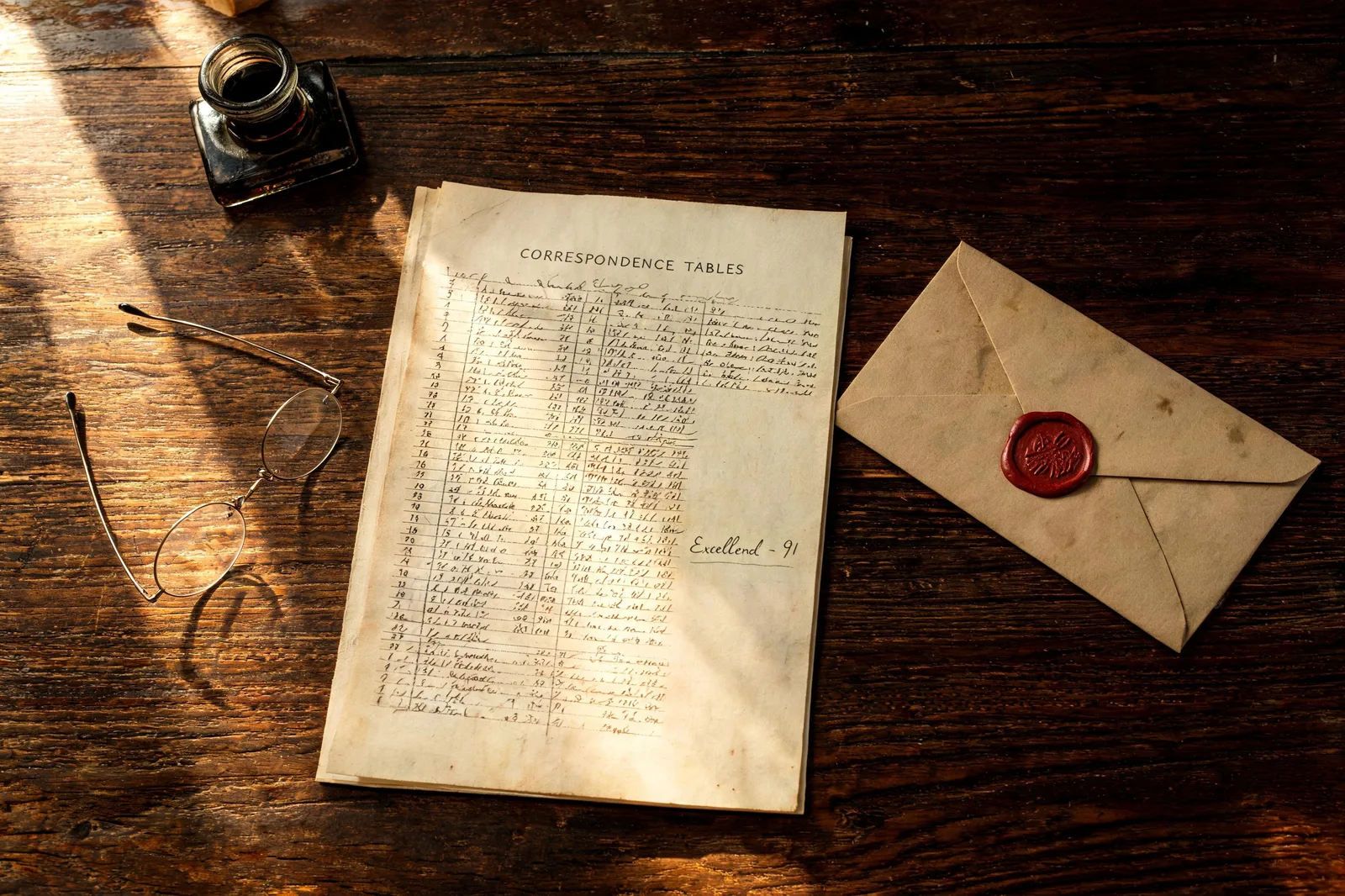
The A.A. order tarot curriculum built the cards into its training from the very grade structure, long before Aleister Crowley's own deck existed. A student working through the order's syllabus met the cards as an examined subject. That happened years before The Book of Thoth gave the subject its final form. Founded in 1907 by Crowley and George Cecil Jones, the order kept the Golden Dawn's grade ladder and much of its Qabalistic curriculum. It ran that ladder as a solitary path between a student and a personal superior, rather than a lodge.
A Silent Order, A Public Curriculum
The A∴A∴ (the letters are never spelled out in its own literature) never met as a congregation the way the Golden Dawn or the Stella Matutina did. Its structure survives mainly in print: Crowley published the order's reading lists, grade requirements and examinations openly in The Equinox, the journal he edited from 1909, on the theory that true secrecy lies in understanding, not in withholding a text. That decision means historians can reconstruct its curriculum with unusual precision, even where the order's actual membership and meetings remain obscure. George Cecil Jones, a chemist and Golden Dawn initiate, brought Crowley into magic in the first place. He co-founded the order and later sued a magazine for libel over its activities, one of the few moments the order's existence was tested in open court.
Where the A.A. Order Tarot Sat in the Grades
The published grade papers placed tarot study at the Practicus grade, the rung the Golden Dawn itself had long attached to Hod, the sphere of intellect, communication and Mercury on the Tree of Life. A Practicus was expected to know the correspondences of each trump and small card, to read with the cards competently, and to show that reading as a skill distinct from the meditative and ceremonial work set at other grades. This placement was not new: it continues the division the Golden Dawn had built decades earlier, discussed at length in The Hermetic Order of the Golden Dawn and Its Tarot Curriculum. What the A∴A∴ added was Crowley's own expanding correspondence tables, eventually gathered into Liber 777, which gave a Practicus far more columns to memorise than the Golden Dawn's original Book T ever held.
From Syllabus to Deck
For three decades the order's tarot teaching rested on written correspondences rather than a finished set of pictures; members used the Golden Dawn-derived Book T designs or drew their own. That changed only when Crowley, working with the painter Lady Frieda Harris from 1938, built the Thoth deck as a direct expression of the syllabus he had taught for thirty years. It drew on the same Golden Dawn papers that Israel Regardie's Publication of the Golden Dawn Papers later made public for a wider readership. The Book of Thoth, the deck's companion text, reads less like an introduction for newcomers than like a final examination paper, dense with the same Hebrew letters, planetary rulers and Hod-level distinctions the A∴A∴'s own grade papers had required for years. The The Hierophant, renamed the Hierophant still in Crowley's deck but reworked as a teacher of inherited law, stands near the start of that syllabus much as it had in older systems.
A Teaching Tool, Not a Fortune-Telling Kit
Reading Crowley's own instructions, the tarot's job inside the order was never primarily to predict events for a client. It was a mnemonic engine: seventy-eight images carrying the whole Qabalistic, astrological and elemental system in portable form, meant to be turned over daily until the correspondences became second nature. Divination was permitted and even required at Practicus level, but as a demonstration of fluency in the system rather than an end in itself. That emphasis still marks how the Thoth deck is taught today, including by readers who have no interest in the order that first assigned it a place in a syllabus: the cards reward study of their correspondences at least as much as intuitive reading. A modern Thoth reader who wants the order's own logic behind a spread is, in effect, still sitting the Practicus paper, decades after the grade that set it stopped meeting.
Several groups today still call themselves A∴A∴, each claiming continuity with Crowley's original lineage through a different line of succession; none of them controls the Thoth deck itself, which commercial publishers have printed and reprinted since 1969, well outside any order's membership rolls. That split between a contested lineage and a freely sold deck is itself instructive: the cards escaped the syllabus that built them, and most of the people who now study the Practicus correspondences do so from library copies of The Book of Thoth, not from a superior's hand.
Frequently Asked Questions
Did the A∴A∴ exist before the Thoth tarot deck was made? Yes. The order was founded in 1907; the Thoth deck was painted between 1938 and 1943, more than thirty years into the order's published curriculum.
At what grade did the A∴A∴ require tarot study? Its published papers set tarot correspondences and reading practice at the Practicus grade, continuing the Golden Dawn's own attachment of the subject to Hod.
Did ordinary members meet in lodges? No. The order worked through a private student-and-superior relationship rather than communal lodge meetings, with its syllabus published openly in The Equinox.
Is the Thoth deck only for A∴A∴ members? No. Crowley designed it as a public teaching document, and it is read today by people with no connection to the order that shaped its grade structure.
Questions
Did the A∴A∴ exist before the Thoth tarot deck was made?
Yes. The order was founded in 1907; the Thoth deck was painted between 1938 and 1943, more than thirty years into the order's published curriculum.
At what grade did the A∴A∴ require tarot study?
Its published papers set tarot correspondences and reading practice at the Practicus grade, continuing the Golden Dawn's own attachment of the subject to Hod.
Did ordinary members meet in lodges?
No. The order worked through a private student-and-superior relationship rather than communal lodge meetings, with its syllabus published openly in The Equinox.
Is the Thoth deck only for A∴A∴ members?
No. Crowley designed it as a public teaching document, and it is read today by people with no connection to the order that shaped its grade structure.
This article talks about
You might also like
 Major Arcana
 Symbolism
 Symbolism
© 2026 TAROTS chat (tarots.chat). All rights reserved. No part of this article may be reproduced, distributed or adapted without the owner's written permission.
The Journal
 Kabbalah
 Symbolism
 Symbolism
 Kabbalah
 Disks
 Symbolism
 Symbolism
 Symbolism
 Kabbalah