Why the Golden Dawn Swapped Strength and Justice
by Redazione · 7 October 2026 · 9 min read
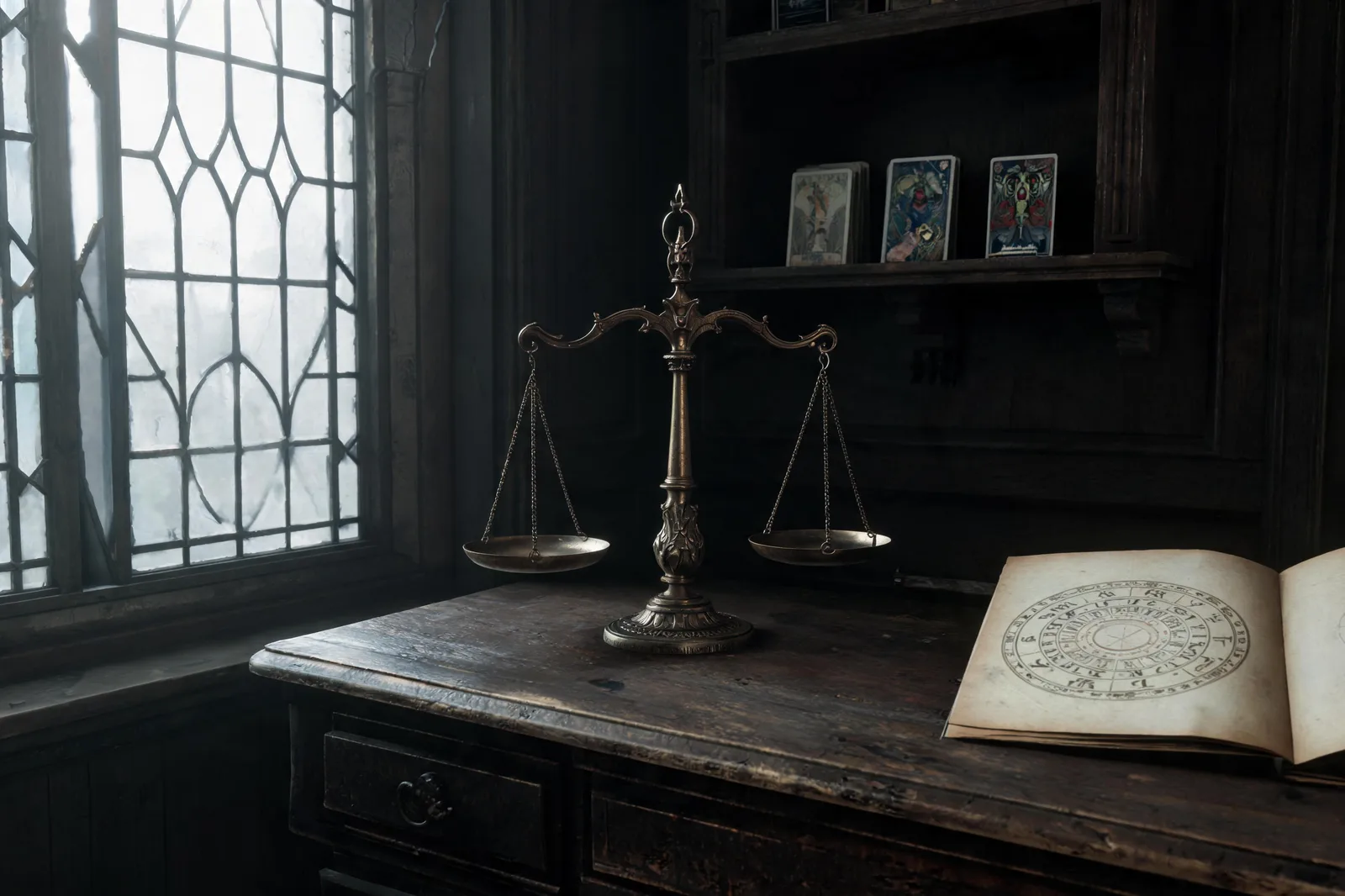
The strength and justice tarot order is the small argument that runs underneath most of what you think you know about the major arcana. In the Tarot de Marseille, the pattern that fixed the order of the trumps, Justice is the eighth and Strength the eleventh. In the deck most people actually reach for, they have been swapped: Strength sits at VIII, Justice at XI. In the Thoth deck the two are renamed and renumbered again, and now the question is whether you are reading the card or its shadow. This piece traces that single swap back to its source, and explains why the Golden Dawn moved them, why Aleister Crowley moved them back, and what a reader of the Thoth deck should do with the result.
The strength and justice tarot, in order
Start with the sequence you actually find in a deck. In the Tarot de Marseille, and in the order Éliphas Lévi still worked with in the 1850s, the two trumps sit in a fixed relationship. The Chariot is VII. Then Justice is VIII. Then the Hermit is IX. Then the Wheel of Fortune is X. Then Strength is XI. Justice comes before the Hermit; Strength comes after the Wheel. The earliest Italian decks were unnumbered, and their order changed from city to city: Michael Dummett sorts them into three families in The Game of Tarot (1980). The Marseille pattern is where the sequence became fixed.
That is the older arrangement, and it is not arbitrary. The two cards belong to a small family of virtues. Justice, Temperance and Strength (then called Fortitude) sit together in the middle of the arcana rather than being clustered at one end. Lévi, who did more than anyone to turn the tarot into a body of esoteric teaching, kept Justice at VIII and Strength at XI. If you want to know what "the old order" means, this is it: the virtue of weighing before the virtue of force, with the Hermit between them.
Why the Golden Dawn moved them
The break comes from the Hermetic Order of the Golden Dawn, whose teachings on the tarot were carried into print by Israel Regardie in The Golden Dawn (1937). The Golden Dawn did not treat the major arcana as a picture story to be read top to bottom. It treated them as a set of correspondences. Each trump was bound to a Hebrew letter, a sign of the zodiac, and a path on the Tree of Life. Count the trumps against the alphabet, the Fool on Aleph, the Magician on Beth, and so on, and trump VIII falls on Teth while trump XI falls on Lamed. In the Sefer Yetzirah Teth is Leo and Lamed is Libra. In the Marseille order that put the scales on the lion's letter and the lion on the letter of the scales.
So the Golden Dawn made the move that has ever since defined the modern deck. It gave Strength the position of VIII and Justice the position of XI. Strength, as the tamed lion, is the natural image for Leo. Justice, as the balanced scales, is the natural image for Libra. Put the two where their signs already sit, and the deck reads cleanly against the zodiac. Ronald Decker and Michael Dummett trace this reordering to the Cipher Manuscripts, the anonymous codices that formed the backbone of the Golden Dawn's tarot teaching (in A History of the Occult Tarot). In their account the swap is not a correction but a re-fitting: the sequence was bent so that the astrological correspondences would work, as the Strength card's history records.
What Waite froze into the modern deck
The Golden Dawn order would have stayed a society secret if not for Arthur Edward Waite. His Pictorial Key to the Tarot (1910), and the Rider-Waite deck built around it, printed the swapped arrangement for the world: Strength at 8, Justice at 11. Waite's meanings for the two cards are exactly the virtues you would expect. He gives Strength as "Power, energy, action, courage, magnanimity," and Justice as "Equity, rightness, probity." But the number on the card is already the Golden Dawn number, not the Marseille one.
From the 1910s onward the swapped order became the default in the English-speaking world, and most readers have never met the other arrangement. That is the quiet cost of a successful deck. One order's internal bookkeeping becomes the standard everyone inherits without knowing it. When a modern reader is told that Strength is the eighth card, they are reading a decision made in a London lodge, not a fact about the tarot.
Crowley's reversal in the Thoth deck
Aleister Crowley took the Golden Dawn's attributions and then undid the swap. In the Thoth deck the two cards are renamed and renumbered. The card most readers call Justice becomes Adjustment and returns to VIII. The card most readers call Strength becomes Lust and returns to XI. The names are Crowley's own, and the numbers go back to the old, Marseille order, as the Thoth deck's trump table sets out.
The letters, though, stay. In the Thoth deck Adjustment at VIII carries the letter Lamed and the sign Libra, and Lust at XI carries the letter Teth and the sign Leo. The card keeps its letter and its sign; only the number returns to where it was before the Golden Dawn. That is the precise thing that makes the Thoth arrangement both familiar and strange. You are reading the old sequence with the new attributions, and the two cards are now the mirror image of where your RWS-trained eye expects them.
Crowley did not do this to be inconsistent. In his "New Commentary" and in The Book of Thoth (1944) he argues that his order creates a symmetry the Golden Dawn lacks, a "double loop" in the way the letters and the signs run together. His local example is exactly this pair. Leo and Libra, at VIII and XI, turn around the pivot of Virgo at IX, in the way Aries and Aquarius turn around Pisces elsewhere in the deck. For Crowley the restored numbering is what makes the attributions perfectly symmetrical. That is his claim, in his own terms, and it is the best single reason the Thoth deck keeps the old numbers while holding onto the Golden Dawn letters.
The counter-reading
The strongest objection is a simple one. The swap is a nineteenth-century artefact. It was born in one order's attempt to make the zodiac fit the letters, and it is no more true than the Marseille order it displaced. Lévi kept the old sequence. The Golden Dawn changed it for bookkeeping. Waite commercialised the change. Crowley changed it again for symmetry. At every step the reason is internal to a system, not a fact about the cards.
There is a sharper point underneath that. The two arrangements are not equally grounded. The Marseille order is older and independent of any one esoteric school. The swapped order depends on the Golden Dawn's particular letter-sign mapping, and the Thoth order depends on Crowley's particular symmetry argument. If you do not accept the Golden Dawn correspondence table, the swap loses its only stated reason. Read that way, the correct order is whichever system you are committed to, and there is no neutral answer. The numbering is a position, not a property.
What it changes for a reader of the Thoth deck
Here the argument becomes practical, card by card. In the Thoth deck the card you learned as Strength is now Lust, and it sits at XI, not VIII. It carries Teth, the sign Leo, the element of fire. Its meaning is the same energy: directed force, the tamed lion, will disciplined into power. Only its position in the sequence has moved back to the older place. For that card read on its own, see Lust Tarot Card Meaning in the Thoth Deck: Passion, Focus and Directed Energy.
The card you learned as Justice is now Adjustment, and it sits at VIII, not XI. It carries Lamed, the sign Libra, the element of air. It is the balanced scales, the weighing of cause and effect, the same virtue at the older number. For that card read on its own, see Adjustment Tarot Card Meaning in the Thoth Deck: Balance, Justice and Equilibrium.
Three consequences follow. First, when a Thoth reading returns VIII or XI, the card you meet is not the one your RWS memory expects. VIII is Adjustment, your old Justice. XI is Lust, your old Strength. Second, the letters and signs are the through-line. Teth and Leo, Lamed and Libra, travel with the card across every system, so the work you have done on the Tree of Life is unaffected by which number the card wears. The mapping of the trumps to the letters is covered in Tarot and Kabbalah: How the 22 Trumps Became the Hebrew Letters. Third, Crowley's own key to the deck reads the sequence the way he arranged it, so a reader should follow Aleister Crowley's Book of Thoth Explained for the Thoth order and treat the RWS order as a different, equally valid, system.
The deeper lesson is that the number on a card is not the card. The virtue, the letter, the sign and the element are the durable content. The numeral is a position, and position is where the three traditions disagree. Read the number, and you are reading a choice someone made in the 1880s, 1910 or 1943. Read the letter and the sign, and you are reading the same symbol in all three.
Questions readers ask
Which order is correct, Strength at VIII or Justice at VIII? There is no neutral answer. The Marseille and Thoth orders put Justice at VIII and Strength at XI. The Golden Dawn and Rider-Waite put them the other way. Each follows from a different correspondence system.
Why is the card called Lust in the Thoth deck instead of Strength? Crowley renamed it to name the energy itself, directed force and will, rather than the moral virtue the older word implies. It is the same lion-and-woman image, and it returns to XI, the old Strength position, with the letter Teth.
Why is the card called Adjustment in the Thoth deck instead of Justice? Crowley's name points to the weighing and rebalancing of cause and effect, the energy of the sign Libra. The card sits at VIII, the old Justice position, with the letter Lamed.
Do I need to know this to read the deck? Only if you want to follow the sequence Crowley wrote for. For a single reading, the meaning of the card in your hand is what matters. The numbering matters when you read the deck as a whole, the way the Tree of Life reads the trumps as one continuous path.
Questions
Which order is correct, Strength at VIII or Justice at VIII?
There is no neutral answer. The Marseille and Thoth orders put Justice at VIII and Strength at XI. The Golden Dawn and Rider-Waite put them the other way. Each follows from a different correspondence system.
Why is the card called Lust in the Thoth deck instead of Strength?
Crowley renamed it to name the energy itself, directed force and will, rather than the moral virtue the older word implies. It keeps the same lion-and-woman image and returns to XI, the old Strength position, with the letter Teth.
Why is the card called Adjustment in the Thoth deck instead of Justice?
Crowley's name points to the weighing and rebalancing of cause and effect, the energy of the sign Libra. The card sits at VIII, the old Justice position, with the letter Lamed.
Do I need to know this to read the deck?
Only if you want to follow the sequence Crowley wrote for. For a single reading, the meaning of the card in your hand is what matters. The numbering matters when you read the deck as a whole, the way the Tree of Life reads the trumps as one continuous path.
You might also like
 Kabbalah
 Kabbalah
 Major Arcana
© 2026 TAROTS chat (tarots.chat). All rights reserved. No part of this article may be reproduced, distributed or adapted without the owner's written permission.
The Journal
From the Journal
Chosen for this page
 Major Arcana
Lust Tarot Card Meaning in the Thoth Deck: Passion, Focus and Directed Energy
3 min read
More in Major Arcana Kabbalah
 Thoth Tarot
 Kabbalah
 autumn
 Kabbalah
 Kabbalah