Commitment Questions: Reading the Hierophant and the Four of Wands Together
by Redazione · 9 October 2026 · 5 min read

A commitment tarot reading asks a sharper question than most love spreads: not whether feeling exists, but whether a structure can hold it. The Thoth deck gives two very different cards to that question. The Hierophant speaks of commitment as form — a vow, a shared tradition, a structure recognised beyond the two people inside it. Four of Wands — Completion, Completion, speaks of commitment as something built — a home finished, a foundation settled by labour rather than declaration. Reading them together shows whether a relationship's commitment is formal, lived-in, both, or neither yet.
Two different kinds of commitment
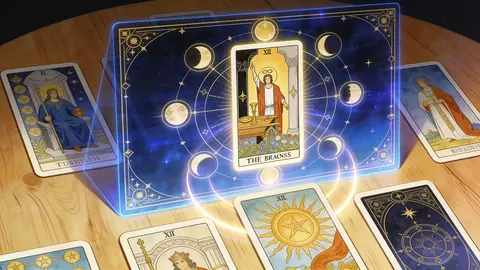
The Hierophant, numbered five, carries the weight of institution: marriage, formal partnership, a bond recognised by family, faith, or law. Crowley kept the Rider-Waite title but placed the card firmly among structures that outlast any one couple — the sense that a commitment is witnessed by something larger than the two parties alone. In a reading, this card asks whether a relationship wants, or already has, that kind of outward recognition.
The Four of Wands works differently. Its number falls among the small cards, not the trumps, and its meaning sits close to the ground: walls raised, a roof set, a home that functions because two people have actually done the work of building it together. Completion here is not a ceremony; it is evidence — shared routines, shared effort, a life that has, in fact, been constructed rather than merely promised.
A relationship can have one without the other. A couple can hold a formal commitment, the Hierophant's structure, while the Four of Wands' lived foundation is still thin — a marriage on paper, not yet built in daily practice. Equally, two people can have built an unmistakably solid life together, the Four of Wands fully present, while never naming or formalising it with anything like the Hierophant's structure. Neither configuration is a verdict on the relationship's worth.
Reading them side by side in a spread
Place the Hierophant and the Four of Wands in positions describing, respectively, the relationship's outward form and its lived substance, and the comparison does real work. Both strong: a commitment matched by its structure, unusually stable. Hierophant strong, Four of Wands weak: a formal bond that has not yet been built day to day, worth naming honestly rather than assuming the ceremony alone will carry it. Four of Wands strong, Hierophant absent: a foundation worth recognising even without, or before, any formal step — a reading should never imply this kind of bond is lesser for lacking a ceremony.
This companion reading follows naturally from Love and Freedom: The Fool in a Relationship Reading, the earlier piece in this series on freedom within a bond. The Fool marks the space before a shape is chosen; the Hierophant and Four of Wands describe what happens once a shape has started to form, whether through declaration, through daily building, or both.
What this reading cannot decide
No pairing of cards tells a querent whether they should marry, move in, or formalise anything. It describes two separate dimensions of a bond's maturity — form and substance — and lets the querent see where their own relationship actually stands between them, rather than assuming the two always arrive together. Arnold van Gennep's study of rites of passage treats formal thresholds like marriage as marking a change already underway rather than creating it outright — a useful frame for a reader tempted to treat the Hierophant alone as proof that anything has really changed.
The honest reading names both layers clearly: what is formally recognised, and what has actually been built. The decision to seek one, both, or neither remains entirely the querent's, made with the people in their life, not with a card.
A simple two-question check
When these two cards appear together, ask the querent two questions in turn: does this relationship have the outward recognition they want, and, separately, has it been built day to day the way they would want it to last. Their answers, set against what the cards show, usually reveal which kind of commitment is present, which is missing, and which the querent actually values more — a distinction worth more than any single verdict a reading could offer.
FAQ
Does the Hierophant mean marriage specifically? It points to a formally recognised structure, which marriage is one example of. Any socially witnessed commitment can fit this reading.
What does the Four of Wands mean without the Hierophant present? A solidly built, lived-in bond without formal recognition — a foundation worth respecting on its own terms, not a lesser version of commitment.
Can this reading tell me if I should get married? No. It describes the current balance between formal and lived commitment. The decision belongs to the querent and the people in their life.
What if neither card appears strongly? It usually means the relationship has not yet moved toward either formal or lived commitment, which can be entirely appropriate depending on its stage.
Questions
Does the Hierophant mean marriage specifically?
It points to a formally recognised structure, which marriage is one example of. Any socially witnessed commitment can fit this reading.
What does the Four of Wands mean without the Hierophant present?
A solidly built, lived-in bond without formal recognition, a foundation worth respecting on its own terms.
Can this reading tell me if I should get married?
No. It describes the current balance between formal and lived commitment. The decision belongs to the querent and the people in their life.
What if neither card appears strongly?
It usually means the relationship has not yet moved toward either formal or lived commitment, which can be entirely appropriate depending on its stage.
This article talks about
You might also like
 Love
 Love
 Love
© 2026 TAROTS chat (tarots.chat). All rights reserved. No part of this article may be reproduced, distributed or adapted without the owner's written permission.
The Journal
 Symbolism
 Learn Tarot
 Kabbalah
 Symbolism
 Major Arcana
 Kabbalah
 Symbolism
 Symbolism
 Kabbalah