A Game Called Trionfi: What the Visconti-Sforza Deck Actually Is
by Redazione · 7 October 2026 · 10 min read
The Visconti-Sforza Tarot is not a prophecy engine. It is a set of playing cards made in Milan in the 1450s for the dukes of Milan. They are painted on tooled gold, and they were built to be played. The exact rules of the game have been lost, but the cards still show you the game. This is the first fact the deck resists you learning: the oldest tarot that survives anywhere is a game. The esoteric meanings you carry into a Thoth reading were not waiting inside these cards for someone to find them. That is the letter attributions, the Tree of Life, the planetary and zodiacal correspondences. They were invented, piece by piece, beginning in 1781. Every later attribution, from Éliphas Lévi to Aleister Crowley, descends from that invention. It does not come from the cards themselves. This article opens the series «Before the Esotericists: The Tarot as a Game, 1450-1780» (Part 1 of 5). It takes the deck on its own terms: what the oldest surviving cards show, what game they were made for, and why that matters before you turn one over for a reading.
The oldest cards are a game deck, not an oracle
The Visconti-Sforza Tarot is a collective name. It covers roughly fifteen incomplete decks from the middle of the fifteenth century. They are now scattered across museums and private collections. The Morgan Library and Museum in New York holds a share of them. The Accademia Carrara in Bergamo holds another. Yale's Beinecke Rare Book and Manuscript Library holds a third, and the Pinacoteca di Brera in Milan holds more. No complete deck has survived. The largest surviving set is the Pierpont Morgan Bergamo pack. It was made around 1451 and originally held seventy-eight cards. Seventy-four remain: twenty trumps, fifteen face cards, and thirty-nine pip cards. The two trumps that are gone are the The Devil (Devil) and the The Tower (Tower).
They were commissioned by Filippo Maria Visconti, Duke of Milan. His successor and son-in-law Francesco Sforza also commissioned cards. The Metropolitan Museum of Art has studied the group closely. It attributes all three surviving luxury sets to the workshop of the Milanese court painter Bonifacio Bembo. The Met stresses what the cards are not. It says that in the Renaissance tarot cards were not the paraphernalia of fortune tellers. They were used in a normal card game enjoyed by the nobility. The link between tarot and the occult is, in the Met's words, a nineteenth-century development. It has nothing to do with the medieval tarot cards. That is the Metropolitan Museum of Art's own account of the group.
The earliest written reference to a trump deck dates to a letter of 11 November 1449. The Venetian senator Jacopo Antonio Marcello wrote it. He asks for "a deck of the game of triumphs," triumphorum genus. The deck was commissioned by the Duke of Milan and painted by Michelino da Besozzo. "Trionfi" is simply the Italian word for trumps. English "trump" and German "trumpfen" both come from it. By the time of the Visconti-Sforza packs, the game had settled its shape. It used the standard Italian suits: cups, swords, batons, and coins. The values ran from ten down to one. Each suit had four face cards, a king, a queen, a knight, and a knave. That made fifty-six pip and face cards, plus a fool and twenty-one trumps. The surviving cards make the point unmistakable. It was a trick-taking game.
What the surviving trumps actually show
A card game is two systems at once. It is a system of rank, and it is a system of pictures. The Visconti-Sforza trumps are remarkable for both. In the surviving Pierpont Morgan Bergamo order, the highest trump is the World. Then come the Angels, the Sun, the Moon, and the Star. Temperance follows. Then Death (Death), the Traitor, the Old Man, and the Wheel of Fortune. Fortitude, the Chariot, Justice, and Love come next. The Pope, the Emperor, the Popess, and the Empress close the sequence, with the Mountebank and the Fool at the very end. That is a specific, checkable order. It is not the order of the deck in your hand.
The Met notes that the older Visconti Tarot is even freer in structure. It has as many as six court cards per suit. It runs a male and a female of every rank. It also adds three trumps that never enter the standard game: Faith, Hope, and Charity. The Met is careful to say the answer is uncertain. It is unclear whether this pack was uniquely structured. Or it may represent an earlier stage before the tarots were standardized. That uncertainty is the point. You are looking at the deck at the moment it was still being decided. It was not a finished esoteric program. The Visconti-Sforza Tarot entry on Wikipedia records the same uncertainty about the pack's structure.
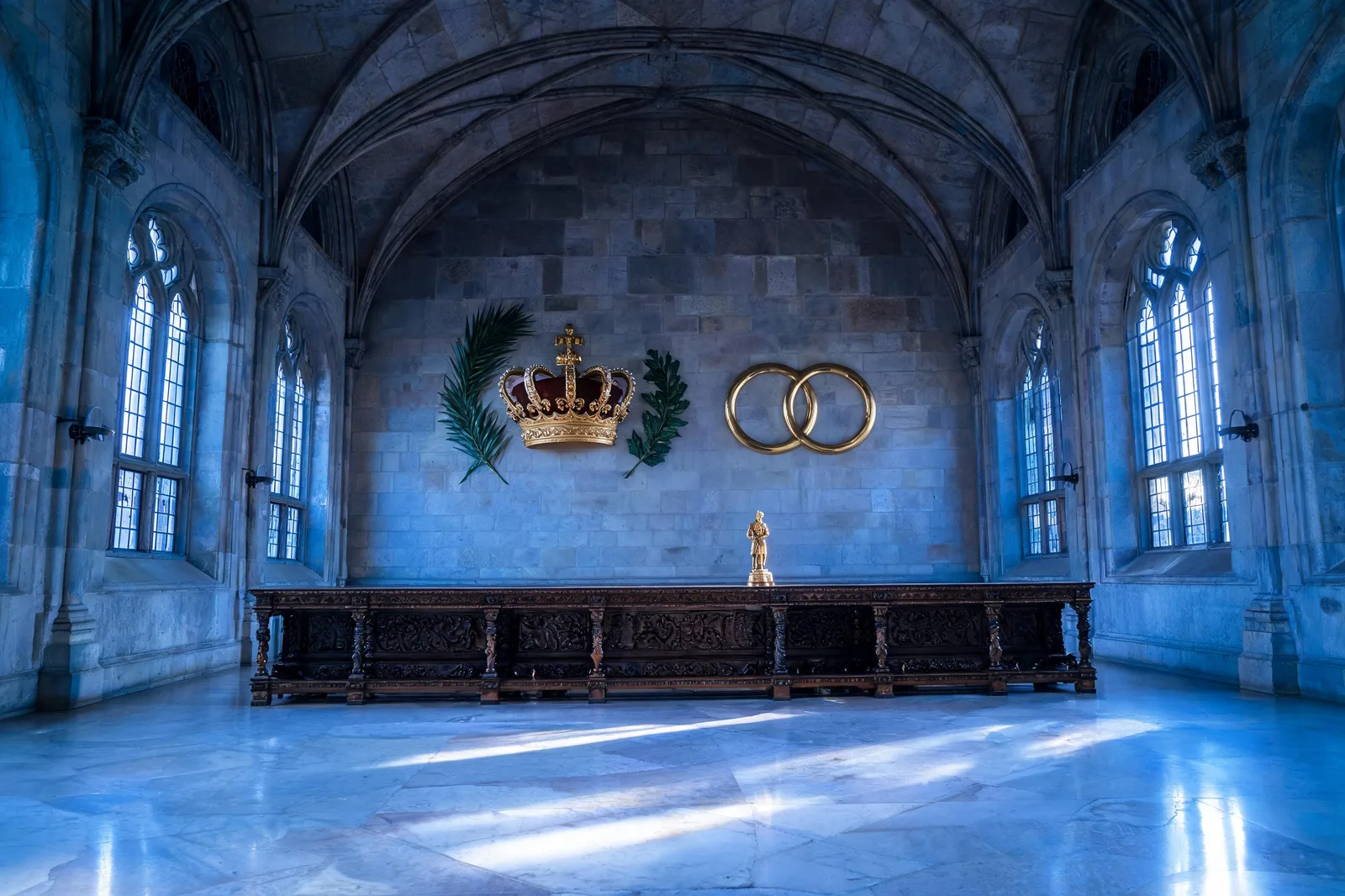
The pictures are a window into Renaissance Milan as much as into any symbolism. The trumps sit on a tooled gold ground. The pips sit on cream paper with a flower-and-vine motif. The figures wear the actual garments of the court that commissioned them. The cards carry the ducal crown of Milan with its palm and laurel. They carry the Sforza interlinked rings and the livery of the household. If you want to know what a Milanese duke's court looked like in the 1450s, this is a better source than any fresco. It was made for a duke to play with.
The Fool's place and the court cards
Two details of the deck's structure matter most for the reader of the Thoth deck. Both concern cards you turn over every session.
The first is the The Fool (Fool). In the Visconti-Sforza order the Fool is the last card. It is the lowest trump, sitting below the Mountebank. In the older Visconti Tarot the Fool is a wild or "excuse" card. It is the matto, not a numbered position at all. When the Thoth deck gives the Fool the number 0 and places it before the Magus, it makes a decision. The oldest surviving cards never made that decision. The Fool in Milan was the card that let you out of a bad trick. The Fool in Thoth is the card that walks before the whole system. These are not the same card in a different costume. They are a different conception of the same figure. The difference runs all the way to how you read it.
The second is the court. The standard game settled on four court cards per suit. They are the page, the knight, the queen, and the king. The older Visconti deck still runs six, a male and a female of each rank. The Thoth deck inherits the four-court structure. But its pages, knights, queens, and kings are drawn from a Kabbalistic and planetary logic. None of that logic appears in any surviving fifteenth-century pack. When you read a Knight of Wands in Thoth, you are reading a card with a long history. It has passed through the Marseille pattern, the Golden Dawn, and Crowley's letter attributions. None of those layers is in the Bembo workshop.
The one inversion that survived
The most concrete difference you can check with a deck in your hand concerns Strength and Justice. In the surviving Visconti-Sforza order, Fortitude sits above the Chariot. Justice sits below it. The Marseille and Thoth decks call Fortitude Adjustment (Strength). In the Marseille numbering that the Thoth deck follows, the two are reversed. Strength is the Eighth trump and Justice is the Eleventh. So Justice outranks Strength. The Golden Dawn swapped the two relative to the older Italian order. The Thoth deck keeps the swap. This is a small thing on the face of it. But it is a clean, verifiable example of the series' thesis in miniature. The order of the trumps you read is not the order the oldest cards were in. The deck you hold is a later arrangement of an earlier deck. The esoteric reading began to attach itself at that later stage.
The counter-reading: a deck that was already "sacred"
The strongest objection to "it was just a game" comes from the deck's own history. The trumps are not arbitrary. They are allegorical personifications. They cluster around ideas a fifteenth-century court would recognize. Fortune, Temperance, Death, and the Wheel all come from Roman and Christian moral tradition. The scholar Giordano Berti has argued that one set of denari cards carries the obverse and reverse of a golden florin. He says it was minted by Filippo Maria Visconti in 1442 and withdrawn at his death in 1447. On that basis he dates the deck between 1442 and 1447. The cards were made with intention, for specific people. They marked specific events: marriages, triumphal entries, the ducal succession.
None of that contradicts the thesis. It refines it. A deck can be a deliberate, meaningful object and still not be an oracle. "Meaningful" in the fifteenth century meant something specific. It meant a picture of the world as a court understood it. It did not mean a map of the soul as a Kabbalist understands it. The first reading of the tarot as a mystical system is a documented, datable event. Etteilla laid the ground in the 1750s. Court de Gébelin's Egyptian myth followed in 1781. Neither was a recovery of something the deck already contained. The deck was rich, but it was rich in the way a courtly game is rich. It was not rich in the way a sacred text is rich.
What this does to the Thoth deck
None of this is an argument against the Thoth deck. The Thoth deck is one of the most coherent esoteric systems ever built into a deck. The letter attributions are a genuine achievement of their tradition. So are the planetary and zodiacal correspondences and the Tree of Life. What the Visconti-Sforza cards do is give you a baseline. They are the baseline against which to measure the Thoth deck. They tell you that the Fool you read is not the card the game knew. They tell you that the order of the trumps is a later arrangement. The court cards are a later simplification of an older and stranger set. The whole Kabbalistic and planetary architecture is a later overlay on a fifteenth-century game. Knowing that does not subtract from the Thoth deck. It tells you exactly what layer you are reading when you open it. It keeps you from mistaking a later attribution for something the card itself says. That is what the rest of this series will do. It will follow each attribution back to the moment it was made. It will separate the deck you hold from the deck that came first.
Questions
Is the Visconti-Sforza Tarot a complete deck?
No. Roughly fifteen incomplete decks survive, none of them complete. The largest, the Pierpont Morgan Bergamo pack, was made around 1451 and originally held 78 cards; 74 remain.
Were tarot cards used for fortune-telling in the 1400s?
No. They were a trick-taking card game for the nobility. The association of tarot with the occult is a 19th-century development.
Who painted the surviving luxury decks?
The workshop of the Milanese court painter Bonifacio Bembo, commissioned by Filippo Maria Visconti and by Francesco Sforza.
Why is the Fool the last card in the oldest decks?
In the surviving Visconti-Sforza order the Fool sits at the end, below the Mountebank. In the older Visconti Tarot it is a wild or excuse card, not a numbered position at all.
This article talks about
- #golden dawn
- #major arcana
- #series-before-the-esotericists-the-tarot-as-a-game-1450-1780
- #tarot decks
- #tarot symbolism
- #thoth tarot
You might also like
 Thoth Tarot
 Thoth Tarot
 Kabbalah
© 2026 TAROTS chat (tarots.chat). All rights reserved. No part of this article may be reproduced, distributed or adapted without the owner's written permission.
The Journal
 Thoth Tarot
 Kabbalah
 Major Arcana
 autumn
 Kabbalah
 Kabbalah