Etteilla's Invention: The First Tarot Interpretation System
by Redazione · 7 October 2026 · 8 min read
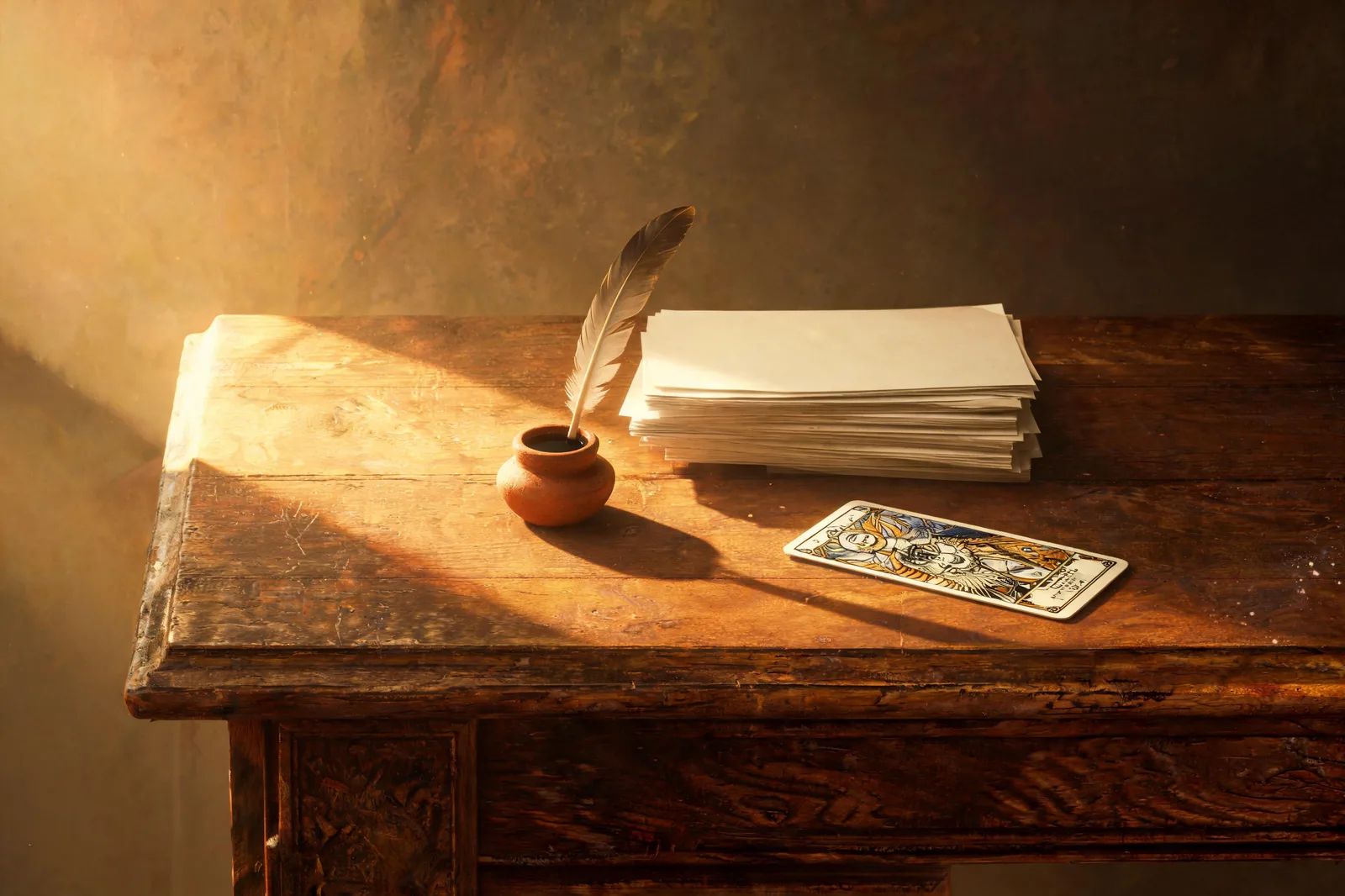
The etteilla tarot interpretation is the oldest system for reading the trumps that survives anywhere. It is not a discovery. It is an invention, made by one man in 1783. That man was Jean-Baptiste Alliette, and he published his system under a name that is his surname spelled in reverse. Every later reading you have ever done descends from what he built. When you turn the The Fool (Fool) in Thoth and read him as the number 0, before the Magus, you are reading a decision that was made in the late eighteenth century. It was not waiting inside the card for someone to find it. This is the second part of the series «Before the Esotericists: The Tarot as a Game, 1450-1780». In A Game Called Trionfi: What the Visconti-Sforza Deck Actually Is (A Game Called Trionfi), Part 1 took the Visconti-Sforza cards on their own terms. This one takes the man who turned them into an oracle, and shows exactly what he added. The argument is simple. The meaning was not recovered. It was authored. And once it was authored, every later attribution inherits its terms from him.
The man behind the name
Jean-Baptiste Alliette was born in Paris on 1 March 1738, and he died there on 12 December 1791. His father was a caterer, a maître rôtisseur. His mother sold seeds. He married Jeanne Vattier in 1763, and the marriage lasted about five years. After that he worked as a seed merchant himself. He published his first book in 1770, before he ever turned to the cards. The name Etteilla is not a mystic title. It is Alliette read backwards. The Wikipedia entry for Etteilla gives the same dates and the same reading of the name. He was not a priest, a philosopher, or a member of an order. He was a small Parisian print seller who decided to make a living from the cards. That is the part most accounts skip. The first professional tarot reader in the record was a tradesman.
The 1783 book that started the etteilla tarot interpretation
The work that matters is the Manière de se récréer avec le jeu de cartes nommées tarots. The title means a way of recreating yourself with the deck of cards called tarots. Etteilla published it from 1783 to 1785, in a series of parts, and it is still the standard reference work of tarot cartomancy. It is the first printed book that gives a method for reading the trumps. Before 1783 there was no such book. There were game rules, and there were cards, and there was a long history of the deck as a pastime. There was no system for drawing a card and reading what it meant. That system begins with this publication, and it begins as his. He did not find an ancient manual. He wrote one.
In the preface Etteilla says he learned his system from an Italian, and he claims he was introduced to the art of cartomancy as early as 1751. That claim predates the Egyptian myth by a decade, and it is worth holding onto. It shows that he was building a personal system, not recovering a received one. He was positioning himself against the current fashion. Court de Gébelin had published the Egyptian idea in 1781, and the deck was suddenly ancient. Etteilla answered with a system of correspondences. He did not need the Egypt. He needed a method, and he gave people one. The Wellcome Collection holds one of his tarot collages, dated between 1780 and 1789, which shows how central the deck was to his public work in that decade.
The correspondences he actually built
This is where the invention is concrete, and where you can check it. Etteilla built a web of correspondences around the deck. He assigned the four suits to the four classical elements. He wove the signs of the zodiac into the major trumps. He found a place for the Hebrew letters in the same system. None of this was read off the pictures. It was laid over them. The pictures did not demand it. The system did.
You can see the method at work in the suits. In the game the four suits are four ways to count. In the reading they are four kinds of substance. Etteilla names the four elements and attaches each to a suit, so that a draw in one suit is read as a draw in a state of nature. That is not a description of the pictures. It is a translation of them. The pictures stay the same. What changes is what the pictures are allowed to mean. A card that once told you you had won the trick now tells you something about the element it stands for. The move is small, but it is the move. It is the moment the deck stops being a game and starts being a language.
The point of the web was coherence. A card game gives you rank and trick. A reading system gives you meaning. Etteilla converted the first into the second. The Fool became a position in a sequence. The trumps became a map. The four suits became the four elements. Once that map existed, a reader could say something about a card that a player never could. The deck was no longer only a thing you played. It had become a thing you interpreted. And the interpretation had an author, a date, and a method. That is the whole difference between the Milan of 1450 and the Paris of 1783.
The deck he drew for the reading
The second part of the invention is the deck itself. In 1789 Etteilla published his own tarot, drawn specifically for divination. It was the first tarot deck made to be read rather than played. The difference from the Marseille pack is not decorative. It is structural. His deck changed the structure and the names of the cards. He was not illustrating a fixed tradition. He was building a new one around the system he had already written. When the card and the meaning were designed together for the first time, the deck became an instrument of the reading. That is what the Visconti-Sforza cards were never made to be.
The 1789 deck matters for a reason that is easy to miss. It closed the loop. The 1783 book gave the cards meanings. The 1789 deck gave the meanings their own pictures. After that, the two could not be separated. A later reader could not easily look at a tarot deck and treat it as a mere game, because the deck now carried the reading in its very design. The invention had become the object.
Why every later system traces back to him
The reason the later attributions all point to Etteilla is that he was first. He set the terms of the question. He decided that a card could carry a meaning that the player never saw. He decided that the meaning came from a web of correspondences, not from the picture alone. Once that move was made, the later work became a matter of filling in the details. Éliphas Lévi added the letters and the tree. Papus added the planetary assignments. The Golden Dawn added the sephirotic correspondences. Crowley added his own layer on top of all of it. Each of them worked inside the frame Etteilla built. They disagreed with him, and they changed his details, but they did not abandon the idea that the trumps are a map. That idea is his.
Marie Anne Lenormand, the famous French diviner, worked inside the same field. She is a later name, but the ground was already laid. The profession of the card reader was established in the eighteenth century, and it was established by a man with a reversed name and a 1783 book. Everything since is a variation on a theme he wrote down.
What this does to the Thoth deck
None of this is an argument against the deck you hold. The Thoth deck is a complete and deliberate esoteric system. Its letter attributions, its Tree of Life, its planetary and zodiacal correspondences, are a genuine achievement of their tradition. What this history does is give you the date on each layer. The meaning is real. But it is also authored. When you read the Fool as the number 0, you are reading a decision from the late eighteenth century and after. When you read the trumps as a map of the soul, you are reading inside the frame that Etteilla set in 1783. None of that was in the Milanese cards. It was added, by name, by method, and by date.
That is the baseline the rest of the series will keep returning to. The next part follows the Egyptian idea itself, the one that gave the whole field its aura. After that, the letters, the tree, and the planetary layer, each traced to the moment it was made. The deck you read is a stack of those moments, and the Thoth deck is the most complete stack of all. Knowing the order of the layers is not a way to subtract from it. It is a way to see exactly what you are reading when you open it.
Questions
Who was Etteilla?
Jean-Baptiste Alliette (1738-1791), a Parisian print seller. Etteilla is his surname spelled in reverse. He is the first professional tarot reader known to the record.
What did Etteilla publish in 1783?
The Maniere de se recreer avec le jeu de cartes nommees tarots, the first printed book giving a method for reading the trumps, still the standard reference of tarot cartomancy.
Did Etteilla discover the tarot meanings or invent them?
Invented them. He laid a web of correspondences over the existing game cards. The pictures did not demand those meanings; the system supplied them.
Why do later systems trace back to him?
Because he was first. He set the frame that the trumps are a map of correspondences, and each later author worked inside that frame, changing the details, not the premise.
Did the Visconti-Sforza cards carry these meanings?
No. They were a game. The esoteric layer began with Etteilla and the circle after him, and was added to the deck by name, date, and method.
This article talks about
- #series-before-the-esotericists-the-tarot-as-a-game-1450-1780
- #tarot decks
- #tarot symbolism
- #thoth tarot
You might also like
 Thoth Tarot
 Thoth Tarot
© 2026 TAROTS chat (tarots.chat). All rights reserved. No part of this article may be reproduced, distributed or adapted without the owner's written permission.
The Journal
From the Journal
Chosen for this page
 Thoth Tarot
A Game Called Trionfi: What the Visconti-Sforza Deck Actually Is
10 min read
More in Thoth Tarot Thoth Tarot
 Kabbalah
 Thoth Tarot
 Major Arcana
 autumn
 Kabbalah