Pseudo-Dionysius in the High Priestess: Apophatic Theology on a Card
by Redazione · 8 October 2026 · 9 min read
What the High Priestess already is, and what the high priestess apophatic tarot reading adds
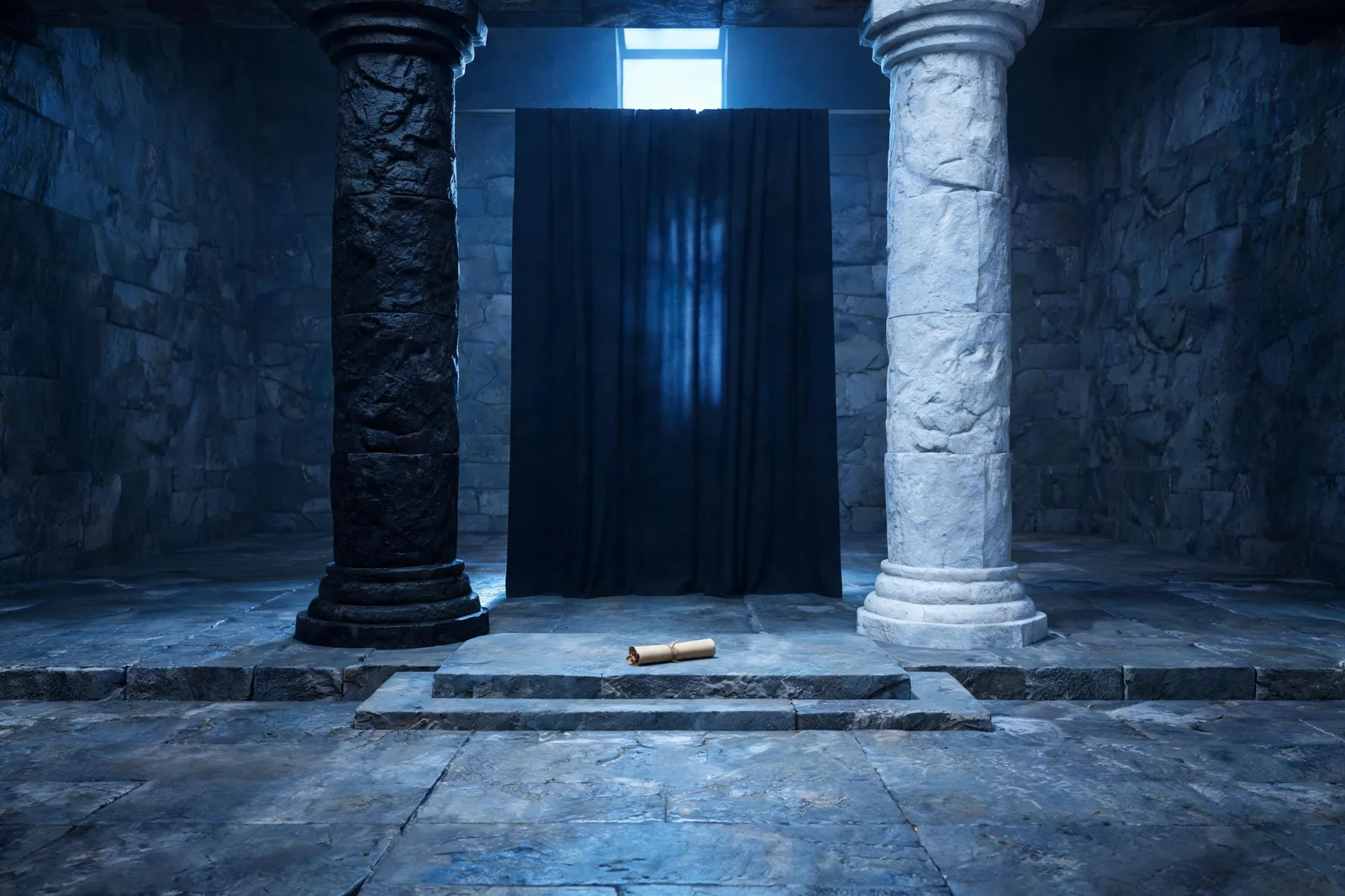
The High Priestess in most decks sits between two pillars, behind a veil, holding a scroll. High priestess apophatic tarot is the reading that the card is not about the subconscious. The card is about the limit of the subconscious. She is the card of the hidden, of the threshold, of what is behind the visible world. In the Marseille pattern she is the second card, the first of the trumps that is not a figure of action but a figure of knowledge, of the world that is not the world you can see.
In the Rider-Waite, she sits between the black and white pillars of Boaz and Jachin, behind a veil embroidered with wheat and pomegranates, holding the Torah scroll with the words I AM inscribed on it. In the Thoth deck, Crowley's High Priestess is a woman seated between two pillars, holding a book, with a crescent moon on her forehead.
The standard reading of the card is the subconscious, intuition, the hidden knowledge, the mystery. This is a fine reading. It is the reading that most tarot books give you, and it is the reading that is wrong in the way that matters.
The apophatic reading goes one step further. It is the reading that the card is not a container of hidden knowledge at all, but the image of the point where knowledge stops. The card is about the moment when the subconscious has run out and there is nothing behind it to find.
What Pseudo-Dionysius says
Pseudo-Dionysius the Areopagite, writing under the name of the disciple of Paul from Acts 17, produced in the late fifth or early sixth century a body of mystical theology that became the foundation of Christian negative theology for the next thousand years. The Internet Encyclopedia of Philosophy entry on Pseudo-Dionysius summarizes the corpus: The Divine Names, The Mystical Theology, The Celestial Hierarchy, The Ecclesiastical Hierarchy, and ten letters.
The key text is The Mystical Theology, a short work in five chapters. Chapter 5 is the one that matters here. It describes a process of ascent: the soul climbs from the particular to the universal, from the named to the nameless, and at the top of the climb it arrives at a darkness that is not the absence of light but a light that is too bright for the eye. The soul enters this darkness, and in entering it, it abandons all speech and all thought, even the negations it has been using to climb.
This is apophatic theology. The word comes from the Greek apophanein, to deny, to negate. The method is to say what God is not, and to keep saying it, and to keep saying it, until there is nothing left to say, and then to stop even the not-saying, and to be in the darkness.
The Vatican's own account, in the General Audience of 14 May 2008, puts it plainly: God cannot be spoken of in an abstract way; speaking of God is always a hymnein, singing for God with the great hymn of the creatures which is reflected and made concrete in liturgical praise. And: the Face of God is our inability to express truly what he is. In this way one speaks of a negative theology.
Where the card fits
The High Priestess is the card of the threshold. She sits between two pillars, behind a veil. She is not in the world you can see. She is in the world behind the world you can see. And the world behind the world you can see, in Pseudo-Dionysius, is the world of the Mystical Theology.
The standard reading says: the High Priestess is the subconscious. She is the hidden knowledge, the intuition, the thing you know but cannot say. This is a reading that stops at the first darkness. It says: there is a darkness behind the veil, and in that darkness there is knowledge, and if you read the card you can get that knowledge.
The apophatic reading says: no. The darkness behind the veil is not a place where knowledge is stored. The darkness behind the veil is the place where knowledge ends. The High Priestess is not a container of hidden knowledge. She is the image of the limit of knowledge itself.
The scroll and the negation
In the Rider-Waite, the High Priestess holds a scroll with the words I AM inscribed on it. In the apophatic reading, this is not a name. It is the one affirmation that Pseudo-Dionysius allows to survive the negation. The I AM is the one thing that is not denied, because it is not a description of what God is. It is the bare fact of presence, the fact that something is there, before the question of what it is.
This is exactly the move that Chapter 5 of The Mystical Theology makes. The soul strips away every attribute, every name, every concept, and what remains is not a concept. What remains is the fact. The I AM is the fact. The scroll is the record of the negation, the list of everything that has been said and taken back, and the one word that was not taken back.
The two pillars and the two methods
The black and white pillars, Boaz and Jachin, are the standard reading of the duality that the High Priestess holds together. But in the apophatic framework, the two pillars are the two methods: cataphatic and apophatic. The black pillar is the negation, the via negativa, the method of saying what God is not. The white pillar is the affirmation, the via positiva, the method of saying what God is.
The High Priestess sits between them. She is not one or the other. She is the threshold between the two. And the threshold, in Pseudo-Dionysius, is the darkness. The darkness is not the black pillar. The darkness is the space between the black pillar and the white pillar, the space where both methods have done their work and there is nothing left to do but stand.
Where the reading is earned
The strongest link is structural. Both the card and the theology place the limit of knowledge at the centre of the system. The deck places the High Priestess between the two pillars, behind the veil. The theology places the darkness at the end of the ascent, after all the negations. Both are the threshold. Both are the place where the method stops.
The second link is practical. In a reading, the High Priestess appears at the point where the questioner has run out of words. The apophatic reading gives you a way to say what that means: you have reached the darkness, the negations have done their work, and what is left is the fact, the I AM, the bare presence that is not a concept.
Where it becomes a stretch
The honest limitation is that Pseudo-Dionysius never wrote about tarot. The Golden Dawn did not use apophatic theology in its correspondence tables. Crowley's Book of Thoth describes the High Priestess in terms of the Hebrew letter Heh and the planet Moon, not in terms of the Mystical Theology.
The connection is an interpretive bridge, not a historical one. It is a reading that a theologian might make, and a tarot reader might recognize, but it is not a reading that either tradition officially endorses.
This does not make it wrong. It makes it a synthesis. The value of the bridge is that it gives the card a depth that the traditional correspondences do not provide. It connects the card to a specific text in the Christian mystical tradition, and it gives the reader a way to think about the card that goes beyond "intuition" or "the subconscious."
How to use it in a reading
When the High Priestess appears in a reading, ask: what has been negated here? What has been said and taken back? The card is not the answer. The card is the silence after the answer, the darkness after the negation, the fact after the concept.
In a position about a decision, the card says: you have run out of arguments. The negations have done their work. What is left is the fact, the bare presence of the situation, the I AM of the question itself.
In a position about a relationship, the card says: you have run out of words. The negations have done their work. What is left is the presence, the fact that the other person is there, before the question of who they are.
The crescent moon on the forehead in the Thoth deck is the key image. It is the light that is too bright for the eye. It is the darkness that is not the absence of light. The High Priestess wears it. She does not know she wears it. That is the point.
The sources
The primary text is The Mystical Theology, the fifth chapter, as translated in Pseudo-Dionysius the Areopagite: On the Divine Names and the Mystical Theology, by C.E. Rolt. The Internet Encyclopedia of Philosophy entry on Pseudo-Dionysius (iep.utm.edu) gives the structural overview of the corpus.
The Vatican General Audience of 14 May 2008 (vatican.va) is the clearest statement of the negative theology in its liturgical context.
For the High Priestess in the Rider-Waite and Thoth decks, see the companion article on the High Priestess card meaning. The High Priestess Tarot Card Meaning: Intuition, Mystery and the Subconscious For the structural context of the Tree of Life and the position of Binah, see the Three Trees series. Kircher's Tree, the Gra's Tree, Luria's Tree
The card is not a container of hidden knowledge. The card is the image of the limit of knowledge. Read it as a silence, not as a presence, and the reading works.
Questions
What is apophatic theology?
Apophatic theology, the via negativa, is the method of speaking of the divine by negation: saying what it is not, and continuing until even the negations are set aside and one stands in a darkness that is not the absence of light.
Why does the High Priestess fit apophatic theology?
The card sits between two pillars, behind a veil, at the threshold between the visible and the hidden. In the apophatic reading that threshold is the darkness of Pseudo-Dionysius: the place where the method of negation has done its work and what remains is not a concept but a bare presence.
Is this a historical reading of the card?
No. Pseudo-Dionysius never wrote about tarot and the Golden Dawn correspondences do not include apophatic theology. It is an interpretive bridge, useful in a reading, not an official correspondence.
You might also like
 Major Arcana
 Major Arcana
 Major Arcana
© 2026 TAROTS chat (tarots.chat). All rights reserved. No part of this article may be reproduced, distributed or adapted without the owner's written permission.
The Journal
From the Journal
Chosen for this page
 Spirituality
The High Priestess Tarot Card Meaning: Intuition, Mystery and the Subconscious
3 min read
More in Spirituality Kabbalah
Sefer Yetzirah Tarot: Traces of the Trumps in the Book of Formation
7 min read
More in Kabbalah Major Arcana
Adjustment Tarot Card Meaning in the Thoth Deck: Balance, Justice and Equilibrium
3 min read
More in Major Arcana Major Arcana
 Major Arcana
 Major Arcana
 Spirituality
 Symbolism
 Kabbalah