Court de Gebelin's Egyptian Hunch and Nine Volumes of Certainty
by Redazione · 9 October 2026 · 5 min read
A theory born at a Paris card table
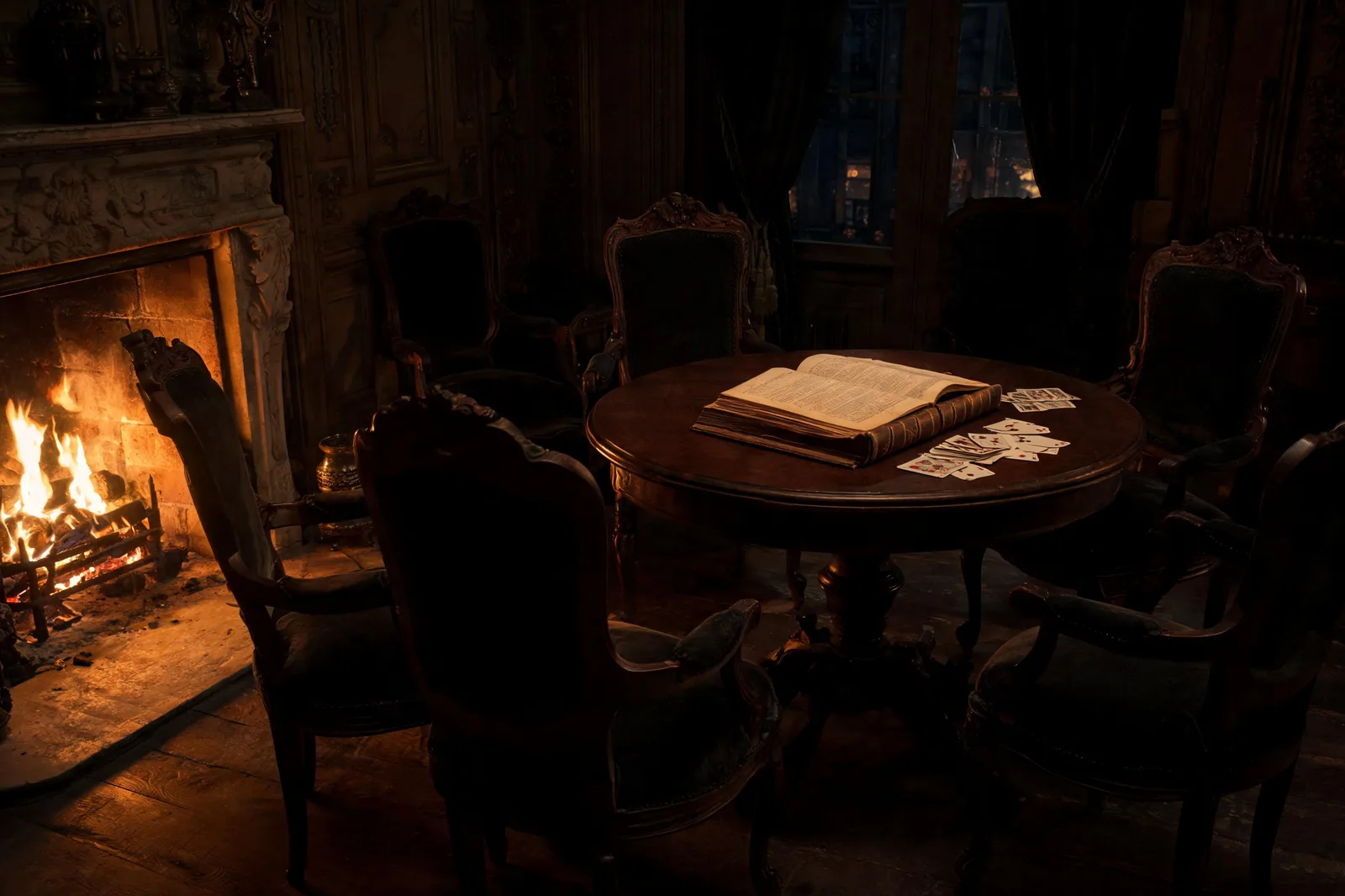
Picture a dinner party in Paris, 1781, where someone pulls out a deck of ordinary playing cards for a game, and one guest looks at the Tarot de Marseille trumps on the table and announces, with total confidence, that he is looking at the surviving fragments of an Egyptian sacred book. That guest was Antoine Court de Gébelin, and the Court de Gébelin nine volumes of certainty behind that claim are less about Egypt than about how fast a clever man can talk himself, and then a continent of readers, into an idea with no evidence behind it at all. He never opened a tomb, never read a line of hieroglyphs (nobody could, decades before Champollion), and never set foot in Egypt. He simply looked at a four-suited card game and decided it had to be older and grander than it looked.
Nine volumes building to one card game
Court de Gébelin was a serious man of the Enlightenment, a Protestant pastor's son, a Freemason, and the author of Le Monde Primitif, a sprawling nine-volume attempt to trace all language, myth and custom back to a single primitive source. The tarot chapter is a famous aside within this larger, equally confident project: a scholar convinced that everything from alphabets to agriculture descended from one lost wisdom, and that the Egyptians kept the purest version of it. Reading the tarot as an Egyptian survival was not a detour from his method, it was the method working exactly as designed, finding grand unity wherever he looked, whether or not the sources agreed to cooperate.
The etymology that clinched it, allegedly
The detail that keeps this anecdote funny rather than merely wrong is his reasoning for the deck's very name. Tradition holds that he broke «tarot» into Egyptian roots meaning roughly «royal road», built an entire chapter of symbolic correspondences on top of that reading, and never paused to check it against an actual Egyptian dictionary, because for his era there effectively wasn't one worth trusting. A fellow contributor to his tarot chapter, the Comte de Mellet, piled on further correspondences between the trumps and astrology, deepening a theory that two confident amateurs had essentially built from vibes, published with the full weight of a multi-volume reference work behind it.
Why nobody fact-checked him in time
The fascinating part is not that an eighteenth-century writer got something wrong; people get things wrong constantly. It is how long the claim outran any correction. Le Monde Primitif ran through further volumes before Court de Gébelin died in 1784, by most accounts still a committed proponent of mesmerism as well as Egyptian tarot origins, and the Egyptian theory had already escaped into wider circulation. Later writers folded it into their own systems rather than checking the sources, including Etteilla's Invention: The First Tarot Interpretation System, who ran with the Egyptian premise to build the first full reading method, and much later the occult revival tied to From the Golden Dawn to Waite and Crowley: Two Heirs, Two Decks kept Egypt in the picture even as scholarship moved on. One confident paragraph in one chapter of one enormous book became, for the better part of two centuries, received wisdom repeated by writer after writer who had never gone back to check it.
What actually survives of the claim
Modern card historians are fairly settled: the tarot almost certainly developed in fifteenth-century northern Italy as an expanded playing-card game, not an Egyptian relic smuggled through the centuries, and the deeper story of that origin is told properly in Court de Gebelin and the Egyptian Myth of 1781 for anyone who wants the fuller account rather than the punchline. What survives of the Court de Gébelin nine volumes argument is mostly atmosphere: a lingering sense, in some corners of tarot writing, that the cards are older and stranger than a card game, a flavour that the Egyptian theory helped cement even after its factual basis evaporated. in particular still gets described in some popular writing with vaguely Egyptian or Isis-like language that traces straight back to this one eighteenth-century guess, dressed up with unrelated scholarship for cover.
The real lesson in the anecdote
The episode is a tidy reminder that confidence is not evidence, however many footnotes surround it. A respected scholar, publishing in a respected multi-volume work, can still be simply wrong about a specific claim, and the wrongness can travel for generations precisely because it arrived wearing the clothes of serious research. It is also, frankly, a funnier story than most tarot history offers: an Enlightenment intellectual, deep into a theory of universal primitive language, glances at a card game mid-dinner and decides it is Egyptian scripture, and nobody at the table apparently asked him to show his work. The deck survived the theory. The theory, somewhat unfairly, outlived its own debunking by at least a century.
Readers curious about the man behind the chapter can start with the Antoine Court de Gébelin Wikipedia entry, which covers his wider linguistic project alongside the tarot detour that made him famous for the wrong reasons.
Questions
Did Court de Gebelin ever travel to Egypt?
No. By every account he built his Egyptian tarot theory from a card game viewed at a Paris gathering, without visiting Egypt or reading hieroglyphic texts, which were undeciphered in his lifetime.
What is Le Monde Primitif?
It is Antoine Court de Gebelin's nine-volume Enlightenment project tracing language, myth and custom to a single ancient source. His tarot chapter is one famous section inside that much larger, equally speculative work.
Do historians today accept the Egyptian origin of tarot?
No. Mainstream card history places the tarot's origin in fifteenth-century northern Italy as an expanded playing-card game, not as an Egyptian survival.
Why did the Egyptian tarot theory last so long?
It was published inside a respected multi-volume reference work and repeated by later writers, including Etteilla, who built further systems on top of it without checking the original claim.
You might also like
 Tarot Journal
 Tarot Journal
 Tarot Journal
© 2026 TAROTS chat (tarots.chat). All rights reserved. No part of this article may be reproduced, distributed or adapted without the owner's written permission.
The Journal
 Disks
 Love
 Disks
 Love
 Kabbalah
 Tarot Journal
 Symbolism
 Symbolism
 Kabbalah