The Three of Disks: Works and Craft
Mars in Capricorn and why this card measures labor by what it actually builds.
by Redazione · 9 October 2026 · 5 min read
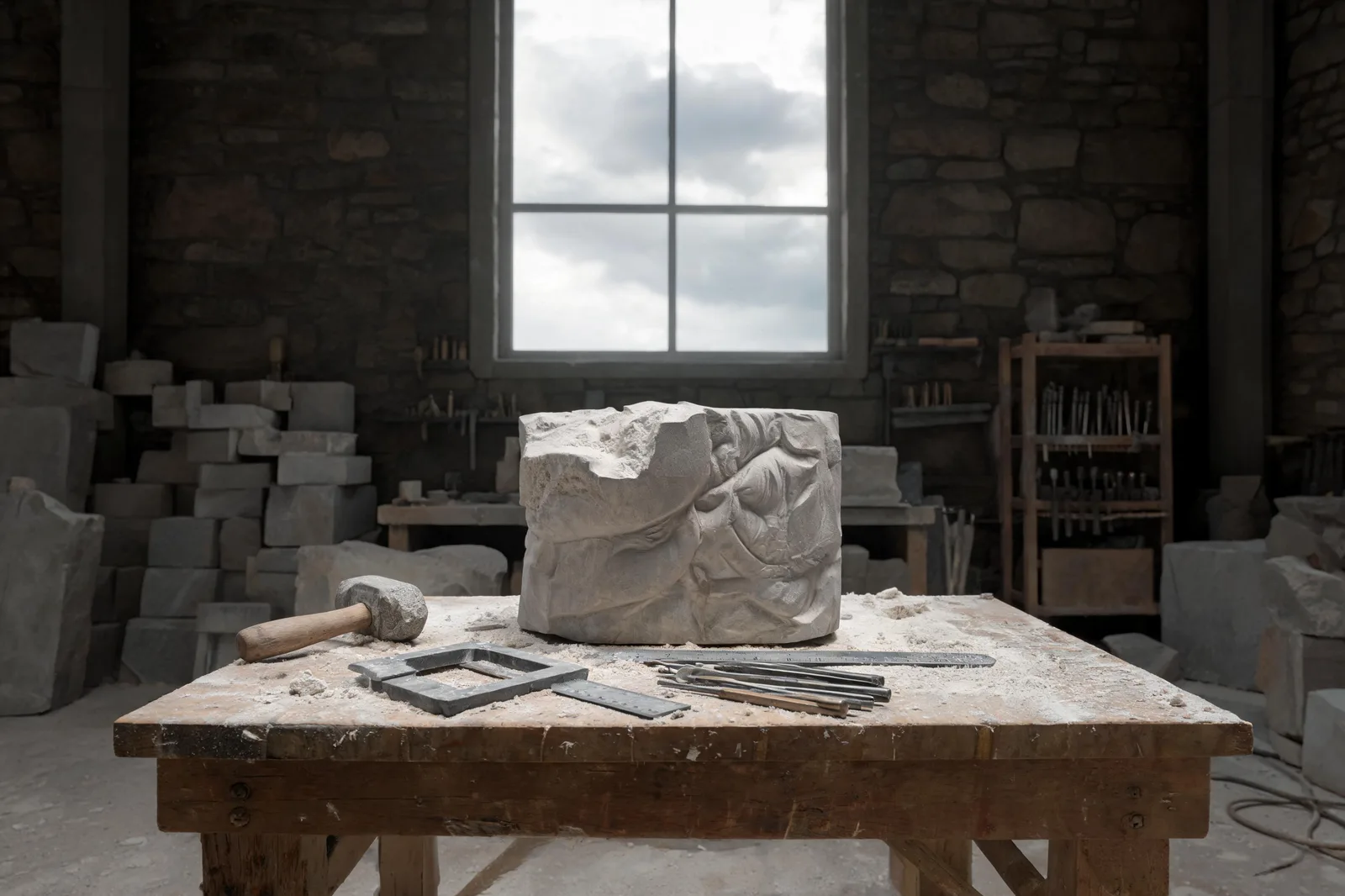
Builders, not dreamers, hold the Three of Disks. Work in this card means a plan that has already left someone's head and entered the hands of people who answer to a standard. After How to Ask the Tarot About Work: Questions That Help opened this series by asking how to frame a work question at all, this second part sits with the first card that answers plainly: skilled labour, taking visible shape, judged by people who know the craft.
Three of Disks Work: What Builders See in the Card
Crowley titled this card Works, and the Thoth image shows a wheel formed from a triangle inside a circle, drawn as a mason's or architect's device, something measured rather than improvised. The card does not show an individual inspired. It shows a design being executed to specification, with tools, materials and a result that other craftsmen can judge. That is the heart of reading it for a career question: has effort actually produced something, or is it still just intention.
A reading that turns up this card over a work question is rarely asking "will I succeed." It is pointing at a stage: the planning is done, the materials are gathered, and what remains is the discipline of building it correctly. For a reader weighing a project, the card asks whether the blueprint has been tested against people who will actually use the result.
Mars in Capricorn: The Astrology Behind Steady Labor
The Golden Dawn and Crowley both place this card under Mars in Capricorn, an earth sign ruled structurally by Saturn. Mars supplies the drive; Capricorn supplies the patience to keep applying it through a long, unglamorous middle. Neither force alone explains the card. Mars without Capricorn's discipline burns out before the structure is finished; Capricorn without Mars's push never breaks ground. Together they describe exactly the kind of effort a craft guild would recognise: ambitious enough to attempt something real, patient enough to see it through the unglamorous stages.
This pairing also explains why the card so often appears when someone has been working hard without yet seeing the reward. Saturn's timeline is long. A reading should not promise that recognition arrives on schedule; it can only describe the quality of the labour itself, which is already under the reader's control even when the outcome is not.
Reading It in a Career Spread
In a spread about a current job or a new venture, the Three of Disks usually points to competence being built, tested and, ideally, recognised by others qualified to judge it. Paired with cards of beginning, like the fresh drive explored elsewhere in this series through Ace of Disks — Root of the Powers of Earth, it can describe the difference between starting something and actually constructing it. Paired with a card of excess effort, it can warn that steady work is tipping toward strain, a theme this series addresses directly later through the suit's harder cards.
A useful habit when this card appears: ask what concrete, checkable thing has been produced so far. Not a feeling of progress, an actual result a colleague or client could inspect. The card rewards that kind of honesty more than any other in the suit.
The Three Workers: Collaboration, Not Solo Effort
Unlike the suit's aces, which show force arriving alone, the Three of Disks' imagery gestures at collaboration: a design handed from one craftsman to another, work measured against a shared standard rather than private satisfaction. At work, this often reads as a signal to check the design against the people who will actually use it: a manager, a client, a team that has to live with the result. Solo conviction is not what the card asks for. It asks whether the structure holds when someone else leans on it.
This is also where the card differs most from a card like The Chariot, a figure of controlled ambition driven by a single will. The Chariot moves toward a goal; the Three of Disks checks that will against a trade's actual requirements, which is a humbler and often more useful question for anyone mid-project.
What the Card Does Not Promise
The Three of Disks never promises that a project will succeed, that an employer will notice, or that money will follow competent work. Those are separate questions, and a careful reading keeps them separate. What the card does offer is a clear description of where labour stands: whether it has become something testable yet, and whether the standard being built against is the right one. A reader who takes that description seriously, rather than treating the card as a verdict on the outcome, gets the most honest use out of it.
Read plainly, this is a working card for people doing working things: it rewards the slow, checkable kind of progress, and says nothing at all about luck.
A practical way to use the card in a spread is to treat it as a question rather than an answer: what has this effort actually produced, who could check it, and what remains unfinished. Those three questions turn the Three of Disks from a static symbol into a working tool, one that fits naturally beside the other career cards in this series. Tradition holds that craftsmen once marked finished work with a guild stamp, a small sign that a piece had met a shared standard; the card asks a modern reader to find the equivalent moment in their own project, the point where effort becomes something that stands on its own.
Questions
What does the Three of Disks mean for work?
It shows skilled labor taking visible shape, judged against a real standard rather than private satisfaction.
What is the astrology of the Three of Disks?
The Thoth tradition places it under Mars in Capricorn, pairing driving energy with earthy patience and discipline.
Does the Three of Disks mean success at work?
Not directly. It describes competent progress on a project; whether that progress is recognised or rewarded stays an open question.
How is the Three of Disks different from the Ace of Disks?
The Ace shows a fresh start arriving on its own; the Three shows that start already built into something others can test.
This article talks about
You might also like
 Disks
 Disks
 Disks
© 2026 TAROTS chat (tarots.chat). All rights reserved. No part of this article may be reproduced, distributed or adapted without the owner's written permission.
The Journal
 Kabbalah
 Thoth Tarot
 Career
 Thoth Tarot
 Kabbalah
 Symbolism
 Symbolism
 Symbolism
 Kabbalah