Swords at Work: Conflict, Strategy and Communication
Why the suit of air reads workplace conflict as a matter of clarity, not combat.
by Redazione · 9 October 2026 · 5 min read
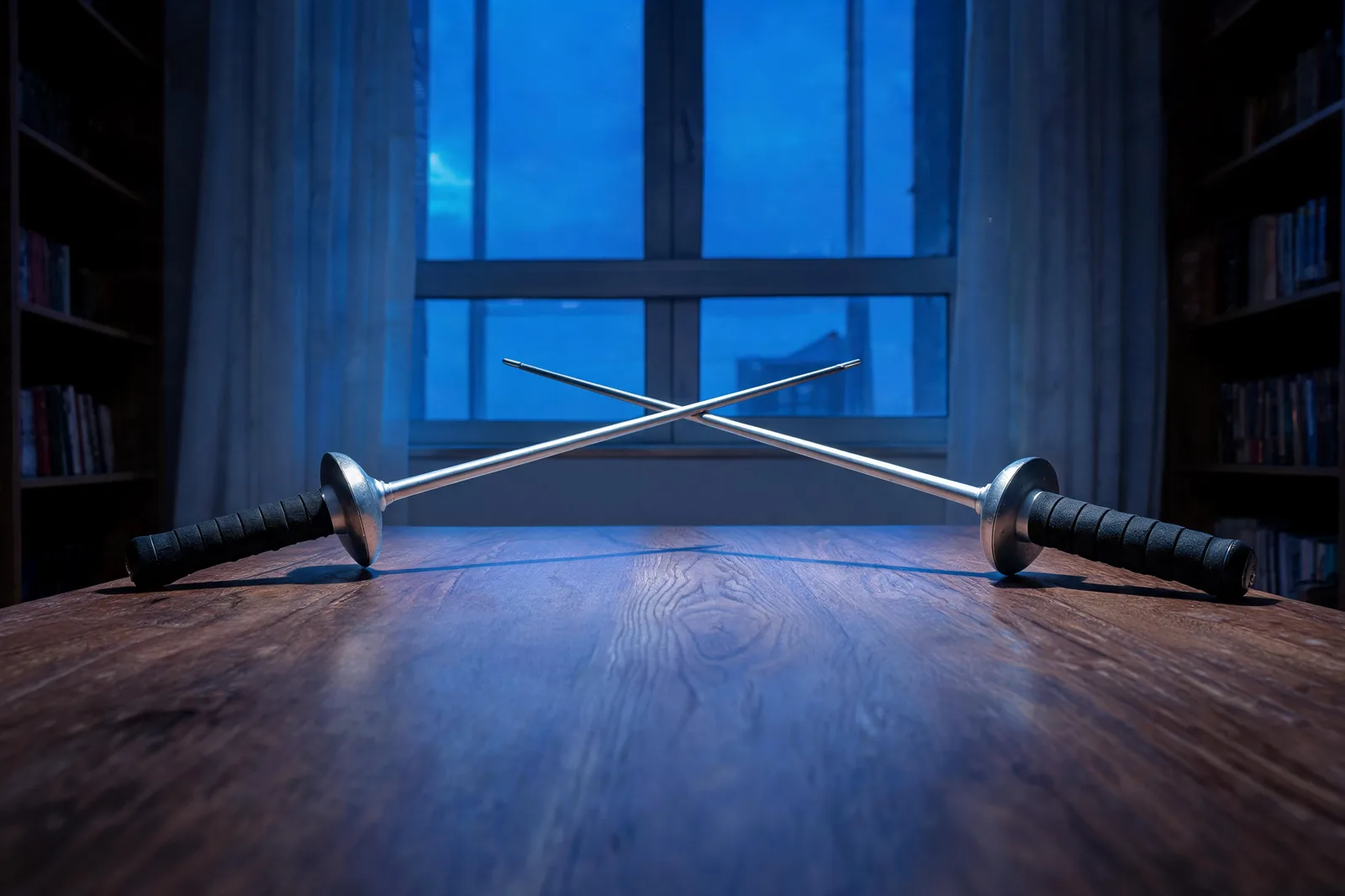
A disagreement at work rarely needs a sword to settle it, but the suit of sword cards office conflict readings draw on is built exactly for this territory: thought, argument, strategy, the clean or messy ways people cut through disagreement. After The Seven of Disks: Failure, Effort and Timing faced disappointing results honestly, this part turns to the suit that governs how conflict itself gets handled, well or badly, at work.
Why Air Rules Conflict
The Thoth tradition assigns Swords to the classical element of air, the realm of thought, speech and argument rather than the earth of labour or the fire of ambition. This matters for how the suit reads at work: Swords describe the mental and verbal terrain of conflict, not necessarily its emotional cost. A reading dominated by swords is often less about whether a dispute feels painful and more about how clearly it is being thought through, and how honestly it is being communicated.
Air cuts, and the suit's imagery leans hard into that: blades, clashes, strategy. Crowley's cards range from the hopeful clarity explored elsewhere in this series through Ace of Swords Tarot Meaning: Clarity, Breakthrough and Mental Power at Work to much darker cards of cruelty, ruin and self-defeating overthinking. The suit's range matters, because a single sword card rarely means the same thing twice; context inside the spread decides whether a mental edge is being used well or turned against the person holding it.
Sword Cards Office Conflict: Reading Strategy, Not Just Tension
In a career spread, swords often appear around negotiations, disagreements with colleagues, or decisions that require careful, unemotional thinking. A reader seeing several sword cards together is usually being asked to look at the quality of the thinking behind a conflict: is a position well-reasoned, or is anxious overthinking being mistaken for analysis. Swords reward precision. They punish avoidance and they punish impulsive, unexamined certainty just as readily.
A useful habit when swords dominate a reading is to separate the emotional charge of a conflict from its actual structure. What is the real disagreement about? What does each side actually want, stated plainly rather than defensively? Swords work best as a prompt toward that kind of clarity, not as an invitation to sharpen an argument for its own sake.
Where Communication Goes Wrong
Several cards in the suit describe communication failing in specific, recognisable ways: a truce held too rigidly instead of renegotiated, a clever plan that backfires on its own author, exhaustion mistaken for progress. A reading that surfaces these cards is rarely telling a reader to fight harder. More often it is pointing at a pattern, perhaps a habit of winning arguments at the cost of the relationship, or avoiding a necessary conversation until it becomes a crisis instead of a discussion.
This is where the suit connects back to The Chariot's lesson about opposing forces held in balance. A sword wielded only to win, without regard for what it costs afterward, tends to produce exactly the kind of short-term victory that creates long-term conflict. The suit rewards a reader who treats conflict as something to resolve clearly, not merely to win decisively.
Using Swords Wisely at Work
The healthiest reading of this suit treats its cards as a call to clarity rather than combat. A difficult conversation handled with a clean, honest sword, direct, specific, free of unnecessary cruelty, tends to resolve faster and cost less than one avoided until it festers. A reader who draws sword cards over a workplace disagreement does well to ask what the clearest, most honest version of their position actually is, and whether it can be stated without needless harm to the other side.
None of this promises an easy resolution, and no reading should claim to settle a real dispute or predict how a colleague will respond. What the suit offers instead is a sharper lens: a way of seeing a conflict's actual shape, so that whatever is said next is said with intention rather than reflex.
A Small Habit Before the Next Hard Conversation
Before a difficult meeting, it helps to write out the actual claim being made, in one plain sentence, and to read it back as if a stranger had said it. Vague grievances rarely survive that test; specific ones usually do. This small discipline mirrors what the suit of Swords values most: an argument sharp enough to be examined honestly, rather than one that only works while it stays unspoken or half-formed.
It is worth remembering, too, that the suit's harsher cards describe failure modes, not inevitabilities. A sharp mind used carelessly can cut the wrong thing; the same mind used deliberately can end a long-running tension in a single honest conversation. The suit does not choose which outcome happens. It only sharpens whatever intention a reader brings into the room, for better or for worse, which is exactly why clarity matters more here than in almost any other part of a career reading.
Questions
What do sword cards mean for office conflict?
They point to the mental and verbal side of a disagreement: how clearly it is being thought through and communicated, not just how it feels.
Is the suit of Swords always negative?
No. It ranges from clear, breakthrough thinking to cards of cruelty or self-defeating strategy, so context in the spread matters.
Can a tarot reading resolve a workplace dispute?
No. It can clarify the shape of a disagreement and each side's real position, but resolving it stays a human conversation.
Why is the suit of Swords linked to air?
The Thoth tradition assigns Swords to the element of air, governing thought, speech and strategy rather than labor or raw drive.
This article talks about
You might also like
 Disks
 Disks
 Disks
© 2026 TAROTS chat (tarots.chat). All rights reserved. No part of this article may be reproduced, distributed or adapted without the owner's written permission.
The Journal
 Kabbalah
 Thoth Tarot
 Kabbalah
 Tarot Journal
 Love
 Cups
 Symbolism
 Symbolism
 Kabbalah