Robert Wang and the Golden Dawn Tarot Deck
by Redazione · 9 October 2026 · 5 min read
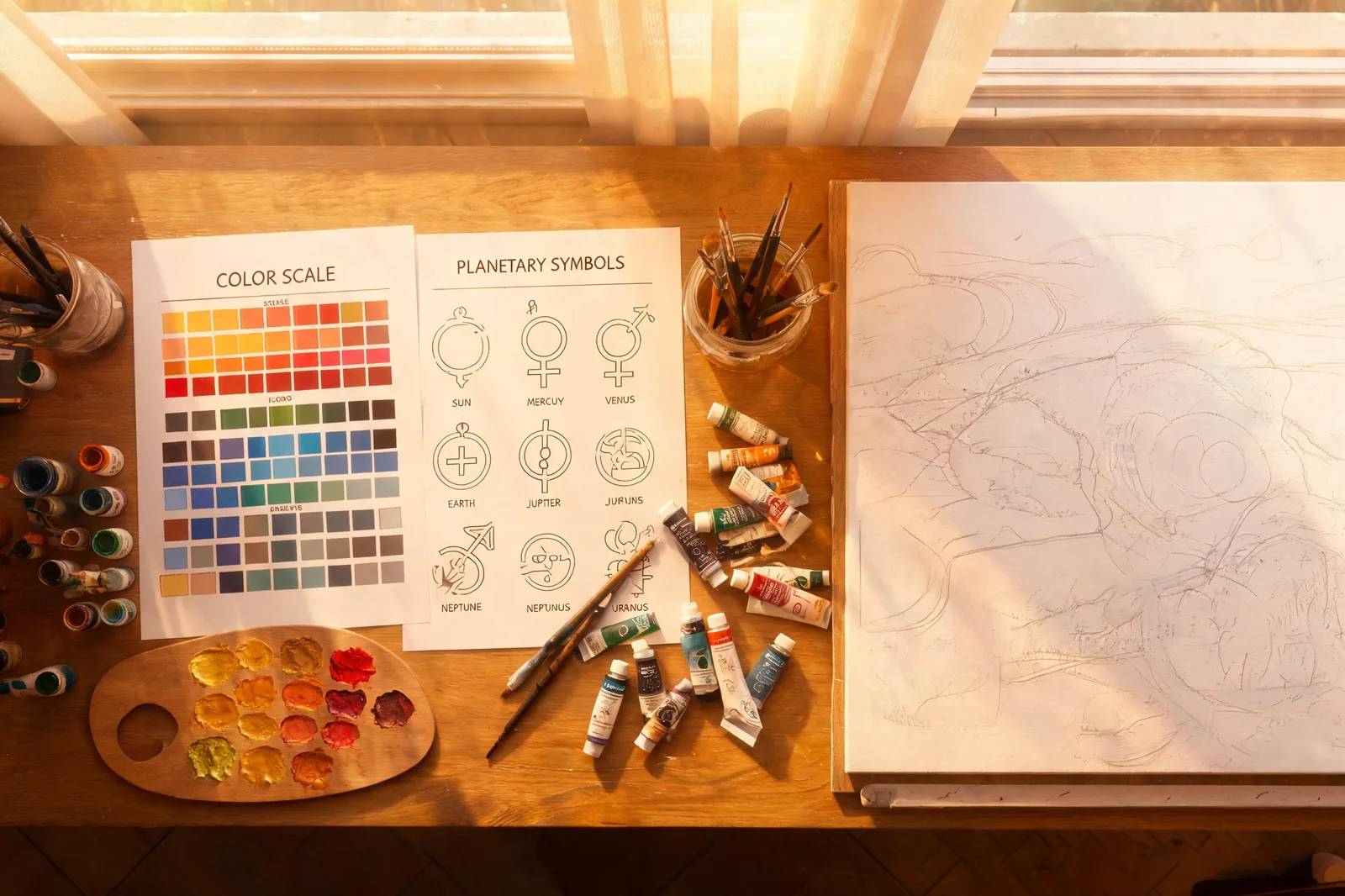
The Robert Wang Golden Dawn tarot deck exists because Israel Regardie wanted a set of cards that followed the order's own written instructions exactly, rather than the freer artistic choices Lady Frieda Harris had made for Crowley. Wang, a working artist, painted that deck under Regardie's direct guidance in the late 1970s, and the two published it through U.S. Games Systems as one of the most deliberately faithful tarot sets ever made from a single written tradition.
Robert Wang's Golden Dawn Tarot: A Painter Working to Instructions
Wang trained as an artist before this project and brought a disciplined, illustrative hand to work that needed precision more than personal expression. Regardie had spent decades publishing the Golden Dawn's papers, discussed at length in Israel Regardie's Publication of the Golden Dawn Papers, but those papers describe each trump's symbolism in dense written detail without providing finished artwork of their own. Wang's task was to translate that written description, the exact colours of the Golden Dawn's four colour scales, the precise placement of symbols, the planetary and elemental attributions, into a complete and consistent set of seventy-eight paintings. Where Harris had license to interpret Crowley's instructions imaginatively, producing the Thoth deck's often abstract and energetic compositions, Wang worked closer to a technical illustrator's brief, checked at every stage against Regardie's own expertise.
The Qabalistic Tarot
Wang followed the deck with The Qabalistic Tarot, a 1983 companion book that explained the reasoning behind every card in far more systematic detail than most tarot guides of the period attempted. The book reads as a kind of answer key to the deck: for each trump it lays out the Hebrew letter, the astrological or elemental attribution, the colour scale and the Golden Dawn's own symbolic reasoning, in a register closer to a reference manual than to a devotional text. That approach gave students who wanted to check their own reading of a card against the order's documented intentions a resource that neither the Book T papers alone nor Crowley's more idiosyncratic Book of Thoth could easily provide on their own.
Fidelity Over Invention
The Empress illustrates the difference in method well: Golden Dawn papers specify her Venusian rulership, her garden setting and particular symbolic details tied to fertility and the number three on the Tree of Life, and Wang's version renders those specifications about as literally as a painted card can. A reader comparing his Empress against the same card in the Thoth deck, or against the earlier designs that grew from Éliphas Lévi's School: The Tarot as a Universal Key's broader symbolic project, sees two legitimate but differently motivated choices: one deck aiming at documentary accuracy to a written source, the other aiming at a single artist's visionary synthesis of that same source material.
A Living Artist, A Settled Legacy
Robert Wang has continued his working life as an artist and, in later decades, as a specialist in Chinese and Asian art and antiques, a career distinct from his tarot work and one this article does not attempt to summarise beyond the public record of his published books. His Golden Dawn tarot deck and The Qabalistic Tarot remain in print and are still recommended to students who want the order's own system rendered as literally as a deck of cards allows, a useful counterpart to the more interpretive decks that dominate most shop shelves.
Why Collectors and Students Both Return to It
The Wang deck occupies an unusual place in tarot publishing: valued by collectors for its clean, consistent execution and by students for its near-documentary reliability, rather than for any single striking artistic statement. Few decks before or since have been built this directly from one order's internal written curriculum, checked card by card against a living authority on that curriculum's original intentions, which is exactly what made Regardie choose Wang for the project in the first place.
That makes the deck an unusually good teaching tool for anyone trying to separate the Golden Dawn's own documented system from the many later interpretations layered on top of it. A student comparing three or four modern decks against the same trump can lose track of which details come from the original nineteenth-century papers and which were added by a later artist's imagination. Wang's deck offers a control group of sorts: open it beside The Qabalistic Tarot and a reader can trace almost every colour, symbol and gesture back to a specific line in the order's own curriculum, rather than to an illustrator's private intuition.
Frequently Asked Questions
Who painted the Golden Dawn tarot deck associated with Robert Wang? Robert Wang painted it in the late 1970s, working under Israel Regardie's direct guidance to match the order's original written instructions.
What is The Qabalistic Tarot? Wang's 1983 companion book, which explains each card's Hebrew letter, colour scale and symbolic reasoning in systematic reference-manual form.
How does Wang's deck differ from the Thoth deck? Wang aimed at literal fidelity to the Golden Dawn's written instructions, while Crowley and Harris aimed at a more personal, interpretive synthesis of the same source material.
Is the Wang Golden Dawn tarot deck still available? Yes, both the deck and its companion book remain in print and widely used by students of the Golden Dawn tradition.
Questions
Who painted the Golden Dawn tarot deck associated with Robert Wang?
Robert Wang painted it in the late 1970s, working under Israel Regardie's direct guidance to match the order's original written instructions.
What is The Qabalistic Tarot?
Wang's 1983 companion book, which explains each card's Hebrew letter, colour scale and symbolic reasoning in systematic reference-manual form.
How does Wang's deck differ from the Thoth deck?
Wang aimed at literal fidelity to the Golden Dawn's written instructions, while Crowley and Harris aimed at a more personal, interpretive synthesis of the same source material.
Is the Wang Golden Dawn tarot deck still available?
Yes, both the deck and its companion book remain in print and widely used by students of the Golden Dawn tradition.
This article talks about
You might also like
 Thoth Tarot
 Symbolism
 Symbolism
© 2026 TAROTS chat (tarots.chat). All rights reserved. No part of this article may be reproduced, distributed or adapted without the owner's written permission.
The Journal
 Career
 Kabbalah
 Kabbalah
 Swords
 Love
 Spirituality
 Symbolism
 Symbolism
 Kabbalah