Niki de Saint Phalle's Tarot Garden: Twenty-Two Trumps in Tuscany
by Redazione · 9 October 2026 · 6 min read
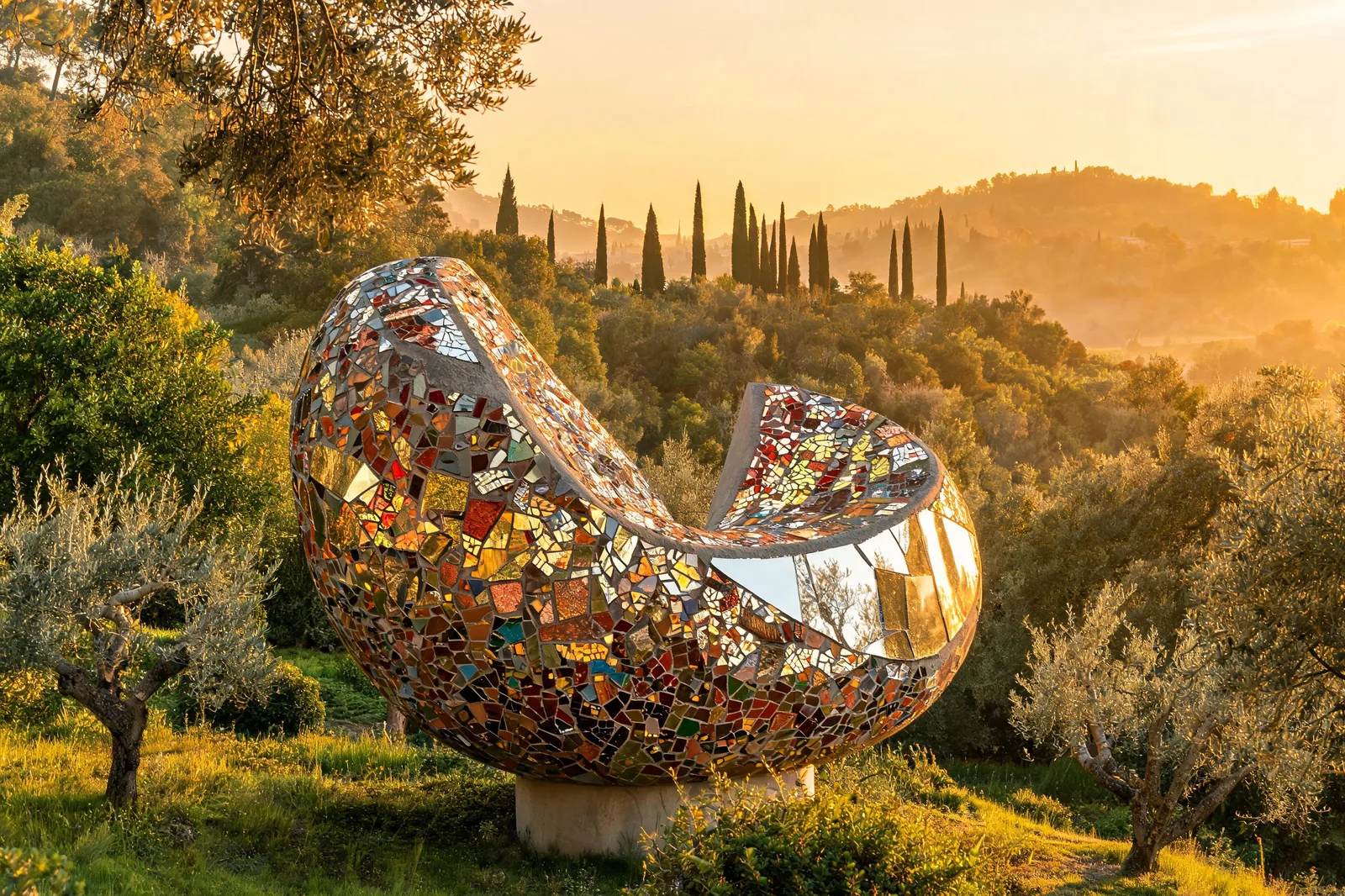
The tarot garden Niki de Saint Phalle built is the clearest proof that the trumps could leave the printed page and become architecture. On a wooded hillside near Garavicchio, in southern Tuscany, twenty-two monumental figures rise in concrete, mirror glass and glazed ceramic. Each one is a Major Arcana card built at the scale of a small building. The garden answers a simple question with an extravagant gesture: what happens when a serious artist takes the tarot literally, as a plan for a place rather than a deck to shuffle?
Niki de Saint Phalle, the French-American sculptor known for her bulbous, brightly coloured "Nanas," had been drawn to the trumps for years before she broke ground. She found a patron in the Caracalla family, who offered her the land in the late 1970s, and construction began in 1979. It would occupy much of the rest of her life. The project was never a quick commission; it was a vocation she funded partly by licensing her own perfume and jewellery, an arrangement unusual enough that she wrote about it candidly in her own notebooks.
The Tarot Garden Niki de Saint Phalle Built from Twenty-Two Trumps
Each sculpture follows a card, but none of them illustrates it the way a printed deck would. The Empress becomes a sphinx-like structure with mirrored breasts, which Saint Phalle lived inside during the early years of construction, cooking and sleeping among the scaffolding. The Magus, the High Priestess, the Tower and the Sun are scattered through the trees rather than lined up in sequence. A visitor walks the Major Arcana roughly in the order the Fool would meet them on a real journey, not the order of a spread. The effect owes an acknowledged debt to Antoni Gaudí's Park Güell in Barcelona, whose broken-tile mosaics Saint Phalle had admired since her twenties, and to the older Italian precedent of the Sacro Bosco at Bomarzo, a Renaissance garden of monsters not far away. Readers who think of the The Empress mainly as a figure of fertility and comfort meet here a version that is also a livable shell, half body and half house.
Jean Tinguely and the garden's machinery
Saint Phalle did not build the garden alone. Jean Tinguely, the Swiss sculptor who had been her partner since the 1950s, engineered several of the kinetic and structural elements, continuing a collaboration that stretched back through their joint fountains and installations in Paris. Craftsmen from the area learned mosaic and ceramic techniques on site, some staying with the project for years, which gives the garden a consistency of hand that a single sculptor working alone could not have achieved across two decades. The result reads less like a single artwork than like a small workshop town organised entirely around one deck of cards, including the The Magus rebuilt as a towering figure among the trees.
Opening to the public
The garden opened to visitors in 1998, after roughly two decades of construction that outlasted several of the people who had helped start it. Saint Phalle kept working on details into her final years, and the project is often described as the summary of her whole career rather than one commission among others. It sits inside a longer twentieth-century habit of artists treating the tarot as raw material rather than as a fixed system to illustrate. The Salvador Dalí's Tarot: A Surrealist's Private Mythology project from the same decades shows a different, more private route to the same impulse, painting over found cards instead of pouring concrete. Where Dalí worked small and kept much of his tarot imagery out of public view for years, Saint Phalle built hers to be walked through, climbed on and photographed by strangers.
Why a tarot garden makes sense in that decade
The Tarot Garden belongs to a wider moment: the The Tarot Boom of the 1960s and 1970s had already put the cards back into galleries, record covers and countercultural bookshops by the time ground was broken at Garavicchio. Saint Phalle was not reacting to a publishing trend so much as sharing its appetite for taking esoteric imagery seriously as contemporary art, at a scale earlier illustrators of the Major Arcana rarely attempted. Pamela Colman Smith painted a deck that fit in the hand; Saint Phalle built one a person could get lost inside. The comparison is instructive for anyone reading cards today: the same twenty-two archetypes can be a pocket companion or a public monument, and the garden argues that neither form exhausts what the images can do.
A monument, not a reading tool
It is worth saying plainly that the Tarot Garden was never built as a divination device. Saint Phalle used the Major Arcana as a structure for a life's work in public sculpture, closer to the Catholic garden shrines and grottoes of her upbringing than to a working deck meant for a reader's hands. Visitors today walk the grounds as they would any sculpture park, and the site is usually presented as an art destination rather than an occult one. For a tarot reader, the garden still offers something useful. It is a reminder that the trumps carry meanings large enough to survive being rebuilt in concrete and glass. Each card's core idea, Empress as life-giver, Tower as rupture, Sun as unguarded joy, can be stretched to a wildly different scale without breaking.
The Tarot Garden remains open seasonally near Capalbio, and tradition holds it is one of the twentieth century's strangest and most sincere tributes to the deck. More on Saint Phalle's life and other projects is on her Wikipedia page.
FAQ
Is the Tarot Garden based on the Thoth deck or the Marseille tradition? Saint Phalle drew on the general Major Arcana repertoire familiar from European tradition rather than copying any single named deck's artwork.
Can visitors go inside the sculptures? Some structures, including the Empress, have interior spaces that visitors can enter during opening hours, though access varies by season.
How long did the garden take to build? Construction began in 1979 and the site opened to the public in 1998; Saint Phalle continued refining details afterward.
Did Niki de Saint Phalle work alone? No. Jean Tinguely contributed engineering and mechanical elements, and local craftsmen worked on the mosaics over many years.
Questions
Is the Tarot Garden based on the Thoth deck or the Marseille tradition?
Saint Phalle drew on the general Major Arcana repertoire familiar from European tradition rather than copying any single named deck's artwork.
Can visitors go inside the sculptures?
Some structures, including the Empress, have interior spaces that visitors can enter during opening hours, though access varies by season.
How long did the garden take to build?
Construction began in 1979 and the site opened to the public in 1998; Saint Phalle continued refining details afterward.
Did Niki de Saint Phalle work alone?
No. Jean Tinguely contributed engineering and mechanical elements, and local craftsmen worked on the mosaics over many years.
This article talks about
You might also like
 Symbolism
 Symbolism
 Symbolism
© 2026 TAROTS chat (tarots.chat). All rights reserved. No part of this article may be reproduced, distributed or adapted without the owner's written permission.
The Journal
 Love
 Spirituality
 Symbolism
 Kabbalah
 Symbolism
 Spirituality
 Symbolism
 Symbolism
 Kabbalah