Lady Frieda Harris: Five Years Painting the Thoth Deck
by Redazione · 9 October 2026 · 5 min read
Lady Frieda Harris spent five years, from 1938 to 1943, painting the seventy-eight cards of what became the Thoth deck. She was not a beginner recruited for a quick job, like Pamela Colman Smith: The Artist Behind 78 Images three decades earlier, but a trained artist in her fifties who treated Aleister Crowley's brief as a serious commission with its own deadline pressures, technical failures and repeated revisions.
Harris, born Frieda Bloxam in 1877, had studied at the Chelsea School of Art and already exhibited watercolours and oils in London galleries before she met Crowley through mutual Co-Masonic connections in 1937. She was married to Percy Harris, a Member of Parliament, which gave her social standing and, crucially, the private income that let her fund the entire project herself. Crowley had no publisher and little money left by the 1930s; without Harris's cheque book, the Thoth deck would likely never have left his manuscript notes.
By the time she took on Crowley's commission, Harris had already spent two decades painting in a recognisably modern idiom, closer to Cubism and Vorticism than to the Pre-Raphaelite manner still common among occult illustrators. She brought that formal training to a brief that asked for something stranger than a gallery canvas: a system of pictures meant to carry precise correspondences, not simply mood or likeness. Few artists of her generation combined serious technical skill with patience for a client as demanding as Crowley; fewer still could have financed the work without needing it to sell.
Crowley's instructions, Harris's craft
Crowley supplied a dense set of written briefs for each card, citing astrology, the Hebrew alphabet, Egyptian deities and his own Thelemic doctrine. Harris's job was to turn paragraphs of correspondence into a single composition that satisfied his symbolism while still working as a picture. Letters between them, later published in part by Crowley's biographers, show real friction: Harris pushed back on details she thought pictorially unworkable, and Crowley sometimes conceded, sometimes did not. The finished cards are hers in execution even where the iconography is his.
Frieda Harris's painstaking technique
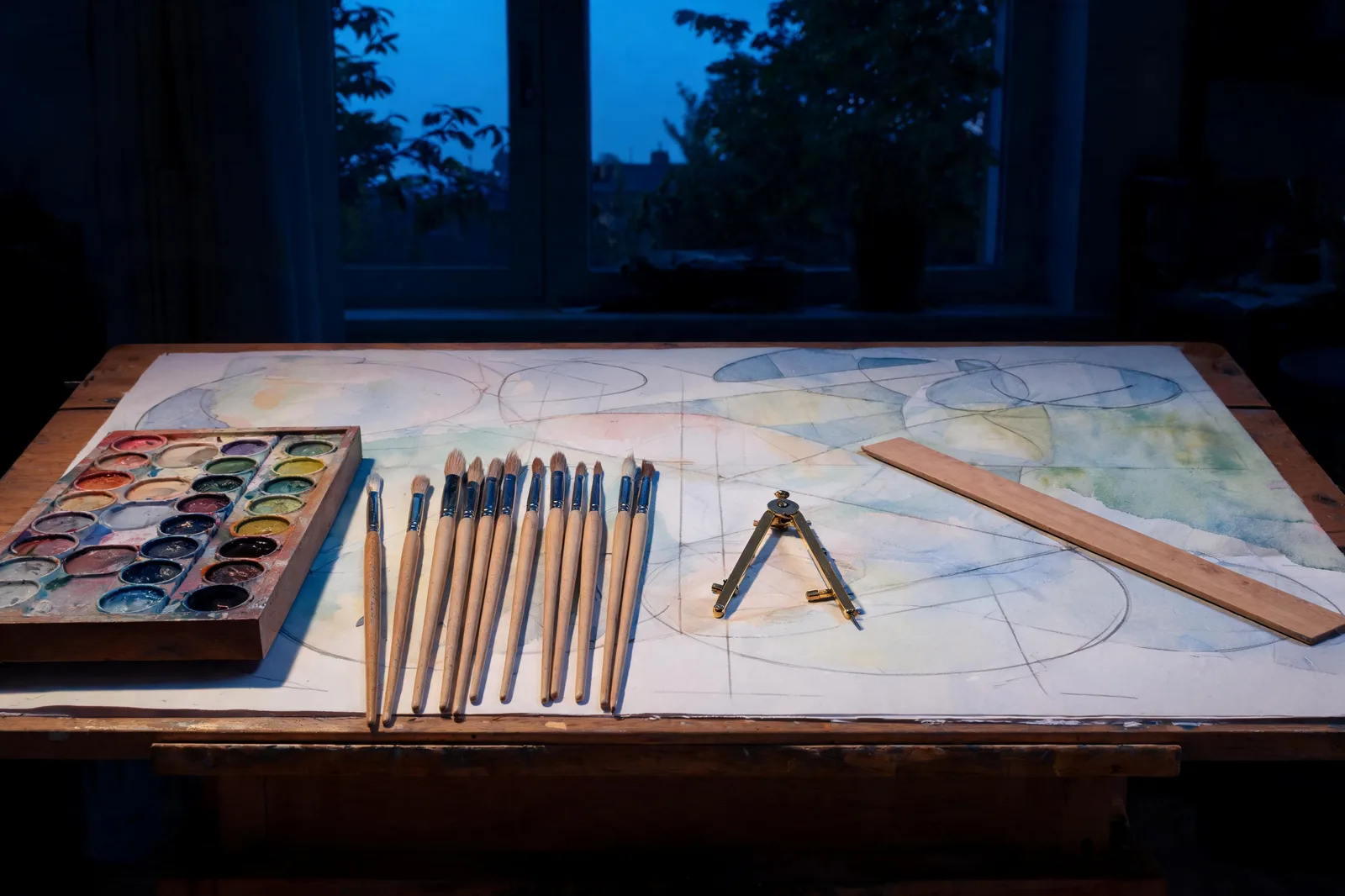
Harris worked in watercolour and gouache over pencil, often reworking a single card many times; surviving drafts for cards such as The Tower show several complete repaintings before she judged one correct. She experimented with a technique she called "projective geometry," using compasses and straightedges to build compositions from interlocking circles and angles rather than freehand sketching, a method meant to encode sacred proportion directly into the image. Contemporary accounts describe her studio floor littered with discarded attempts; she reportedly destroyed as many versions as she kept.
Exhibition before publication
The paintings were largely finished by 1942, in time for the exhibitions that are the subject of the next part of this series, long before any printed deck existed. Harris wanted public exhibition and eventual publication in her own lifetime; she died in 1962, seven years before Weiser's 1969 edition finally put the deck into readers' hands, a gap this series follows in its coming parts. She never saw the commercial success her paintings would earn.
Why five years, not one
The gap between Harris's pace and Pamela Colman Smith's near single-year sprint on the earlier deck is not a question of talent. Smith illustrated under Waite's relatively simple brief, working fast in a commercial studio rhythm. Harris answered to a far denser esoteric program, funded no one but herself, and treated accuracy to Crowley's doctrine as non-negotiable even when it cost her a repainted card. The result reads as noticeably more intricate: layered astrological glyphs, Hebrew letters and Egyptian motifs compressed into a single frame, a density that still rewards close study on a card like Atu VII or the Queen of Disks.
Her place in the deck's authorship
Later editions increasingly credit "Crowley-Harris" rather than Crowley alone, a correction similar to the one that restored Pamela Colman Smith's name to the earlier deck's title. Harris's own letters make clear she saw herself as a full creative partner, not an executant of someone else's vision; the project's five-year span is itself evidence of that independence, since a merely obedient illustrator would have moved faster. Readers who want deeper context on how the Golden Dawn's correspondences, which Crowley inherited, reached both artists should see From the Golden Dawn to Waite and Crowley: Two Heirs, Two Decks.
Harris also designed her own set of smaller companion cards and worked briefly as a theatrical designer, skills that show in the staged, almost scenic quality of several trumps; the Hierophant and the Chariot both read like set pieces lit for a single dramatic moment. Modern commentators treating the Thoth deck as Crowley's alone tend to skip past this, yet every surviving sketch shows a working artist solving compositional problems Crowley's text never addressed: how to balance a figure against a packed field of symbols, where to place a border, which colour would carry the eye first. Those are an illustrator's decisions, made by Harris, five years running.
Harris's full biography and her other paintings are documented in the Wikipedia article on Frieda Harris.
Questions
How long did Frieda Harris take to paint the Thoth tarot?
About five years, from 1938 to 1943, working from Aleister Crowley's written briefs for each of the 78 cards.
Did Frieda Harris fund the Thoth deck herself?
Yes. Her private income, as the wife of Member of Parliament Percy Harris, paid for the entire project since Crowley had no publisher at the time.
What technique did Frieda Harris use to paint the cards?
She called it projective geometry: building each composition from compasses and straightedges to encode proportion directly into the image, alongside watercolour and gouache.
Did Frieda Harris see the deck published in her lifetime?
No. She died in 1962, seven years before the first printed edition appeared in 1969, though her paintings were exhibited publicly from 1942.
This article talks about
You might also like
 Symbolism
 Symbolism
 Symbolism
© 2026 TAROTS chat (tarots.chat). All rights reserved. No part of this article may be reproduced, distributed or adapted without the owner's written permission.
The Journal
 Thoth Tarot
 Kabbalah
 Kabbalah
 major arcana
 Symbolism
 Spirituality
 Symbolism
 Symbolism
 Kabbalah