The Opening of the Key: The Golden Dawn's Great Divination
by Redazione · 9 October 2026 · 5 min read
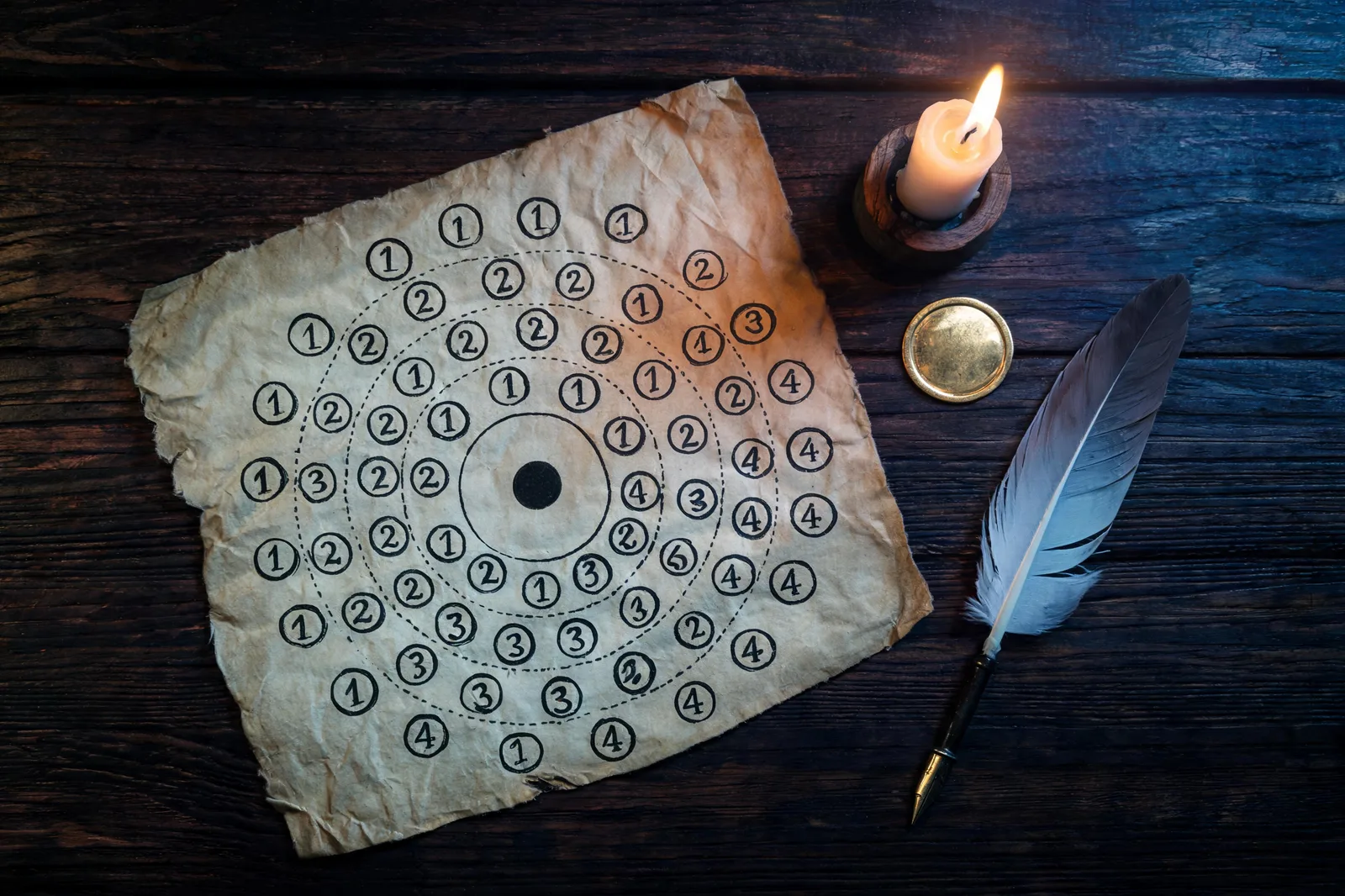
The Opening of the Key is the Golden Dawn's most elaborate divinatory method, a four-part reading that moves the whole seventy-eight-card deck through signification, dealing, counting and elemental checking before a single sentence of interpretation is spoken. Where a modern three-card pull answers one question quickly, this method was designed by adepts who had already studied The Hermetic Order of the Golden Dawn and Its Tarot Curriculum for years and wanted a system thorough enough to test a serious matter from several independent angles at once. It survives today mostly through Israel Regardie's published transcriptions of the Order's papers, and it remains the clearest window into how trained nineteenth-century occultists actually read cards.
Choosing the Significator
Every working begins with a court card chosen to represent the querent or the question, matched by temperament, colouring or astrological sign to a Knight, Queen, Prince or Princess. This significator is removed from the pack and later becomes the pivot the whole reading turns around: cards are dealt around it, counted toward it, and its position relative to major trumps is read as a comment on the querent's present state. Choosing wrongly, Golden Dawn teaching warned, could unbalance an otherwise sound reading, which is why the method spends real attention on this first step rather than treating it as a formality.
Four Dealings, Four Different Lenses
After the deck is shuffled and cut, it is dealt out in four distinct passes, each exposing a different layer of the question. The first deal lays every card face up in a long line and reads it as a single continuous narrative. The second separates the trumps from the small and court cards to isolate the purely symbolic forces at work. The third deals the cards into stacks that are then read by counting rather than by position, a technique described in detail in a companion article on the Order's counting method. The fourth and final pass focuses only on the cards nearest the significator, narrowing a broad first impression into a specific, immediate answer. A reader who only ever learned one dealing method, Golden Dawn teaching held, had learned a fragment of the system, not the system itself.
Counting and Reversals
Central to the Opening of the Key is a counting technique: starting from the significator, the reader counts a fixed number of cards, commonly five, in each direction and notes what falls on that count, repeating the operation until a pattern of repeated cards or reversed numbers emerges. Reversed cards are not simply read as negative versions of their upright meaning; the Order treated a reversal as a sign that the card's energy was blocked, delayed or turned toward its shadow side, a reading nuance still used by careful Thoth readers today. A card like The Tower appearing reversed near the significator was read as upheaval already underway rather than only threatened, a distinction that changed the practical advice an adept gave the querent.
Elemental Dignities as a Cross-Check
No dealing was trusted alone. The final stage checks the elemental dignities between cards lying next to each other, whether their suits reinforce, weaken or neutralise one another, a cross-check examined fully in its own article in this series. Two cards of compatible elements lying together were read as strengthening each other's message; two of opposing elements, Fire against Water or Air against Earth, signalled friction or an unresolved internal conflict for the querent. This step forced a reading to be internally consistent: no single card could carry a conclusion the surrounding cards flatly contradicted. A The Hermit drawn beside a card of conflicting element, for instance, tempered any reading of solitary withdrawal with a note of unresolved tension.
Why Few Readers Use the Full Method Today
The complete Opening of the Key can take well over an hour and demands fluency in several overlapping sub-systems, significators, decans, elemental dignities, counting, that most modern readers never learn in full, which is why simplified three- or ten-card spreads dominate casual practice. But the method's underlying logic, that a single card should always be checked against its neighbours before its meaning is trusted, still quietly shapes good Thoth practice. A reader pausing before a confident verdict to ask whether the surrounding cards actually agree is applying, in miniature, the discipline the Golden Dawn built this whole elaborate method to enforce. Israel Regardie's published edition of the Order's papers remains the standard source for the method's full instructions, including the exact counting tables the Order used; his own life and work are summarised on the English Wikipedia page for Israel Regardie.
Frequently Asked Questions
Do I need the full seventy-eight-card deck to try the Opening of the Key? Yes. The method depends on dealing and counting through the complete deck; a partial deck breaks the counting logic entirely.
Is the Opening of the Key only for trained Golden Dawn initiates? It was designed for trained adepts, but a patient modern reader can learn it from Regardie's published papers, ideally after practising simpler spreads first.
How is this different from a Celtic Cross reading? A Celtic Cross fixes meaning to position; the Opening of the Key layers several independent dealing methods and a final elemental cross-check before settling on an answer.
Why does the significator matter so much? Every count and every comparison in the method is measured from the significator, so an ill-chosen card skews the whole reading rather than just one position.
Questions
Do I need the full seventy-eight-card deck to try the Opening of the Key?
Yes. The method depends on dealing and counting through the complete deck; a partial deck breaks the counting logic entirely.
Is the Opening of the Key only for trained Golden Dawn initiates?
It was designed for trained adepts, but a patient modern reader can learn it from Regardie's published papers, ideally after practising simpler spreads first.
How is this different from a Celtic Cross reading?
A Celtic Cross fixes meaning to position; the Opening of the Key layers several independent dealing methods and a final elemental cross-check before settling on an answer.
Why does the significator matter so much?
Every count and every comparison in the method is measured from the significator, so an ill-chosen card skews the whole reading rather than just one position.
This article talks about
You might also like
 Thoth Tarot
 Thoth Tarot
 Thoth Tarot
© 2026 TAROTS chat (tarots.chat). All rights reserved. No part of this article may be reproduced, distributed or adapted without the owner's written permission.
The Journal
From the Journal
Chosen for this page
 Kabbalah
 Love
 Symbolism
 Tarot Journal
Crowley's Deck Was Published After Everyone Involved Had Died
5 min read
More in Tarot Journal Thoth Tarot
 Spirituality
 Symbolism
 Symbolism
 Kabbalah