Elemental Dignities: How the Golden Dawn Read Cards Together
by Redazione · 9 October 2026 · 5 min read
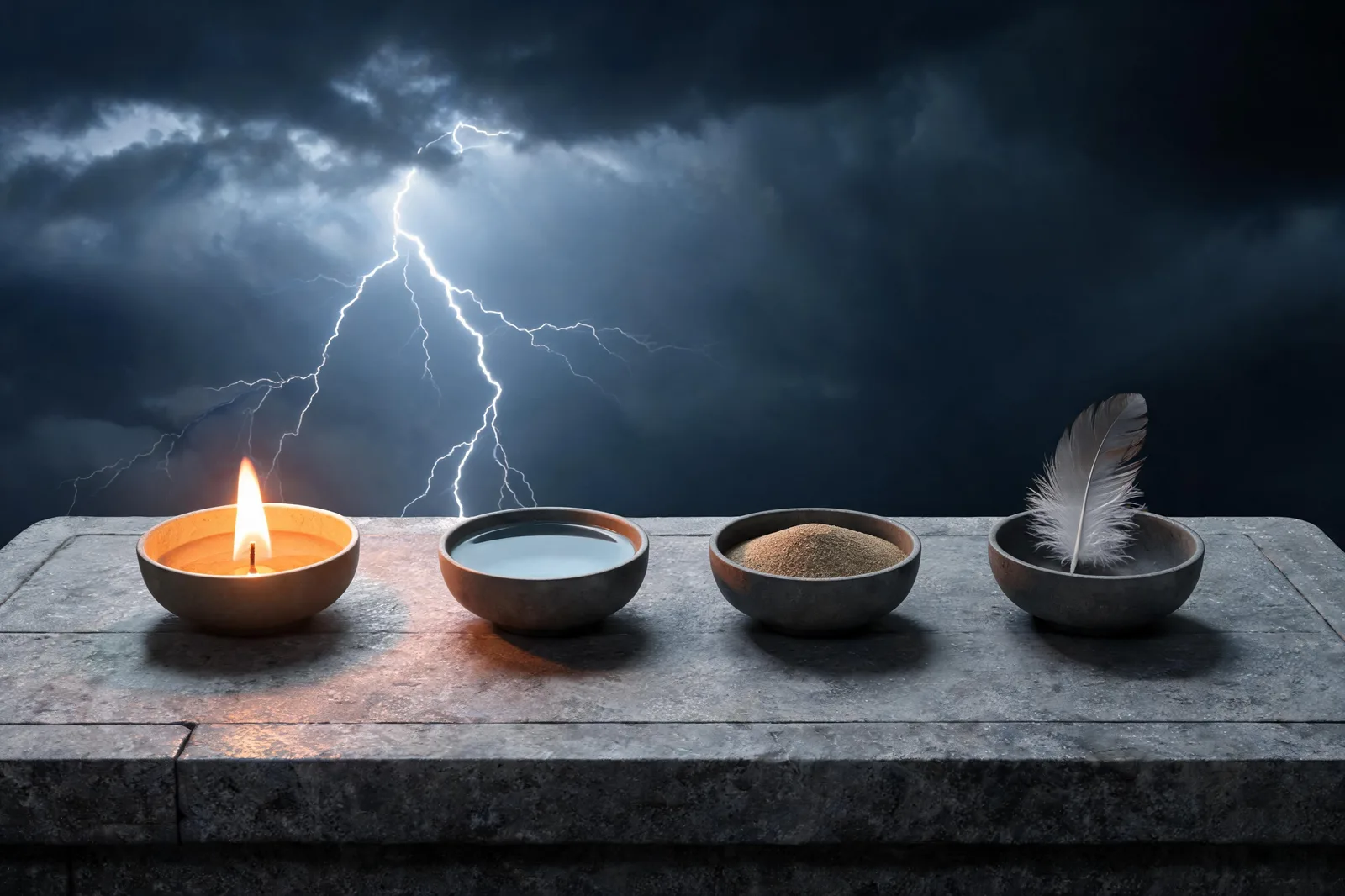
Elemental dignities are the Golden Dawn's rule for reading two cards together rather than one at a time: lay a Fire card beside a Water card and the pairing dampens both; lay two Air cards together and their shared element amplifies the message. The Order built this system to stop readers from treating each card as an island, and it remains one of the most useful tools a Thoth reader can borrow from The Hermetic Order of the Golden Dawn and Its Tarot Curriculum without needing the whole ceremonial apparatus around it. This article sets out the four elements, the strengthening and weakening rules between them, and how the method still sharpens a modern reading.
The Four Elements and Their Tempers
Every small and court card in the Thoth deck carries an elemental signature: Wands are Fire, Cups are Water, Swords are Air, Disks are Earth. The Golden Dawn treated these not as decoration but as physical temperaments with real interactions, borrowed from the classical and medieval idea that Fire and Air share a quality (heat) and so support each other, as do Water and Earth (coldness), while Fire and Water actively oppose, as do Air and Earth. A reading built from this logic asks not just "what does this card mean" but "what does this card mean here, next to that one."
Strengthening Pairs
When two cards of the same element sit together, their shared quality intensifies, for better or worse. Two Wands cards beside each other push a Fire theme, ambition, haste, conflict, toward its most forceful expression. Compatible neighbours, Fire with Air or Water with Earth, support each other more gently: an Air card lifts a Fire card's ideas into communicable form, and an Earth card gives a Water card's feeling somewhere practical to land. A sun-themed trump like The Sun next to a strong Fire card reads as vitality compounding on vitality, a reading that would overstate the case if the cards were judged separately.
Weakening and Cancelling Pairs
Opposed elements do the reverse work. A Wands card next to a Cups card, Fire against Water, signals that neither force gets a clean expression: ambition is cooled by feeling, or feeling is scorched by haste, and the reading should flag the tension rather than pick one card's meaning and ignore the other. Swords against Disks, Air against Earth, works similarly: an idea stalls against stubborn material reality, or a solid plan gets picked apart by overthinking. The Golden Dawn did not treat this as "a bad card ruins a good one"; it treated it as information about where the querent's situation is genuinely unresolved, which is a more honest reading than forcing an artificial single verdict.
Reading Trumps Within the System
Major trumps carry elemental attributions too, through their paths on the Tree and their zodiacal or planetary rulers, so a card like The Devil, attributed to Capricorn and Earth, interacts with a neighbouring Earth or Water card differently than it would beside a Fire card. This is one reason the full The Opening of the Key: The Golden Dawn's Great Divination method treats elemental dignity as a final cross-check rather than a first step: a reader needs the whole spread laid out before these interactions can be weighed card by card. Treating a trump as elementally inert, exempt from the same rules that govern the small cards, was considered a beginner's mistake in Golden Dawn teaching.
Using the Method Without the Whole System
A modern reader does not need the Order's full grade structure to use elemental dignities honestly. The discipline is simple to state even if it takes practice to apply: before reading any card's meaning as settled, check what element sits on either side of it, and let a clash soften an otherwise confident verdict. This habit alone catches a common error, reading a strong card in isolation and promising more certainty than the spread actually supports. Paul Foster Case's The Tarot and other twentieth-century manuals popularised simplified versions of this method for English-speaking readers outside the Order; a solid overview of the underlying classical theory of elemental qualities is on the English Wikipedia's page on the classical elements.
Frequently Asked Questions
Do elemental dignities apply to trumps as well as small cards? Yes. Trumps carry elemental, planetary or zodiacal attributions through their path on the Tree, so they interact with neighbouring cards by the same logic, though the attribution has to be known first.
What happens when three or more cards of mixed elements sit together? The Golden Dawn method reads the pair relationships one at a time rather than averaging the whole group, so a reader weighs each adjacent pair before forming an overall impression.
Is a weakening pair always a bad sign? No. It signals unresolved tension or a situation genuinely still in motion, not automatic misfortune; the two cards' individual meanings still matter.
Can elemental dignities be used in a simple three-card spread? Yes, and it is one of the easiest ways to bring Golden Dawn rigour into a casual reading: just check whether the elements of the three cards reinforce or clash before concluding.
Questions
Do elemental dignities apply to trumps as well as small cards?
Yes. Trumps carry elemental, planetary or zodiacal attributions through their path on the Tree, so they interact with neighbouring cards by the same logic, though the attribution has to be known first.
What happens when three or more cards of mixed elements sit together?
The Golden Dawn method reads the pair relationships one at a time rather than averaging the whole group, so a reader weighs each adjacent pair before forming an overall impression.
Is a weakening pair always a bad sign?
No. It signals unresolved tension or a situation genuinely still in motion, not automatic misfortune; the two cards' individual meanings still matter.
Can elemental dignities be used in a simple three-card spread?
Yes, and it is one of the easiest ways to bring Golden Dawn rigour into a casual reading: just check whether the elements of the three cards reinforce or clash before concluding.
This article talks about
You might also like
 Thoth Tarot
 Kabbalah
 Kabbalah
© 2026 TAROTS chat (tarots.chat). All rights reserved. No part of this article may be reproduced, distributed or adapted without the owner's written permission.
The Journal
From the Journal
Chosen for this page
 Major Arcana
The Wheel of Fortune Tarot Card Meaning in the Thoth Deck: Cycles and Destiny
3 min read
More in Major Arcana Kabbalah
 Learn Tarot
 Love
 Symbolism
 Cups
 Symbolism
 Symbolism
 Kabbalah