Counting and Pairing: The Golden Dawn's Reading Technique
by Redazione · 9 October 2026 · 5 min read
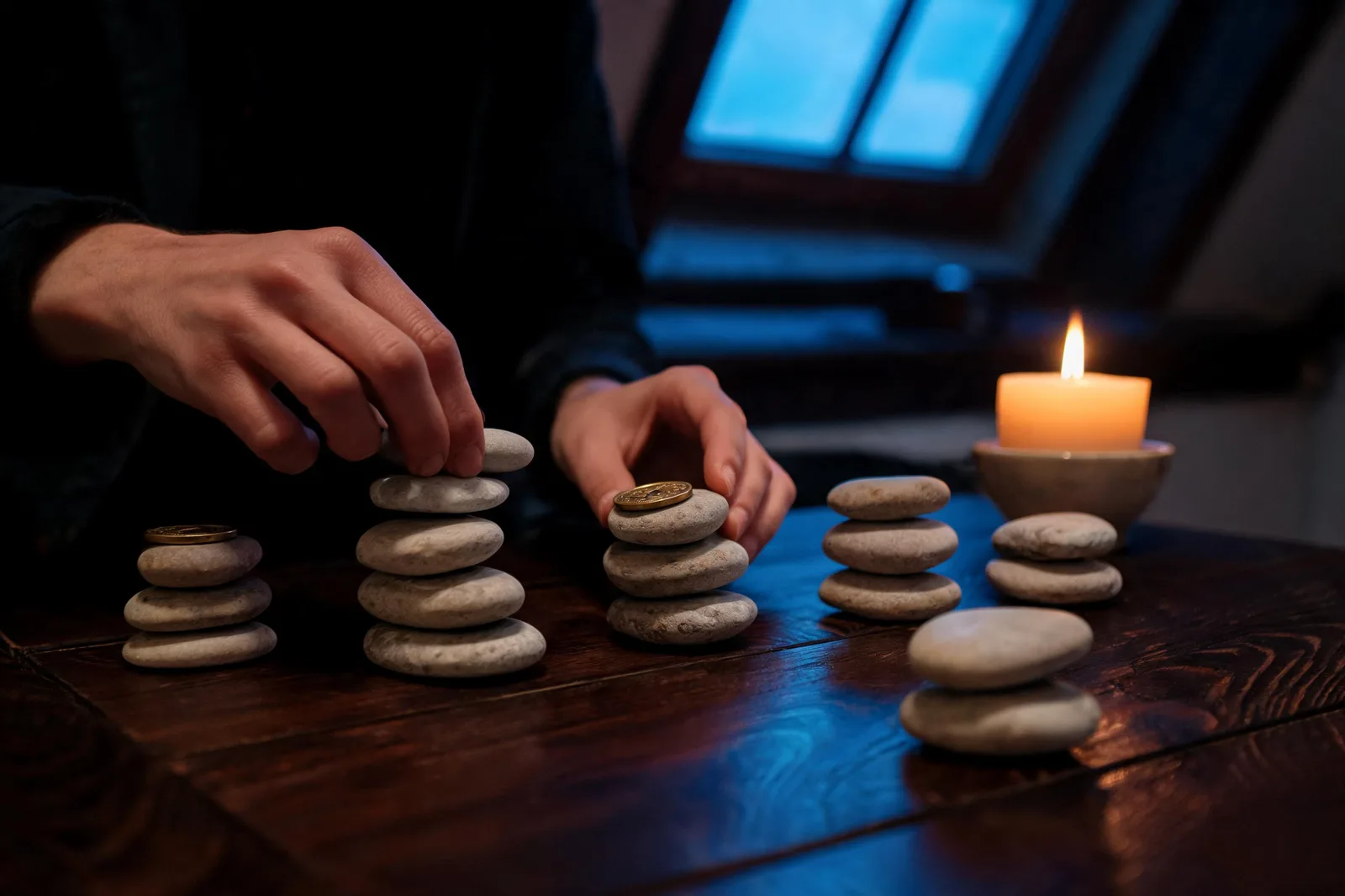
The golden dawn counting method is the engine inside the Opening of the Key that turns a shuffled pile of cards into a structured answer: deal the deck into stacks, count a fixed interval from a chosen card, and read whatever lands on that count as a direct comment on the question. It looks almost mechanical compared to free-form intuitive reading, and that was deliberate. The Order wanted a technique a student could get wrong in a checkable way, following directly from the dealing patterns described in The Opening of the Key: The Golden Dawn's Great Divination, so an examiner could confirm a candidate had actually learned the system rather than improvised a plausible story.
Dealing Into Packets
The method starts by dealing the shuffled deck, face down, into a series of packets of a fixed size, traditionally stacks built around the number five or seven depending on which stage of the Opening of the Key is being worked. Each packet is then read in turn, its top card revealed and set beside the others to form a developing row. The packet size is not arbitrary: five relates to the elements plus spirit, and other intervals map onto zodiacal or Sephirotic counts the Order used elsewhere in its curriculum. A reader who changed the packet size mid-working without a reason recorded in the ritual notes was considered to be working sloppily, not creatively.
Counting From the Significator
Once a significator card has been placed, as set out in the article on choosing it, the reader counts outward from its position by the chosen interval, in both directions along the dealt row. Whatever card falls on the count is treated as weighted information: a major trump landing on the count is read as a stronger, more decisive signal than a small card would be in the same spot. This is why the significator's placement in the shuffle matters so much; it is the fixed point every count in the reading is measured against, and a reading redone with a different significator can genuinely land on different cards.
Pairing Repeated Cards
A second layer of the technique looks for repetition: if the same card, or two cards of the same number across different suits, appear more than once within a few positions of each other, the Golden Dawn treated this as the deck underlining its own message. Two cards of the same rank falling near each other, say a pair of Fives, was read as the number's theme, conflict and adjustment for Five, repeating itself too insistently to be incidental. This pairing rule works alongside elemental dignities rather than replacing them: a repeated number still gets checked against the elements of the suits involved before a reader commits to a verdict, since two cards agreeing in number but clashing in element send a mixed signal worth noting rather than averaging away.
Why the Method Resists Overreading
Because the counting interval and the packet size are fixed before the cards are seen, the method cannot be quietly adjusted to produce a wanted answer partway through a reading. A reader tempted to reach for a dramatic card like Lust to make a reading feel more decisive has no room to do so under this technique: the count lands where it lands, and the card that turns up has to be worked with as it is. Golden Dawn adepts saw this constraint as a safeguard against a reader's own wishful thinking, not as a limitation on insight, since the interpretive skill still lies in explaining why that card, at that count, answers the question asked.
Bringing the Discipline Into a Simpler Reading
A modern reader rarely needs the full packet-and-count apparatus for an everyday question, but the underlying discipline travels well into smaller spreads: fix your method before you deal, note repetitions honestly rather than cherry-picking the ones that flatter your first impression, and treat a significator's placement as meaningful rather than incidental. Aleister Crowley's own description of Golden Dawn-derived technique appears throughout The Book of Thoth, and a general history of the Order's divinatory practices is summarised on the Wikipedia page for the Hermetic Order of the Golden Dawn.
Frequently Asked Questions
Why does the Golden Dawn counting method use fixed intervals like five or seven? These numbers carried Qabalistic and elemental significance for the Order, tying the mechanical act of counting to the same correspondences used throughout its teaching.
Does a repeated card always strengthen the same meaning? Only if the elements involved agree; a repeated number across clashing elements signals tension rather than simple reinforcement.
Can this method be used with a smaller spread than the full Opening of the Key? Yes, in a simplified form: choosing a significator, fixing a count in advance and checking for repetition works even in a modest three- or five-card layout.
Is the counting method considered more reliable than intuitive reading? The Golden Dawn did not claim it replaced interpretive skill; it was meant to discipline that skill by removing the temptation to pick convenient cards after the fact.
Questions
Why does the Golden Dawn counting method use fixed intervals like five or seven?
These numbers carried Qabalistic and elemental significance for the Order, tying the mechanical act of counting to the same correspondences used throughout its teaching.
Does a repeated card always strengthen the same meaning?
Only if the elements involved agree; a repeated number across clashing elements signals tension rather than simple reinforcement.
Can this method be used with a smaller spread than the full Opening of the Key?
Yes, in a simplified form: choosing a significator, fixing a count in advance and checking for repetition works even in a modest three- or five-card layout.
Is the counting method considered more reliable than intuitive reading?
The Golden Dawn did not claim it replaced interpretive skill; it was meant to discipline that skill by removing the temptation to pick convenient cards after the fact.
This article talks about
You might also like
 Thoth Tarot
 Thoth Tarot
 Thoth Tarot
© 2026 TAROTS chat (tarots.chat). All rights reserved. No part of this article may be reproduced, distributed or adapted without the owner's written permission.
The Journal
 Kabbalah
 Thoth Tarot
 Kabbalah
 Kabbalah
 Kabbalah
 Kabbalah
 Symbolism
 Symbolism
 Kabbalah