The Hermetic Brotherhood of Luxor and Practical Occultism
by Redazione · 9 October 2026 · 5 min read
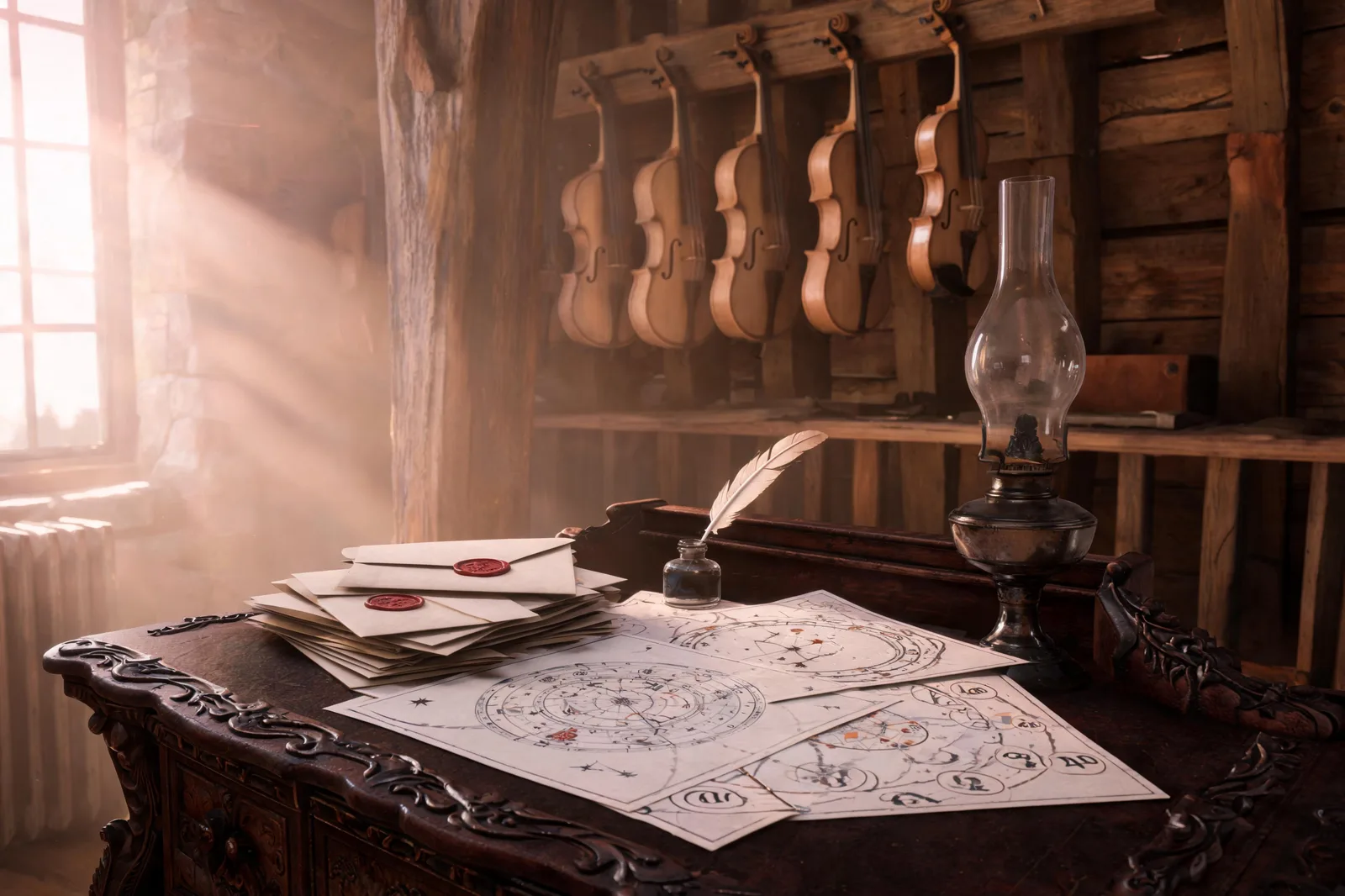
The Hermetic Brotherhood of Luxor was a small, secretive order of practical occultism that operated in Britain and the United States from the early 1880s, teaching astrology, correspondence-based ritual and sexual polarity work rather than a tarot system of its own. Unlike the Golden Dawn, it never produced a deck, but its members and its literature fed into the generation that did, which is why any history of esoteric orders and the tarot has to pass through it.
A Mail-Order Mystery School
The order surfaces in the historical record around 1884, when Peter Davidson, a Scottish violin-maker living in the United States, began corresponding with students on behalf of an "Egyptian" hierarchy he claimed to represent. Its real guiding intelligence, according to the scholarship of Joscelyn Godwin, Christian Chanel and John P. Deveney in their 1995 study of the order's surviving papers, was Max Théon, born Louis-Maximilian Bimstein in Warsaw, who worked through Davidson and the Scottish-American writer Thomas Henry Burgoyne. Burgoyne had served time in prison in California for fraud under an earlier identity, a fact the order's admirers rarely mention. Tradition holds that the group ran as a lodge, but in practice it was a postal network: instructions, degrees and warnings against premature practice travelled by letter between Scotland, Georgia and California.
Astrology, Not Arcana
What the Brotherhood actually taught was less a card system than a curriculum: natal astrology, breathing exercises, visualisation and a doctrine of polarity between a "positive" solar force and a "negative" lunar one, worked out between partners of opposite sex. Burgoyne's book The Light of Egypt, published in 1889 under the signature "An Initiate," became the order's most lasting public document and stayed in print among American occult booksellers well into the twentieth century. It talks at length about the stars and almost not at all about the tarot; a reader hoping for a Brotherhood deck, in the way the Golden Dawn left behind cards built on the system Éliphas Lévi's School: The Tarot as a Universal Key first proposed, will be disappointed. Members sometimes studied Éliphas Lévi's own writing, so his imagery sat in their library even without a painted card to match it.
Practical Occultism, Not a Painted Deck
This gap is worth dwelling on, because it marks a real fork in nineteenth-century esotericism. One branch, running from Lévi through Papus and Oswald Wirth to the Golden Dawn, treated the tarot as the master glyph of the whole Hermetic system, a wordless alphabet onto which every other correspondence could be mapped. The Brotherhood belonged to a second branch, more American and more pragmatic, that cared about bodily discipline, trance and the sidereal clock and left card symbolism to others. When later writers folded the two branches together, as happened repeatedly in American occult publishing after 1900, the Brotherhood's astrology was sometimes relabelled as "tarot philosophy" without real textual support. A careful reader should resist that conflation: the surviving circulars, catalogued by Godwin, Chanel and Deveney, show star-charts and polarity exercises, not trump sequences.
Where the Lines Actually Cross
The genuine connection to the cards runs through people rather than doctrine. Davidson and Burgoyne both corresponded with figures who later moved in circles that did build tarot systems, and the American current they started fed, more distantly, into the stream of practical magic that The Martinist Current and the Tarot also drew upon in France. The order's emphasis on a disciplined solitary apprenticeship under an unseen master gives it a natural affinity with The Hermit, whose lantern and staff describe exactly the kind of isolated, correspondence-taught initiation Davidson offered his American students. Its solar-and-lunar polarity doctrine likewise echoes the pairing of The Sun with the night-side forces the order's letters warned against misusing.
A Caution Worth Keeping
Because so much of the Hermetic Brotherhood of Luxor's own archive was deliberately destroyed or dispersed after internal scandals in the late 1880s, modern accounts rest on a thin layer of primary sources and a much thicker layer of later retelling. Writers in the twentieth century, eager to find an unbroken lineage from ancient Egypt to their own lodge, sometimes inflated the order's size, its antiquity and its influence well beyond what the letters themselves support. The honest version is smaller and stranger: a handful of correspondents on two continents, one of them with a criminal record, building a curriculum out of astrology, breath and polarity, who left no deck of cards but did leave a trace in how later orders imagined what a secret teaching body could look like. For a reader of the Thoth tarot, the Brotherhood is less a source of symbols than a reminder that not every order calling itself Hermetic reached for the cards to say what it meant.
Frequently Asked Questions
Did the Hermetic Brotherhood of Luxor have its own tarot deck? No surviving evidence shows one. Its curriculum centred on astrology and polarity practices, not card symbolism.
Who were its key figures? Peter Davidson and Thomas Henry Burgoyne ran its correspondence courses; scholars identify Max Théon as the hidden source behind their teaching.
What is the order's most accessible text today? The Light of Egypt (1889), published under the pseudonym "An Initiate," remains the Brotherhood's best-known public document.
How does the order relate to the Golden Dawn? The two were contemporaries, not the same lineage; the Golden Dawn built an explicit tarot curriculum where the Brotherhood built an astrological one, though both drew on the same wider Hermetic revival.
Questions
Did the Hermetic Brotherhood of Luxor have its own tarot deck?
No surviving evidence shows one. Its curriculum centred on astrology and polarity practices, not card symbolism.
Who were its key figures?
Peter Davidson and Thomas Henry Burgoyne ran its correspondence courses; scholars identify Max Théon as the hidden source behind their teaching.
What is the order's most accessible text today?
The Light of Egypt (1889), published under the pseudonym "An Initiate," remains the Brotherhood's best-known public document.
How does the order relate to the Golden Dawn?
The two were contemporaries, not the same lineage; the Golden Dawn built an explicit tarot curriculum where the Brotherhood built an astrological one, though both drew on the same wider Hermetic revival.
This article talks about
You might also like
 Symbolism
 Symbolism
 Symbolism
© 2026 TAROTS chat (tarots.chat). All rights reserved. No part of this article may be reproduced, distributed or adapted without the owner's written permission.
The Journal
From the Journal
Chosen for this page
 Symbolism
 Career
Ace of Wands Tarot Meaning: New Ventures, Passion and Creative Beginnings at Work
3 min read
More in Career Kabbalah
 Kabbalah
 Thoth Tarot
 Symbolism
 Symbolism
 Symbolism
 Kabbalah