The Lovers and the Letter Zain: Atu VI on the Seventeenth Path
by Redazione · 8 October 2026 · 9 min read
This is the second part of a series that reads The Book of Thoth chapter by chapter, against its Kabbalistic sources. The first part followed the Fool's zero and its letter, the Aleph, and the move here is the same one Crowley makes with every Trump: the card is a letter, a number, a position on the Tree, and the picture is the illustration of the whole. That move is laid out in The Fool and the Aleph: A Close Reading of The Book of Thoth, and the Lovers is where it gets harder to see, because the Lovers is the card everyone thinks they already understand. The book of thoth lovers is not about two people in love. It is about a sword, a pair of letters, and a marriage that is a piece of alchemy.
The letter Zain and the arch of swords
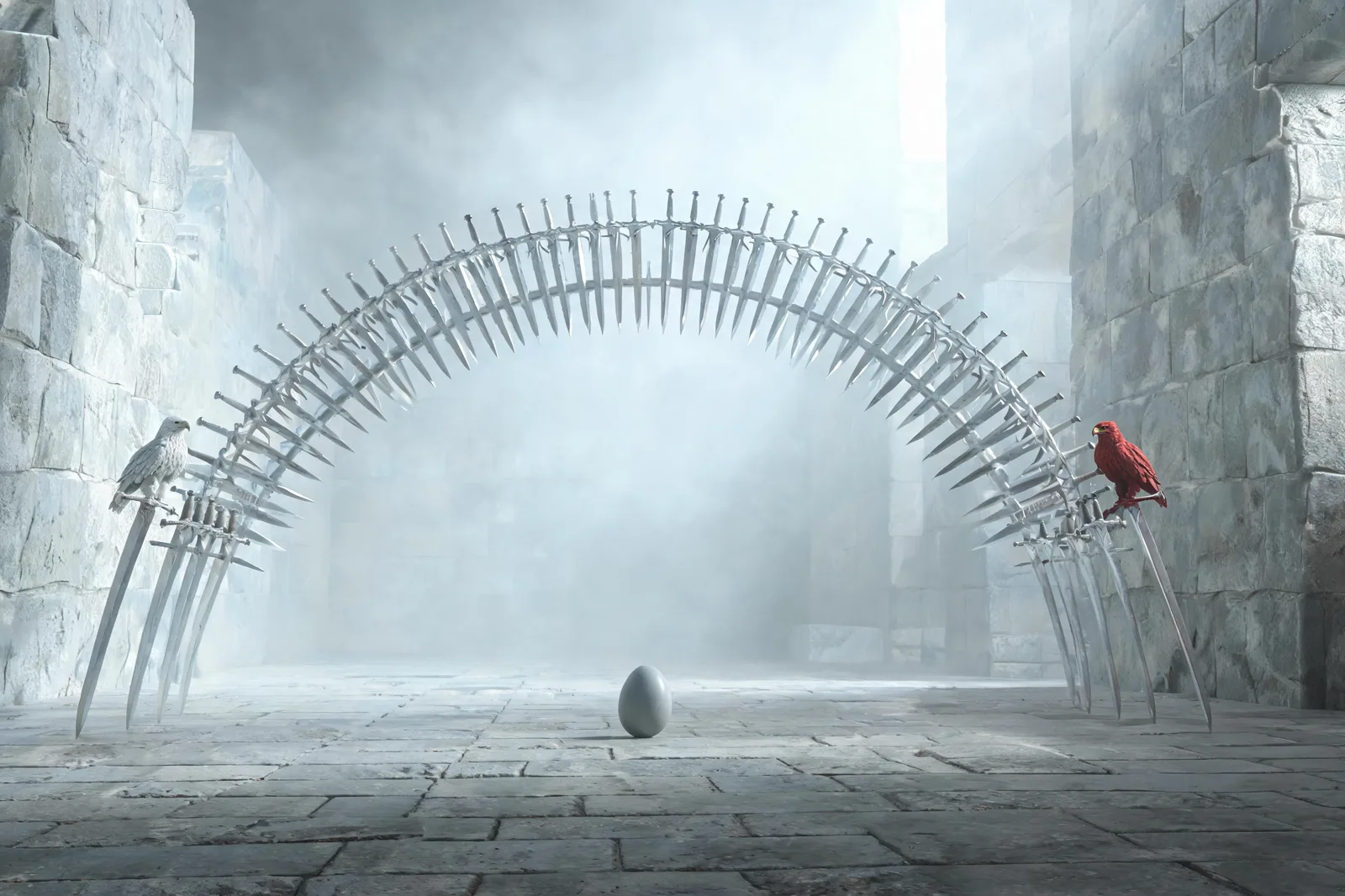
Crowley opens the Lovers the way he opened the Fool, with a letter. "The Hebrew letter corresponding is Zain, which means a Sword, and the framework of the card is therefore the Arch of Swords, beneath which the Royal Marriage takes place." (Hermetic Library, "The Atu — 6. The Lovers") That is the whole frame, and it is a frame that changes the card. The Lovers in a Marseille or a Waite-Smith deck is a couple beneath an angel. The Lovers in the book of thoth lovers reading is a sword made large enough to hold a ceremony inside it. The arch of swords is not decoration. It is the letter Zain drawn as a shape, and everything else in the card happens under that arch.
The sword is, in his words, "primarily an engine of division. In the intellectual world, which is the world of the Sword suit, it represents analysis." That is the quiet redefinition that the whole card turns on. The Lovers are not a card about feeling. They are a card about the faculty that cuts things apart, the faculty that is the intellectual world. The couple is the subject of a division, and the division is the card.
Solve et coagula, the lovers as a pair
The most important sentence in the chapter is the one that joins the Lovers to its twin. "This card and Atu XIV together compose the comprehensive alchemical maxim: Solve et coagula." The Lovers is the Solve, the dissolving, the analysis. The Art, the Fourteen, is the Coagula, the recombining, the synthesis. Read by itself the Lovers is half a statement. Read against the Art it is the whole of the alchemical operation, and that is how Crowley means it to be read.
That is the interpretive choice this part is about, and it is the one that separates this book from a commentary. He does not ask what the Lovers means in a reading. He asks what the Lovers does, and the answer is that it performs the first half of a two-step operation. The card, in his hands, is a move in a process, not a symbol pointing at something. This is the same move we saw in What Thoth Kept and What Crowley Rewrote, where the whole deck is read as a set of operations rather than a set of pictures.
The card as the story of creation
Crowley then does something he rarely does, which is to show the card before the modern deck covered it over. He quotes the primitive form from Liber 418, The Vision and the Voice (Hermetic Library, "The Vision and the Voice"), and the passage reverses almost everything. "Cain was the child of Eve and the Serpent, and not of Eve and Adam." The Lovers, in its original form, was not a couple. It was Cain standing over Abel, the first murder, the first division. The card he calls, in that form, "The Brothers," not "The Lovers."
The point of the reversal is the point of the whole chapter. "It is very significant that almost every sentence in this passage seems to reverse the meaning of the previous one. This is because reaction is always equal and opposite to action." The Lovers is the card of the contradictory, the place where one statement and its opposite are held at the same time. The modern card is the synthesis. The original card is the division that the synthesis came to cover.
Analysis, then synthesis, the policy of science
This is where Crowley leaves the card and steps into the history of science, and it is the boldest move in the chapter. The Initiates who issued the Tarot, in his telling, "superseded the original card" to create a new universe, and their methods are "grouped under the generic term Alchemy." The Lovers, the analysis, and the Art, the synthesis, are the two steps of that method, and the "first question asked by science" is the Solve, "Of what are things composed?", and the second is the Coagula, "How shall we recombine them to our greater advantage?"
That is a genuinely strange thing to write in a tarot book, and it is the thing that the rest of the series will keep returning to. Crowley reads the Lovers as a step in the history of method, the card that names the move from cutting to recombining, and the couple is the picture he hangs on that move.
The hermetic marriage
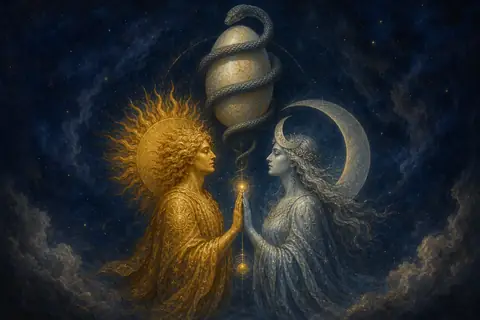
The figure at the centre of the card is, in his reading, "another form of The Hermit," a form of the god Mercury, "closely shrouded, as if to signify that the ultimate reason of things lies in a realm beyond manifestation and intellect." He stands in the Sign of the Enterer, the Sign of Benediction and Consecration, and his action in the card is "the Celebration of the Hermetic Marriage." The marriage is not the card. The marriage is what the card is for.
The married pair is the Black King with a golden crown and the White Queen with a silver crown, he with the Red Lion and she with the White Eagle. "In chemistry they appear as acid and alkali." The King bears the Sacred Lance, the Queen the Holy Grail, and at the bottom of the whole is "the winged Orphic egg," grey, mingling white and black, "the co-operation of the three Supernals of the Tree of Life." The marriage is a chemical equation drawn as a picture, and the egg is the product.
Cupid, Gemini and the seventeenth path
The figure in the air is Cupid, and that is the one part of the card that does not fit cleanly, and Crowley knows it. "Gemini leads from Binah to Tiphareth," and that is the seventeenth path, the path of Zain on the Tree. The Lovers is the card of that path, and the path runs from the Understanding down to the Beauty, which is why the card is about the conjunction of opposites, the joining of two principles that the path connects.
Cupid, in his reading, is "the source of all action, the libido to express Zero as Two," and his arrow is "the spiritual intelligence necessary in alchemical operations." The quiver carries the word Thelema. That is the one link between this card and the rest of the system, the Law that the arrow points toward. And the opposite card, the Sagittarius, is "the Bearer of the Arrow," so the Lovers and the Archer are two halves of one figure, the one who shoots and the one who carries.
How the book of thoth lovers departs from the Golden Dawn
The Golden Dawn reading of the Lovers is a reading of the couple, of the choice, of the union of opposites as a moral or spiritual state. Crowley's reading is a reading of the letter, of the path, of the alchemical operation. The couple is still there, and it is still a good picture. But the card is doing the work of the sword, the work of the division, the first half of Solve et coagula. The Lovers in the book of thoth lovers is not the card you read for a relationship. It is the card that names the move from cutting to recombining, and the marriage is the product of that move.
The practical consequence is the same one the Fool's chapter had, only turned around. In a Marseille or a Waite-Smith spread you read the Lovers as the people, their choice, their union. In a Thoth spread you read the Lovers as the operation, the Solve, the division that the Coagula completes. The people are still there, and the angel is still there, and they are all good pictures. But the card is doing the work of the letter, the work of the path from Binah to Tiphareth, the first half of the alchemical maxim. That is the interpretive choice this chapter makes, and it is the one the rest of the series will keep returning to.
That is the structure of the deck in one sentence, and it is the structure the Fool's chapter set up and this one confirms. Each Trump is a letter, each letter is a path, each path is a position on the Tree, and the image is the illustration. The Fool showed the method at its purest, because the zero has no position. The Lovers show it at its most useful, because the sword has a job to do. The Fool was the balance before the expression. The Lovers are the first expression that needs a partner, the first card in which more than one figure appears, and the first move that has to be completed by another.
You might also like
 Thoth Tarot
 Thoth Tarot
 Thoth Tarot
© 2026 TAROTS chat (tarots.chat). All rights reserved. No part of this article may be reproduced, distributed or adapted without the owner's written permission.
The Journal
From the Journal
Chosen for this page
 Love
Love Relationships
The Lovers Tarot Card in Relationships: Choice, Union and Deep Connection
2 min read
More in Relationships Spirituality
 Thoth Tarot
 Kabbalah
 Kabbalah