Art, Alchemy and the Fourteenth Trump
by Redazione · 8 October 2026 · 8 min read
The card that finishes the marriage
The Lovers, as we saw in The Lovers and the Letter Zain: Atu VI on the Seventeenth Path, is the Solve: the division, the analysis, the first half of the alchemical maxim. The book of thoth art card is the Coagula: the recombining, the synthesis, the second half. Crowley says it plainly in the chapter. "This card is the complement and the fulfilment of Atu VI." The Lovers begins the royal marriage. Art finishes it. That is the whole relationship, and it is why the two cards have to be read together.
In most decks the fourteenth trump is called Temperance. It is an angel pouring water from one cup to another. That is a picture of balance. Crowley's card is a picture of a chemical operation. The name Art is not a decoration. It is the word he gives to the act of combining forces, of realization, of action based on accurate calculation.
Samekh, the letter that binds
The letter of the Art is Samekh, the fifteenth letter of the Hebrew alphabet. Where Zain, the letter of the Lovers, is the sword, Samekh is the support, the thing that holds. It is the letter that carries a load. That is the card's job. The Lovers cut the two things apart. The Art holds them together after the cutting.
The sign is Sagittarius, the opposite of Gemini in the zodiac. Crowley leans on that opposition. The Lovers is Gemini, the double, the pair. The Art is Sagittarius, the archer, the one who shoots the arrow that joins the two. The two cards are opposites that complete each other, and that is exactly the point the chapter is making.
The androgyne figure
In the Lovers the two figures are still two: the black king and the white queen. In the Art they are one. Crowley calls the figure "a single androgyne figure." The black and white personages are now united. Even the bees and the serpents on their robes have made an alliance. The red lion has become white. The white eagle has become red.
This is the visual statement of the synthesis. The two opposites do not merely sit side by side. They exchange what they are. The king gives his red blood, the queen gives her white gluten. The union is not a holding of hands. It is a chemical exchange, and the single figure is the product.
The detail that the bees and the serpents have "made an alliance" is easy to miss, and it is the one that shows the operation is total. The animals are the lower, the instinctive, the part of the figure that does not reason. If the two human halves have united, the two animal halves must have united as well. The synthesis is not a compromise between two people. It is the joining of every level of the figure, the highest and the lowest, into one.
The golden crown and the silver band
The exchange goes right down to the crowns. In the Lovers the king wore the golden crown and the queen the silver. In the Art the division is broken. She now wears the golden crown with a silver band. He wears the silver crown with a golden fillet. The marks of rank, which in the first card separated the two, have been shared by both.
That is the quietest and the clearest image in the chapter. The two figures do not merely agree. They have each taken on the mark that once distinguished the other. The difference has not been erased. It has been distributed. That is what a synthesis does that a compromise does not. A compromise keeps the two apart and calls it peace. A synthesis makes each one carry what the other was.
Fire burns the water, the water extinguishes the fire
The most quoted sentence in the chapter is the one about the two elements. "The fire burns up the water; the water extinguishes the fire." At first that sounds like a contradiction. Two elements that destroy each other. But Crowley means it as the description of a complete operation, not a stalemate.
The equilibrium and the counter-change are carried out inside the figure itself. The white woman now has a black bead. The black king has a white one. She wears the golden crown with a silver band, he the silver crown with a golden fillet. The two have exchanged their marks. The operation is total, and the single figure is the record of it.
The pearl in the wine-cup
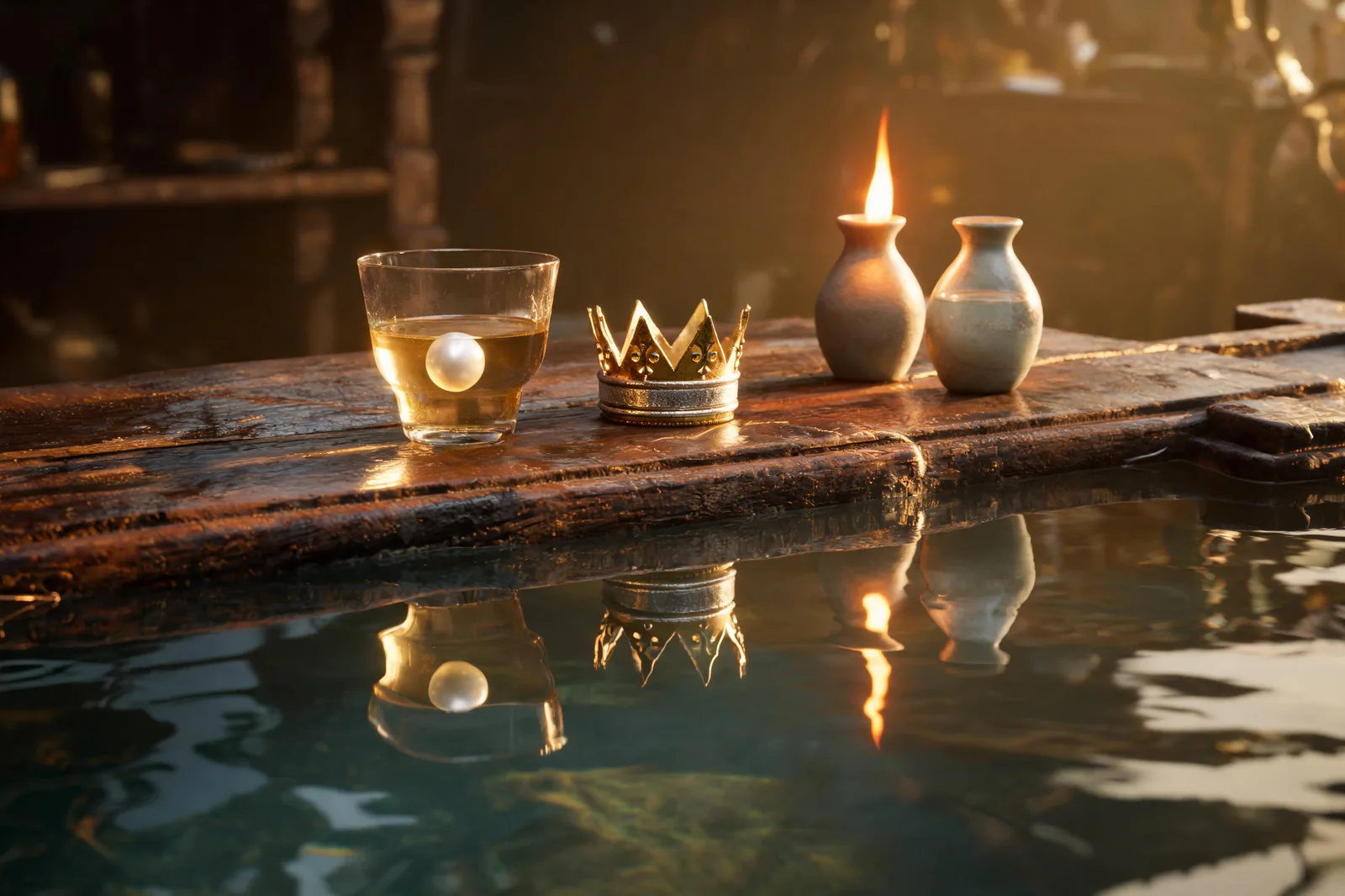
The chapter opens with a set of instructions that read like a recipe. "Pour thine all freely from the Vase in thy right hand, and lose no drop." Then: "Dissolve the Pearl in the Wine-cup; drink, and make manifest the Virtue of that Pearl." (Crowley-Thoth, "Art") That is the alchemy in the plainest form the chapter gives.
The pearl is the thing to be dissolved. The wine-cup is the medium. The act of drinking is the making-manifest. The card is not describing a state of balance. It is describing a procedure, the one that takes a hidden virtue and brings it into the open. That is the Coagula, the recombining, and it is the second half of what the Lovers began.
What makes the passage work as a reading is that it gives the reader a verb, not a noun. A card of Temperance gives you a quality to recognize, moderation, calm, the even hand. A card of Art gives you an act to perform, the pouring, the dissolving, the drinking. The reader is not asked to notice a balance. The reader is asked to carry out a transformation, and to lose no drop. That is the whole of the chapter's difference from a card of meaning, and it is the difference between reading a card and doing what the card does. The Lovers gave the reader the first move. The Art gives the second, and the two together are the operation the deck is built around.
The arrow and the directed will
The arrow is the one symbol that carries across both cards. In the Lovers it is the arrow of Cupid. In the Art it is the arrow of Sagittarius, the archer. Crowley says the arrow is "the simplest and purest glyph of Mercury, being the symbol of directed Will."
That is the link between the two halves. The Lovers is the analysis, the cutting, the arrow that separates. The Art is the synthesis, the joining, the arrow that unites. One arrow, two jobs. The directed will that divides is the same directed will that combines, and the card is the record of the second job done.
The reversed card
The chapter ends with the reversed meanings, and they are the clearest sign that this is a card of action, not of state. Upright, the Art is the combination of forces, realization, action based on accurate calculation, the way of escape. Reversed, the same card becomes the failure to combine, the forces that stay scattered, the calculation that does not close.
A card of Temperance reversed would still be about balance, only a lopsided one. A card of Art reversed is about the operation not happening, the two things that are never joined, the pearl that is never dissolved. The reversal is not a mild inversion. It is the absence of the act, and that is the difference between a card that describes a state and a card that performs one.
The book of thoth art card and the Golden Dawn
The Golden Dawn read the fourteenth trump as Temperance, as moderation, as the balance of opposites held in equilibrium. Crowley keeps the position and the letter and the sign, but he changes what the card does. It is no longer a picture of balance. It is a picture of operation, the Coagula, the recombining that the Lovers, the Solve, set in motion.
That is the specific interpretive choice this close reading shows. In a Marseille or a Waite-Smith spread you read the Temperance as moderation, the angel, the calm. In a Thoth spread you read the Art as the act, the combination of forces, the second half of the alchemical maxim. The picture is the same position. The job is not.
The difference is the same one we saw in The Fool and the Aleph: A Close Reading of The Book of Thoth, and the same one we saw in the Lovers, only now it has reached the card that finishes the pair. The Fool showed the method at its purest, because the zero has no position to do work from. The Lovers showed it at its most useful, because the sword has a job to do. The Art shows it at its completion, because the synthesis is the job that the analysis was done for. Read the three in order, and the deck stops being a set of pictures and becomes a set of operations. That is the reading the rest of the series is building, and the Art is where it lands. In the next part we take the three mother letters, and read how they close the deck.
You might also like
 Thoth Tarot
© 2026 TAROTS chat (tarots.chat). All rights reserved. No part of this article may be reproduced, distributed or adapted without the owner's written permission.
The Journal
From the Journal
Chosen for this page
 Thoth Tarot
The Lovers and the Letter Zain: Atu VI on the Seventeenth Path
9 min read
More in Thoth Tarot Thoth Tarot
The Fool, the Hanged Man and the Aeon: The Three Mother Letters in the Book of Thoth
8 min read
More in Thoth Tarot Major Arcana
 Thoth Tarot
 Thoth Tarot
 Symbolism
 Symbolism
 Symbolism