The Fool and the Aleph: A Close Reading of The Book of Thoth
by Redazione · 8 October 2026 · 9 min read
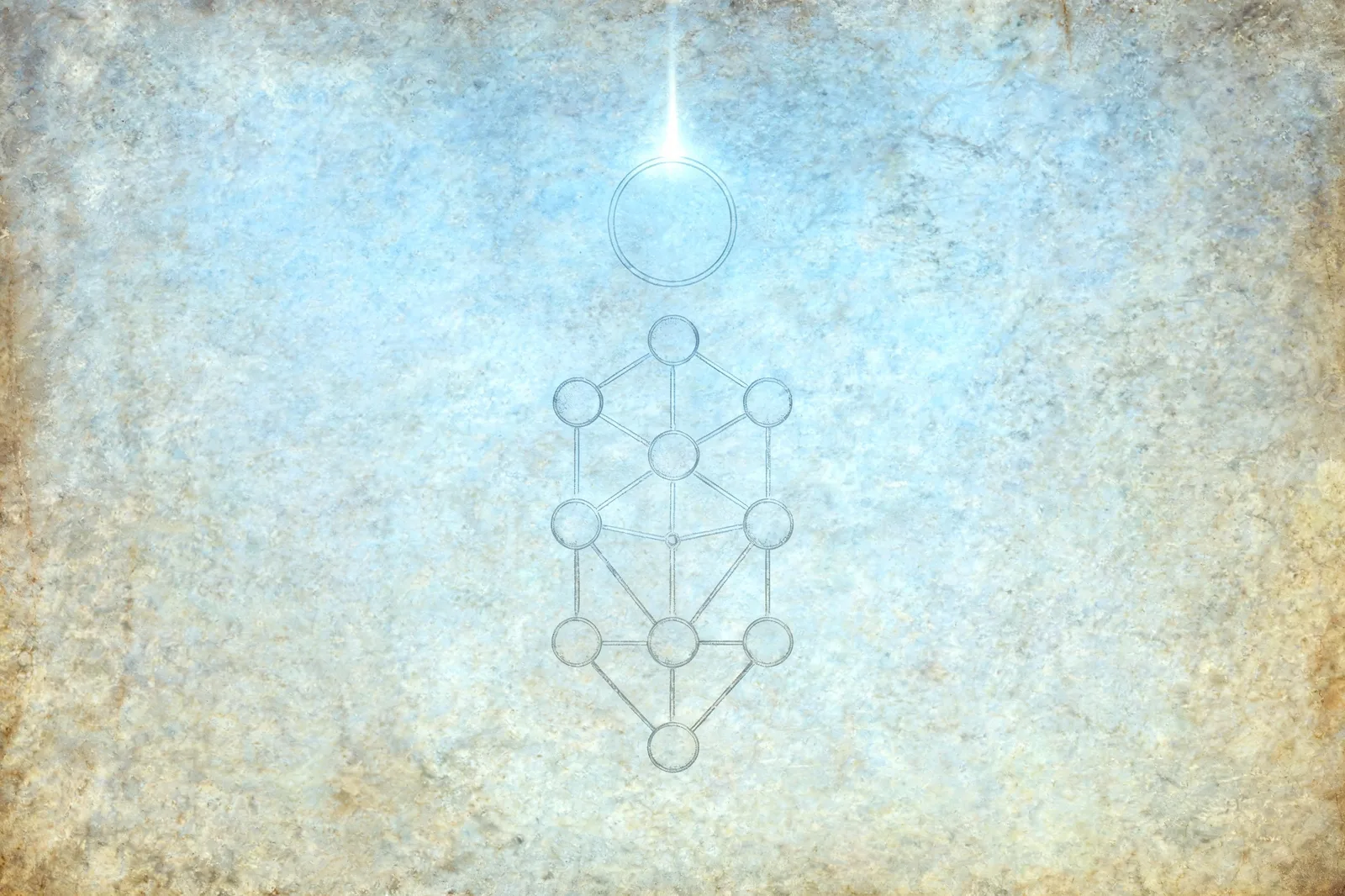
This is the first part of a series that reads The Book of Thoth chapter by chapter, against its Kabbalistic sources. The goal is not to summarize the card. It is to follow one specific interpretive choice: how Crowley reads the book of thoth fool, the zero and its letter, and what that makes of the card as a number rather than a figure. The Fool is the zero of the deck, the Atu attributed to the letter Aleph, and the way Crowley handles that zero in the second chapter of the Atu section is the cleanest single example of how the whole book works.
What the Book of Thoth chapter actually opens with
Crowley opens the Fool with a sentence that does not describe a picture. It identifies a letter. "This card is attributed to the letter Aleph, which means an Ox, but by its shape the Hebrew letter (so it is said) represents a ploughshare; thus the significance is primarily Phallic." (Hermetic Library, "The Atu — 0. The Fool") That is the whole move, and it is worth stopping on it. He does not start from the man in motley, the cliff, the dog. He starts from a consonant. The card is introduced as a letter of the Hebrew alphabet, and the image is treated as what that letter looks like when it is drawn large enough to fill a card.
The source is the standard one, the attribution of each Trump to a letter of the Hebrew alphabet inherited from the Golden Dawn and from the Kabbalistic tradition more broadly. Aleph is the first letter, and in that order it is the natural owner of the Fool, the card that stands before the one. Crowley is not inventing this. He is reading it. The text he is reading is the chapter on the Fool in The Book of Thoth, the Atu section, and the reading itself is where the interpretive choice lives. That choice is the subject of this series, and a fuller account of what Crowley changed against the Golden Dawn is in What Thoth Kept and What Crowley Rewrote.
The Zero as the Negative above the Tree
The second sentence of the card is the one that matters. "It represents therefore the Negative above the Tree of Life, the source of all things. It is the Qabalistic Zero. It is the equation of the Universe, the initial and final balance of the opposites." That is the Fool as a number, and it is the idea that the whole card turns on. The Fool is not a figure who happens to stand at the start of a path. The Fool is zero, the negative, the balance that holds before any of the ten Sephiroth are expressed. The card is a number first, and a man second.
The phrase "the initial and final balance of the opposites" does real work. It says the zero is not nothing. It is the equation. It is the state in which plus and minus are not yet separated, the point at which the sum is balanced and therefore, in a sense, complete. Crowley is treating the Fool as the deck's way of writing a mathematical statement, the balance of opposites, and the image of the man on the cliff is the picture he hangs on that statement. The number is the card. The man is the illustration.
This is the interpretive choice the whole series is about. Where the Marseille deck, and the Waite-Smith deck after it, present the Fool as a character, a man who will begin a journey, Crowley presents him as a quantity, a zero that is also the equation of the universe. The character is what you see. The quantity is what you read.
Aleph, the Ox, the Vacuum
The letter itself carries its own small history, and Crowley leans on it. Aleph means ox in Hebrew, from the West Semitic word for ox, and the shape of the letter is said to derive from a picture of an ox's head (Wikipedia, "Aleph"). In the alphabet it is the first letter, and in the Kabbalistic arrangement it is the one attributed to the Fool. So the Fool is, at the letter level, an ox. Crowley notes the ploughshare reading, the phallic significance, but the deeper point is that the Fool is the first consonant, the letter that in Hebrew is largely a marker, a glottal stop, almost a nothing that lets the other letters be spoken.
That is the quiet joke in the attribution, and it is a good one. The Fool, the zero, the negative, the vacuum, is paired with a letter that in practice functions as a placeholder for a sound, the mark that is there so the rest of the word can be pronounced. Crowley says it plainly. "Air, in this card, therefore quintessentially means a vacuum." The Fool is the vacuum. The Fool is the letter that is not quite a sound. The Fool is zero. The three descriptions are one description, and the card is a single idea seen from three directions.
Plus One, Minus One
The most compact passage in the chapter is the one that follows. "It is only later that one must consider the question of the result of formulating Zero as plus one plus minus one. The result of so doing is to formulate the idea of Tetragrammaton." This is Crowley's way of saying that the zero is not the end of the story. The zero, once you write it as the balance of plus one and minus one, generates the four-letter name. The Fool, the nothing, is the seed of the name of God.
That is a genuinely bold move, and it is the kind of move that separates this book from a commentary. He is not describing what the Fool means in a reading. He is doing Kabbalah with the card. He takes the zero, which is the Fool's number, and he performs an operation on it. He writes the zero as the balance of opposites, and from that balance he derives the Tetragrammaton. The card, in his hands, becomes a step in a derivation. The Fool is not a symbol that points to something. The Fool is the first move in a calculation.
The Green Man, the Fool, the Innocence
Crowley then lists the figures the Fool collects, the Green Man of the spring festival, the April fool, the Holy Ghost, the Great Fool of the Celts, the Rich Fisherman, the crocodile, Hoor-Pa-Kraat, Zeus Arrhenothelus, Dionysus Zagreus, Baphomet. The list is not decoration. It is a demonstration that the zero is a container, the place where every beginning can be stored. The Fool is the name the deck gives to the point before a specific story starts, and because that point is before all stories, it can hold every beginning.
The one thread Crowley pulls out of that list is innocence. "It is the innocence of the Fool which most strongly characterizes him." That is the link from the number back to the figure. The zero is the innocence. The man in motley is the zero. When you read the Fool in a Thoth spread, the innocence is not a mood the man is in. It is the state the zero is in, the state of the balance before it is broken. A fuller reading of that innocence, as the withdrawal of light, is in Tzimtzum and the Fool: A Card for the Withdrawal of Light.
What this does to the card in a reading
The practical consequence of reading the Fool as a number is that the card changes from a character to a position. In a Marseille or a Waite-Smith spread, the Fool is the man. You read his face, his gesture, his cliff. In a Thoth spread, the Fool is the zero. You read the position, the balance, the point before the expression. The man is still there, and he is still a good picture. But the card is doing the work of the number, and the number is the balance of opposites.
That is the interpretive choice this chapter makes, and it is the one the rest of the series will keep returning to. Crowley reads the Fool as a quantity. The zero is the card. The ox is the letter. The vacuum is the element. The innocence is the state. All four are the same thing, the balance of the opposites, and the man in motley is the picture he drew on top of it.
Why this chapter is the key to the book
This is the first Trump in the Atu section, and the way it is written sets the method for every card that follows. Each Trump is a letter, each letter is a number, each number is a position on the Tree, and the image is the illustration of the whole. The Fool shows the method in its purest form, because the zero is the one number that has no position on the Tree at all. It stands above the Tree. It is the negative. It is the source.
If the Fool is the zero above the Tree, then every other Trump is a point on the Tree, and the difference between the Fool and the rest is the difference between the balance and the expression. That is the structure of the deck in one sentence, and it is the structure Crowley is arguing for in this chapter. The rest of the series will test that argument against the other Trumps. This one is the test case, and it is the one that holds.
Questions
What letter is the Fool attributed to in The Book of Thoth?
Aleph, the first letter of the Hebrew alphabet. Crowley opens the Fool's chapter by identifying the card with its letter rather than by describing its image.
Why does Crowley call the Fool the Qabalistic Zero?
Because the Fool represents the Negative above the Tree of Life, the balance of opposites before the Sephiroth are expressed. He treats the zero as the equation of the universe, not as nothing.
What does Crowley mean by formulating Zero as plus one plus minus one?
He is performing an operation on the zero: writing it as the balance of opposites, from which he derives the Tetragrammaton. The Fool becomes the first move in a Kabbalistic calculation.
Is the Fool in The Book of Thoth a character or a number?
Both, but the number is the card. Crowley reads the Fool as a quantity, the zero, the ox, the vacuum, the innocence, all one idea, and the man in motley is the picture drawn on top of it.
You might also like
 Major Arcana
 Thoth Tarot
 Thoth Tarot
© 2026 TAROTS chat (tarots.chat). All rights reserved. No part of this article may be reproduced, distributed or adapted without the owner's written permission.
The Journal
From the Journal
Chosen for this page
 Major Arcana
The Fool Tarot Card Meaning in the Thoth Deck: Infinite Potential and New Beginnings
3 min read
More in Major Arcana Kabbalah
 Thoth Tarot
 Thoth Tarot
 Thoth Tarot
 Kabbalah
 Symbolism
 Symbolism
 Symbolism