What Thoth Kept and What Crowley Rewrote
by Redazione · 8 October 2026 · 9 min read
What this part asks
The last four parts of the series traced the chain: Lévi gave the trumps their letters in the 1850s. The Golden Dawn carried those letters into Book T in 1912. Waite drew them onto the cards in 1909. Crowley read all three and made a deck of his own. This part maps the crowley thoth tarot changes against Book T: which attributions Crowley kept, and which he changed on purpose.
The answer is not "he changed everything." Crowley kept the skeleton — the twenty-two letters, the planetary rulers of the court cards, the decan framework of the minor arcana. What he changed was the skin: the order of two trumps, the names of the courts, the planetary emphases, and the philosophical frame that wrapped the whole system. The last part of the series, Why Waite's Pictorial Key Rewrote Lévi, set up the link that Crowley read.
What he kept: the letters, and the Fool
The letters stayed. Crowley did not reinvent the alphabet-to-trump mapping. Aleph is still the Fool, Beth is the Magician, and so on. He kept the structure because the structure was the system. Without the letters, the deck is a picture book. With them, it is a cipher, and the cipher is what made the Golden Dawn's tarot different from Marseille.
Why did he keep it? Because the letters are the deck's argument. The Marseille deck is a picture set. The Golden Dawn deck is a picture set with a hidden alphabet, and the alphabet is the claim: that the trumps are not twenty-two arbitrary images but twenty-two letters of a hidden writing. Crowley inherited that claim. He could have dropped it and made a purely symbolic deck. He did not. The fact that he kept the letters is the first and quietest of his choices, and it is the one that makes the whole deck a reconstruction rather than an invention.
He kept the Fool as the zero, the unnumbered card that opens the deck. In the Golden Dawn's Book T the Fool is the "Foolish Man," the naked child beneath the rose tree, holding a leash on a grey wolf. Crowley's Book of Thoth keeps that image and deepens it: the Fool is the force of the Unconscious, the raw material of the Work. The image is the same. The meaning is wider. That is the pattern that runs through the whole deck: same picture, larger claim.
The planetary rulers of the court cards stayed. The Page of Wands is still Mercury, the Knight of Cups is still Venus, the King of Swords is still Saturn. Crowley did not reassign the planets to the courts. He kept the scheme because the scheme was the astrology of the deck, and the astrology was the point. The scheme itself is the subject of part three of the series, The Court Cards' Planetary and Decan Scheme.
The decans stayed, with one change. Each pip card carries a decan of the zodiac, a ten-degree slice of a sign. Crowley kept that. But he changed which decan goes with which card in a few suits, because his zodiacal system was the Thelemic one, not the Golden Dawn's. The change is small, but it is a change, and it shows up in the Book of Thoth's tables.
A decan is not a card. It is a position on the zodiac, and the card is the image the deck assigns to that position. When Crowley moved a decan from one card to another, he changed the image that a given ten degrees of the sky maps to. That is a real change in the system, even if the number of decans stays at thirty-six. The minor arcana is where the astrology of the deck lives, and it is where the two systems quietly diverge. A reader who lays out a decan reading on the Thoth deck is not doing the same thing as a reader who does it on a Golden Dawn deck, even though both decks have the same thirty-six decans.
What he changed: the two trumps
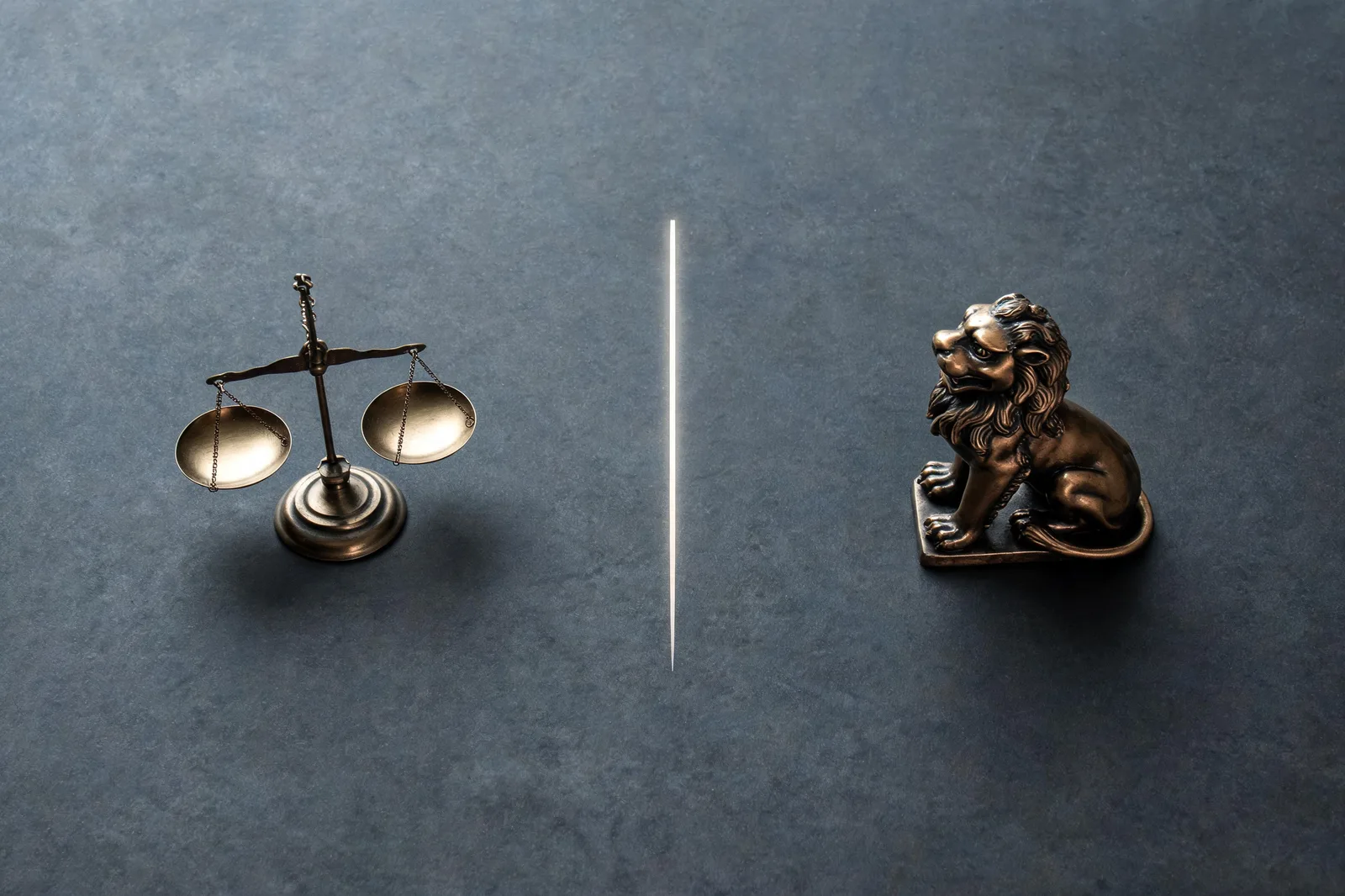
The most visible change is the order of Strength and Justice. In the Marseille tradition, and in the Golden Dawn's Book T, Justice is the eighth trump and Strength is the eleventh. Waite swapped them: Strength is the eighth, Justice the eleventh. Crowley put them back. In the Thoth deck, Justice is the eighth and Strength is the eleventh, the same order as Marseille and Book T.
Why did Crowley put them back? In the Book of Thoth he says the eighth position belongs to the element of fire, and Justice, as the weighing of the heart, is the fire-trial. Strength, as the lion and the woman, is the water-trial, and water is the eleventh. It is a reading of the element, not of the number. The number is the element's number. The card follows the element, not the other way round.
This is not a trivial swap. It changes how a reader of the Thoth deck builds a reading. In the Rider-Waite deck, the eighth card is the gentle hand on the lion's mouth. In the Thoth deck, the eighth card is the scales. A reading that expects one and finds the other is reading a different deck. A side-by-side of the Golden Dawn cards against Book T, which makes the swap visible, is at steve-p.org's Golden Dawn deck comparison.
What he changed: the descriptions of the courts
The Golden Dawn called the four court cards Page, Knight, Queen, King. Crowley kept those four ranks and the planetary assignments behind them. What he changed is the description attached to each court. Book T gives the King of Wands as "the Sun and Mars." The Book of Thoth describes the same card as the King of Fire, the Sun, the active principle of Will. The planet is the same. The job the card is said to do is not.
That is the real difference. In the Golden Dawn, a court is an elemental and planetary station. In the Thoth deck, a court is a working force. Crowley writes the courts as agents in a magical operation, not as positions in a hierarchy. The Page of Wands is not "the messenger of the Sun and Mars." He is the first degree of the Will of Fire expressed. The shift is from map to engine, and it runs through all sixteen courts.
The four ranks also carry a degree of the element. The Page is the first degree, the Knight the second, the Queen the third, the King the fourth. In the Golden Dawn those degrees are levels of a single elemental force moving from birth to mastery. In the Thoth deck the degrees are stages of Will: the Page is the spark, the Knight the mover, the Queen the container, the King the ruler. The same ladder, a different verb. A reader who reads a court as a level in the Golden Dawn sense and a court as a stage of Will in the Thoth sense is reading two different decks with the same sixteen cards.
A reader meets the difference when they interpret a court. A Golden Dawn reading asks what element and planet the court brings. A Thoth reading asks what the court does to the Will in the situation. The same card answers two different questions.
What he changed: the frame
The frame is the part that matters most to a reader. The Golden Dawn's tarot is a tool of the Order. It is a ritual instrument, a mnemonic for the neophyte, a map of the soul's ascent through the ten Sephiroth. The Book of Thoth is a different kind of book. It is a magical text. Crowley calls it "the Book of the Thoth Tarot," and he treats the deck as a grimoire, not a tool. The book itself, published in 1944, sets out the deck card by card in that frame (Aleister Crowley, The Book of Thoth).
This changes what the card means. In the Golden Dawn frame, a card is a stage in the soul's journey. In the Thoth frame, a card is a force in the magician's work. The same card, the same letter, the same planet, but a different job. The Fool is not "the beginning of the journey" in Crowley's hand. The Fool is "the force of the Unconscious, the raw material of the Work."
The difference shows up in the Book of Thoth's own method. A Golden Dawn reading asks the question of the soul's path, and the cards answer in the order of that path. A Thoth reading asks the question of the Will in a situation, and the cards answer as forces that can be called, held, or turned. The deck is the same shape. The question it is built to answer is not. That is the largest of the crowley thoth tarot changes, and it is the one a reader feels most, because it is the one that changes what they are doing with the cards.
The crowley thoth tarot changes at a glance
If you want the short version before the long one, here is the list. Kept: the twenty-two letters, the planetary rulers of the courts, the decan framework. Changed: the order of Strength and Justice back to the Marseille position, the description of the courts from stations to forces, the zodiacal assignment in a few decans, and the philosophical frame from Hermetic map to Thelemic engine. Everything else — the suits, the pips, the four ranks, the twenty-two trumps — is the same deck with a different claim attached to each card.
A reader who knows this does not need to be told the deck is modern. They need to know which layer they are reading. The letter is Lévi's. The planet is the Golden Dawn's. The order is Crowley's. The frame is Thelemic. Four layers, one deck.
Questions
What did Crowley keep from the Golden Dawn in the Thoth deck?
The skeleton: the twenty-two letter-to-trump mapping from Lévi, the planetary rulers of the four court ranks, and the decan framework of the minor arcana. The structure carried over because the structure is the system.
What did Crowley change in the Thoth deck?
He put Strength and Justice back to the Marseille order, rewrote the courts from elemental stations into working forces, shifted a few zodiacal decans, and replaced the Hermetic map frame with a Thelemic engine frame.
Why are Strength and Justice swapped in the Thoth deck?
Crowley restored the Marseille order where Justice is the eighth and Strength the eleventh, reading the position as the element's number rather than the card's number. A Thoth reader meets the scales at the eighth, not the lion.
Is the Thoth deck a modern reconstruction?
Yes. It is a nineteenth and twentieth century reconstruction: Lévi's letters, the Golden Dawn's planets, Crowley's order of the trumps and a Thelemic frame. Each layer is a choice, and the choice is the deck.
You might also like
 Thoth Tarot
 Thoth Tarot
© 2026 TAROTS chat (tarots.chat). All rights reserved. No part of this article may be reproduced, distributed or adapted without the owner's written permission.
The Journal
From the Journal
Chosen for this page
 Thoth Tarot
Where the Twenty-Two Letters Come From: Lévi's 1856 Attribution
8 min read
More in Thoth Tarot Kabbalah
Atziluth Tarot: The World of Emanation, Fire and the Suit of Wands
6 min read
More in Kabbalah Kabbalah
 Major Arcana
 Thoth Tarot
 Symbolism
 Symbolism