The Card Before the Deck Was Esoteric: Marseille Pattern and the Game's Rules
by Redazione · 7 October 2026 · 9 min read
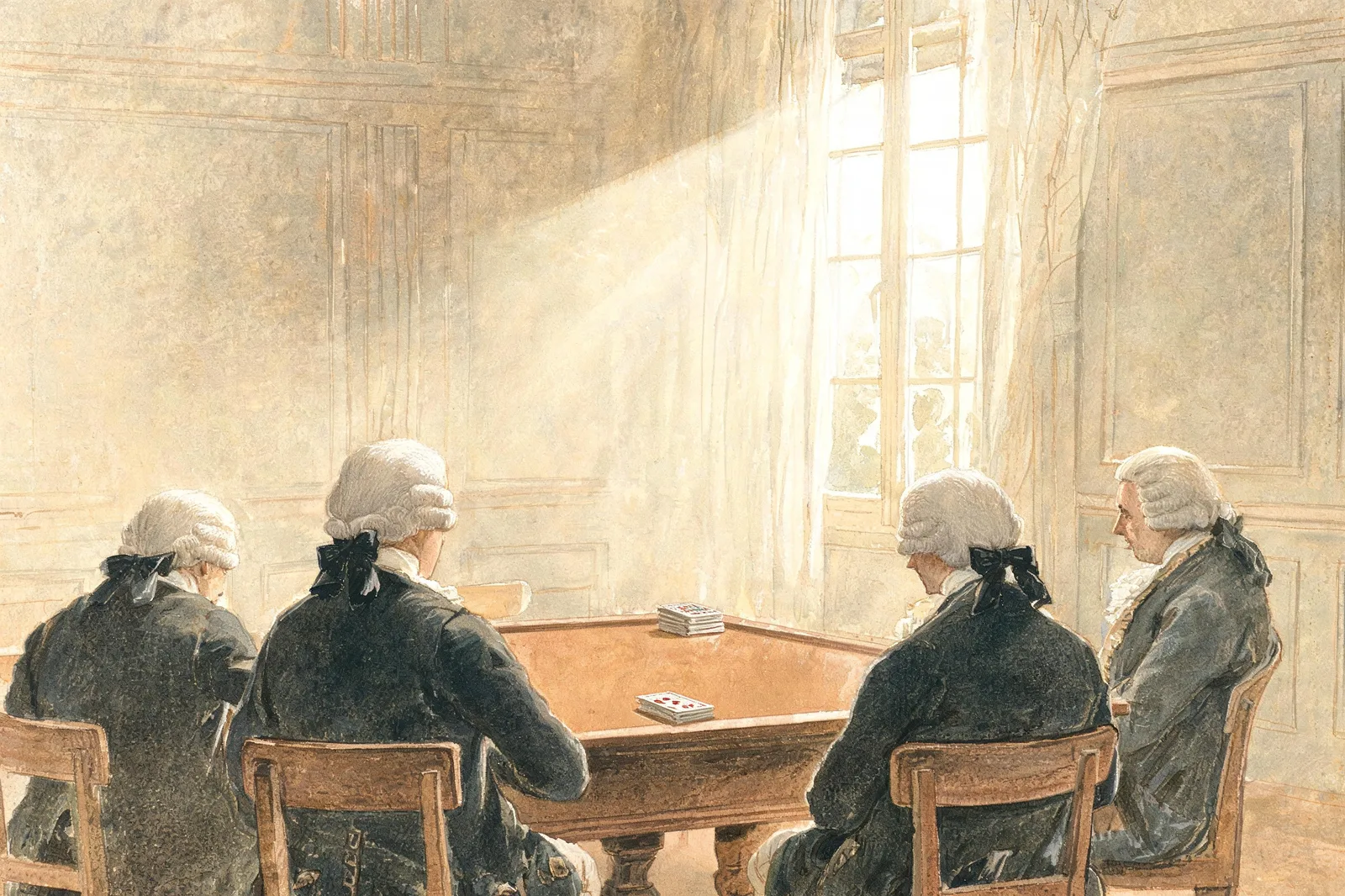
The marseille tarot pattern is the shape of the deck you have probably never seen, but you have read. It is the standard pattern of a seventy-eight-card pack, Italian in its suits, that was made for a game. It was not made for a reading. The name is a bit of a trick. The cards were probably made in Milan first, and then they spread to France, Switzerland, and northern Italy. They were printed in great numbers in Marseille, a port city that was a centre of playing card manufacture, and they took the city's name. That is the whole origin of the name. Marseille did not design the pattern. It printed it. The pattern is older than the name, and older still than the idea that the pattern is a map of anything. This is the fourth part of the series «Before the Esotericists: The Tarot as a Game, 1450-1780». In Court de Gebelin and the Egyptian Myth of 1781 (Court de Gébelin and the Egyptian Myth of 1781) we saw the moment the deck became a sacred text. This part goes back to the moment before that, when the deck was a standard object of play.
The marseille tarot pattern and the shape of the deck
The marseille tarot pattern is a standard pack. It has fifty-six cards in the four standard Italian suits, and twenty-two trumps. The suits are the same as any Italian deck of the period. Cups, swords, batons, and coins. The pip cards in the suit of swords are drawn as abstract curved symbols, a shape that the Wikipedia entry on the Tarot of Marseilles describes as resembling a mandorla. On the even-numbered cards those curves are all that is there. There is no scene, no figure, no allegory. The trumps are the illustrated cards, but they are illustrations in the way a playing card is illustrated. They are a fixed set of pictures that the game knows by name. The Fool is the matto. The World is the last trump. The order is specific, and it is a playing-card order, not a symbolic one.
The standardization is the point. A pattern is not a single deck. It is the shape that a whole industry agrees to print. Once the pattern was settled, any maker in any city could produce a deck that any player in any other city could play with. That is what makes it a pattern. It is a common standard, like the standard fifty-two-card pack that English and American players use. The marseille tarot pattern was that standard for the French-speaking world, and for much of northern Italy and Switzerland. It was the working deck. The decks we now call the Marseille pattern were not relics. They were the cards people played with, printed in runs, in Marseille and in a dozen other towns.
The game it was made for
The deck was made to play, and it was played as a trick-taking game. The earliest complete description of the rules for a French variant of the game dates to 1637. Before that the rules are scattered. A manuscript by Martiano da Tortona, before 1425, gives a cursory explanation of a tarot-like game. Then the next two centuries give vague descriptions and game terminology, but no full rulebook. The Wikipedia entry on the Tarot of Marseilles notes that the pattern was very popular in France in the seventeenth and eighteenth centuries for playing tarot card games, and that it is still produced today. The game was a real game, with real rules, played for points. It was not a fortune-telling apparatus. It was a card game that happened to have twenty-two illustrated trumps.
The rules of the game are not a mystery in the way the meanings are. The game is a trick-taking game, like bridge or ruff. The trumps are the trumps. They win tricks. The Fool has a specific role in the game, usually as the lowest trump or as an excuse card that lets a player out of a bad trick. The value of a trick, the scoring, the melds of four cards of the same rank, all of that is game logic. It has nothing to do with the meaning of the cards. A player who knew the game well could play it for a lifetime without ever reading a single card. That is the baseline the esoteric tradition never had. It had the meanings. It did not have the game.
The contrast is worth stating plainly. A trick-taking game does not need the cards to mean anything. It needs them to be a fixed set, so that every player knows the order and the values. That is exactly what the pattern provides. The pattern is a fixed set. The meaning is something the player adds on top, or does not. In the Marseille pattern, the cards are a fixed set of pictures. The pictures are there because the game needs a fixed set. They are not there because they are a map of the soul, or of the gods, or of the Hebrew letters. The esoteric tradition mistook the second thing for the first. It took a fixed set of game pictures and read them as a fixed set of meanings. The pictures did not change. Only the purpose did.
How the pattern spread
The pattern spread because it was useful, not because it was sacred. It was a standard pack that any player could buy. It was printed in Marseille, and Marseille was a port. Cards printed there went out on the ships. They went to Switzerland, to northern Italy, to the French provinces. The pattern took root wherever players wanted a common deck. In the Austrian-ruled Duchy of Milan, the pattern also took root with Italian captioning, starting around 1810. The Wikipedia entry records that the pattern was probably created in Milan before spreading to much of France. The spread was commercial. It was the movement of a product. The cards were a thing you bought and played, and the pattern was the thing that made them interchangeable.
The spread also explains a detail that the esoteric tradition never noticed. In different regions the same card had different names. The Death card was called il Tredici, the thirteen, in one set of makers. It was called lo Specchio, the mirror, in another. It was called Uguaglianza, equality, in a third. These are not mystical names. They are local nicknames for a playing card. The card had no single meaning. It had several names, and the names were regional. That is what a game card looks like. It is a token in a set of rules, and the rules are local. The esoteric tradition took one of those local names, Death, and made it a fixed meaning. It lost the others.
Why the pattern is still the baseline
The marseille tarot pattern survived for two reasons. The first is commercial. It was a good standard pack, and people kept playing it. The second is that it became the pattern the esoteric tradition worked from. When Etteilla's Invention: The First Tarot Interpretation System (Etteilla's Invention) built his reading system, he built it on the Marseille pattern, because that was the deck he had. When Court de Gébelin wrote the Egyptian myth, he wrote it about the same deck. The pattern did not change. What changed was what people thought it was. The deck that was a standard pack of a card game became, in the telling, a sacred text. The pattern is the bridge between those two. It is the shape that was a game, and then was read as a book.
The pattern is still the baseline for a practical reason too. Most of the decks you will pick up in a shop today are derivatives of the Marseille pattern, or of the later Rider-Waite pattern that was itself built on the Marseille sequence. The order of the trumps, the names of the major arcana, the basic iconography of the Fool, the Magician, the High Priestess, all of it descends from this standard pack. The pattern is the root. When a modern reader pulls a card, they are pulling from a lineage that starts with a card made to play a trick-taking game in the sixteenth and seventeenth centuries. The meaning was added to the pattern, not the other way around. The pattern is the fixed set. The meaning is the layer.
Around 1900, French tarot players largely abandoned the Marseille pattern for the Tarot Nouveau, a different standard pack. The result is a clean separation that the esoteric tradition never had. The playing game moved on to a new deck. The Marseille pattern was left behind, and it is now used mostly by cartomancers. The game and the reading, which once lived in the same deck, ended up on two different decks. The pattern is the hinge. It is the standard pack that the game was made for, and the pattern that the reading was later made from. Knowing which one you are holding is the difference between playing the deck and reading it.
That is the whole of the pattern's story, and it is the story the esoteric tradition never tells. The pattern is a standard pack. It was a game. It spread because it was a good standard, not because it was a sacred text. The meanings came later, and they came from men who had the pattern and a feeling, and no evidence. The pattern is the deck. The meanings are the reading. They are not the same thing, and the pattern is the older one.
Questions
What is the marseille tarot pattern?
A standard pattern of a 78-card, Italian-suited tarot pack, 56 suit cards and 22 trumps. It was popular in France in the 17th and 18th centuries for playing tarot card games, and is still produced today.
Were the cards made in Marseille?
Probably not. They were likely created in Milan first and then spread. Marseille was a major centre of card printing, so the packs took its name.
What game was the deck made for?
A trick-taking game, like bridge or ruff. The earliest complete rulebook for a French variant dates to 1637. The trumps are trumps; the Fool is usually the lowest trump or an excuse card.
Why do the same cards have different names?
Because they were playing cards, not symbols. In different regions the same card had local nicknames, such as il Tredici, lo Specchio, and Uguaglianza for Death.
Is the pattern still used for reading?
Yes. Around 1900 French players largely moved to the Tarot Nouveau, so the Marseille pattern is now used mostly by cartomancers, which is why it is the baseline of the esoteric tradition.
- #series-before-the-esotericists-the-tarot-as-a-game-1450-1780
- #tarot decks
- #tarot symbolism
- #thoth tarot
You might also like
 Thoth Tarot
 Thoth Tarot
 Thoth Tarot
© 2026 TAROTS chat (tarots.chat). All rights reserved. No part of this article may be reproduced, distributed or adapted without the owner's written permission.
The Journal
From the Journal
Chosen for this page
 Thoth Tarot
A Game Called Trionfi: What the Visconti-Sforza Deck Actually Is
10 min read
More in Thoth Tarot Thoth Tarot
 Thoth Tarot
 Kabbalah
 Kabbalah
 Symbolism