Allan Bennett: The Adept Who Became a Buddhist Monk
Crowley's teacher, then Ananda Metteyya
by Redazione · 9 October 2026 · 5 min read
Allan Bennett taught Aleister Crowley most of what Crowley knew about ceremonial magic before either man had published a word, and then walked away from magic entirely to become a Buddhist monk. His path through the Golden Dawn and out the other side is one of the order's strangest, and one of its most instructive: a serious practitioner who tested its methods hard enough to decide they were not, finally, what he was looking for.
Bennett was born in 1872 and suffered from severe asthma for most of his life, a condition that shaped nearly every later decision he made, including his eventual move to a warmer climate. He trained as an analytical chemist, a background that gave his magical work an unusually exacting, laboratory habit of mind. He joined the Golden Dawn in the mid-1890s and advanced quickly through its grades, gaining a reputation among his peers as one of the most technically skilled ritualists in the order, equalled by few besides Mathers himself.
Teaching Crowley
Bennett met Aleister Crowley around 1898 and the two became close, with Crowley later describing Bennett as his first real magical teacher. For a period they shared lodgings in London, where Bennett instructed Crowley in ceremonial technique, the use of correspondences, and increasingly in Eastern practices such as pranayama breathing exercises that Bennett had begun studying on his own. That blend, Golden Dawn ritual grafted onto Hindu and Buddhist technique, became a hallmark of Crowley's later system and, through it, left a trace on how the Thoth deck frames discipline and concentration. The Hermit, the card of solitary withdrawal in search of inner light, is as much a portrait of Bennett's own trajectory as of any abstract virtue.
Bennett's health made London increasingly unlivable. His asthma attacks were severe enough that he experimented, by his own account, with substantial doses of opiates simply to function, and colleagues worried openly about his survival. Golden Dawn tradition credits him with real innovations in ceremonial method, though the surviving record of his specific contributions is thinner than for Mathers or Westcott, so claims about exactly what he originated should stay cautious.
Leaving for the East
In 1900, with his health failing and his finances exhausted, Bennett left England for Ceylon. He hoped the climate would ease his asthma, and he was drawn by a long-standing interest in Eastern philosophy that had been building alongside his magical work. The move effectively ended his active Golden Dawn career just as the order itself was fracturing over the disputes that led to The Battle of Blythe Road: Golden Dawn Members Fight for a Vault. In Ceylon he studied yoga directly under local teachers, and his interests shifted decisively from ceremonial magic toward Buddhist philosophy.
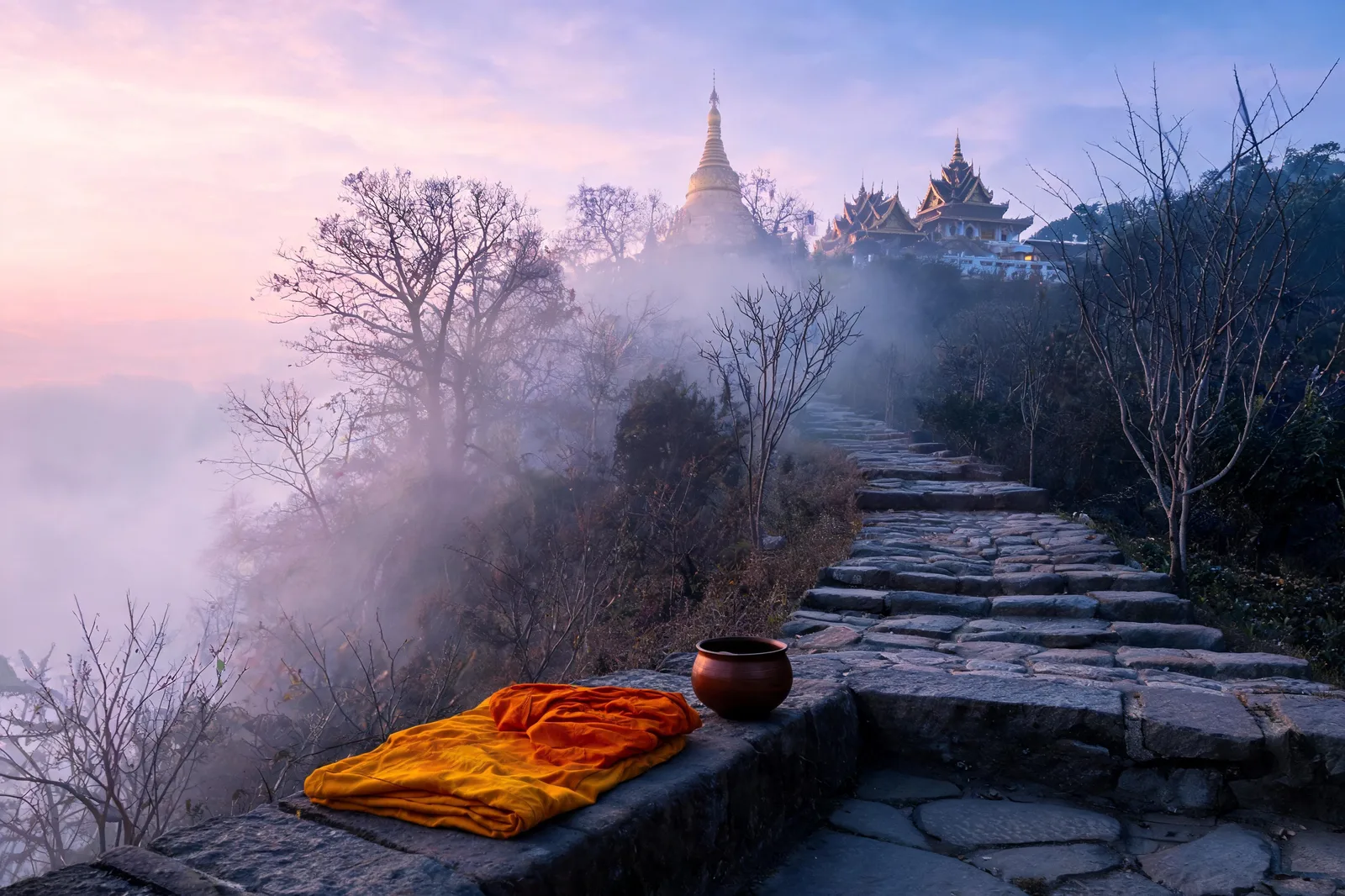
By 1901 Bennett had moved on to Burma, where he was ordained as a Buddhist monk, taking the name Ananda Metteyya. This made him one of the earliest Western-born Buddhist monks of the modern era, a genuinely significant fact in the history of Buddhism's spread to Europe, independent of anything connected to the Golden Dawn. In 1903 he helped found the Buddhasasana Samagama, known in English as the International Buddhist Society, aimed at bringing Buddhist teaching to Western audiences in a structured way.
The first Buddhist mission to Britain
Ananda Metteyya returned to England in 1908 at the head of what is generally regarded as the first Buddhist mission to the West. He lectured and published on Buddhist doctrine for British audiences largely unfamiliar with it outside colonial administration circles. His health, never strong, continued to decline, and he spent his final years teaching and writing in difficult physical circumstances before dying in 1923, poor and in poor health but recognised within Buddhist circles as a genuine pioneer.
A different kind of Golden Dawn member
Next to Florence Farr: Actress, Adept and Golden Dawn Leader and Annie Horniman: The Patron Who Paid for the Golden Dawn, Bennett makes a useful contrast. Farr administered the order's London temple, and Horniman funded its founder. Bennett did neither. His contribution was almost entirely technical: he worked the rituals harder than most members, tested their effects on his own body and mind, and treated the Golden Dawn's grade system as a genuine discipline rather than a social club with robes. That intensity is probably why he burned through the system so completely. Few members pushed ceremonial method as far as Bennett did before deciding it had limits, and fewer still had somewhere else, a Burmese monastery, ready to receive that same intensity once Western magic had given what it could.
Reading Allan Bennett's two careers together
It would be easy to treat Bennett's story as a conversion narrative, magic abandoned for enlightenment, but his own writings resist that tidy arc. He continued to respect ceremonial method even after his ordination, and Crowley continued to credit him as a foundational teacher long after their paths diverged completely. What changed was less his technical interest in disciplined practice than his judgment about which tradition offered the deeper framework for it.
For a reader of the Thoth deck, Bennett is a reminder that the order's own most advanced practitioners did not always conclude that Western ceremonial magic was the final word. Some carried its discipline somewhere else entirely and still called the years of training worthwhile. The fullest account of his unusual double career sits in the Allan Bennett entry on Wikipedia, which traces both the chemist-turned-adept and the monk he became, and is a useful corrective to any version of his story flattened into a single clean conversion.
Questions
What did Allan Bennett teach Aleister Crowley?
Bennett instructed Crowley in Golden Dawn ceremonial technique and in Eastern practices such as pranayama breathing that he was studying himself, a combination that shaped Crowley's later system.
Why did Allan Bennett leave England?
Severe lifelong asthma and exhausted finances pushed him toward a warmer climate in Ceylon in 1900, where his interests shifted toward Buddhist philosophy.
Who was Ananda Metteyya?
The Buddhist monastic name Bennett took after his ordination in Burma in 1901; he became one of the earliest Western-born Buddhist monks and led an early Buddhist mission to Britain in 1908.
Did Bennett reject his Golden Dawn training after becoming a monk?
Not entirely. He continued to respect ceremonial discipline even as a monk, and Crowley kept crediting him as a foundational teacher long after their paths diverged.
This article talks about
You might also like
 Thoth Tarot
 Thoth Tarot
 Thoth Tarot
© 2026 TAROTS chat (tarots.chat). All rights reserved. No part of this article may be reproduced, distributed or adapted without the owner's written permission.
The Journal
 Love
 Spirituality
 Symbolism
 Disks
 Love
 Love
 Symbolism
 Symbolism
 Kabbalah